
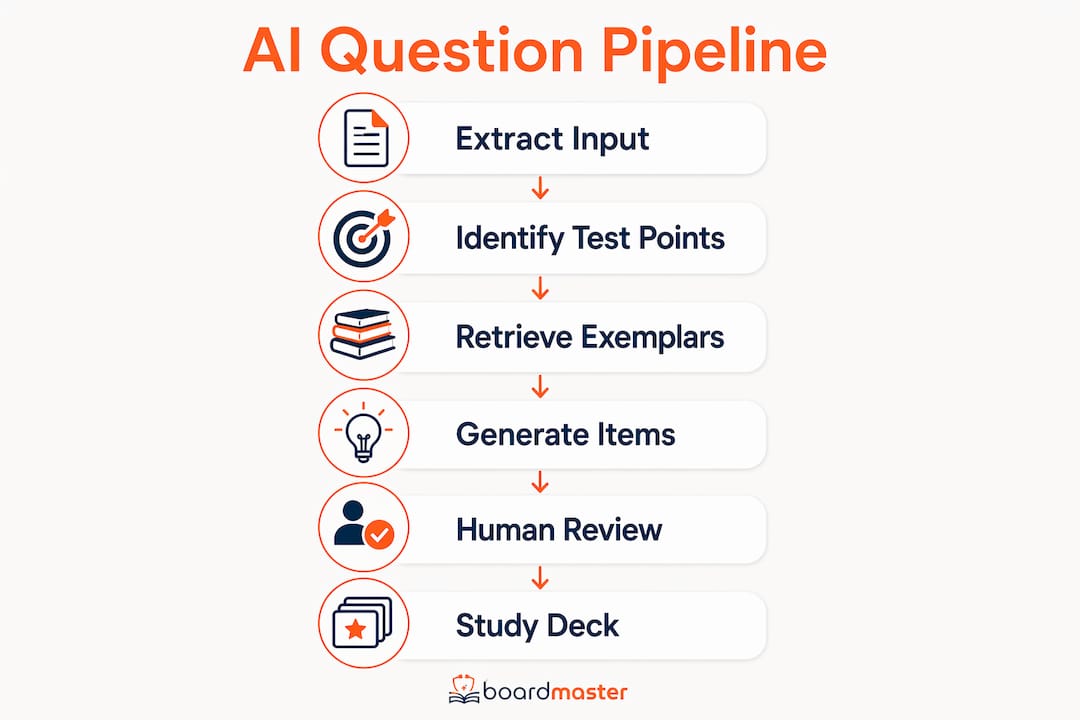
AI converts clinical notes and lecture text into USMLE-style practice items through a six-stage pipeline: input extraction, topic and test-point identification, prompt construction with few-shot exemplars, retrieval-augmented generation, post-processing with distractor refinement, and clinician vetting with psychometric checks. The single step you cannot skip is clinician or expert review. MIT CSAIL research found that even well-trained models generate a "good question" only 63% of the time compared to 80% for human physicians, and answer recovery drops to roughly 25%. That gap is exactly why tools like BoardMaster route every generated item through validation before a student ever sees it.
Table of Contents
- How does AI generate medical questions step by step?
- What prompt design produces high-quality USMLE-style questions?
- What makes a question truly USMLE-style?
- How do systems validate clinical accuracy and exam alignment?
- How should you protect PHI when using AI tools for question generation?
- What are the known failure modes of AI-generated medical questions?
- How should you integrate AI-generated questions into your study routine?
- BoardMaster in practice: from lecture notes to validated questions
- What does the research say about AI medical question generation?
- What training data do medical question generators rely on?
- How do you ensure clinical accuracy in AI-generated content?
- Which evaluation metrics matter most for generated medical questions?
- Key Takeaways
- The gap between what AI promises and what actually matters
- BoardMaster turns your lecture notes into targeted practice
- FAQ
- Useful sources for further reading
How does AI generate medical questions step by step?
The pipeline moves in a fixed order, and each stage has a clear failure point.
- Input extraction. Raw lecture notes, clinical vignettes, or de-identified EMR snippets are parsed into discrete facts. Breaking text into "atomic assertions" before generation, as described in an EMR-to-questionnaire framework, covered 32 of 38 key clinical facts in a sample record versus only 16 covered by a direct end-to-end LLM approach.
- Topic and test-point identification. The system tags each assertion with a subject domain and the specific reasoning skill it should test. The MedQG pipeline from NAACL 2025 formalizes this as explicit topic/test-point extraction before any generation begins.
- Exemplar retrieval. Using embeddings from ColBERT or instructor-large, the system pulls the closest real USMLE items from a reference corpus. These exemplars seed the model with correct format, difficulty, and clinical tone rather than leaving it to guess.
- LLM generation with few-shot prompting. The model receives the test point, the retrieved exemplars, and explicit formatting rules, then produces a stem, lead-in, correct answer, and three to four distractors.
- Self-critique and iterative refinement. The model re-reads its own output and flags ambiguous stems or trivial recall items. MedQG's iterative self-critique loop moves outputs from surface-level recall toward clinically relevant reasoning problems.
- Clinician vetting and psychometric checks. A subject-matter expert reviews flagged items, and item-analysis metrics (difficulty index, discrimination index) filter out weak questions before deployment.
Where human review must occur: after step 5, before any item enters a student's study deck.
Pro Tip: Ask your instructor or a senior resident to spot-check a 10-item sample from any AI-generated set. If more than two items out of ten have ambiguous lead-ins or factually shaky distractors, the whole batch needs another generation cycle.

What prompt design produces high-quality USMLE-style questions?
Explicit instructions outperform vague ones every time. A JMIR iterative evaluation using GPT-4o and LLaMA 3.2 showed that multi-round clinician feedback on prompt structure measurably improved clarity and clinical validity across rounds. The mechanism is straightforward: when you tell the model exactly what fields to produce and in what order, it stops guessing.
Compact prompt template you can paste into any model UI:
You are a USMLE Step 1/2 question writer. Given the clinical note below, write one single-best-answer MCQ. Include: (1) a 3–5 sentence clinical vignette with age, sex, setting, and key findings; (2) a clear lead-in question; (3) one correct answer; (4) three plausible distractors based on common misconceptions; (5) a one-sentence explanation of the correct answer; (6) difficulty level (easy/medium/hard). Do not ask for a diagnosis alone — test a reasoning step. Clinical note: [PASTE TEXT HERE]
Do/don't rules for medical prompts:
- Do specify every required field explicitly.
- Do include one or two few-shot exemplars showing a good item.
- Don't ask for "a question about" a topic without naming the test point.
- Don't accept a stem that ends with "What is the diagnosis?" as the only question type.
- Do request a brief reasoning chain alongside the answer key.
Iterative refinement works like this: generate → prompt the model to identify any ambiguity in its own stem → regenerate with a constraint added (e.g., "the distractor set must include one near-miss based on a common pharmacology error").
Pro Tip: Few-shot exemplars are the single highest-leverage addition to any medical prompt. Two annotated examples of a strong item and a weak item cut trivial-recall outputs faster than any length of written instruction.
What makes a question truly USMLE-style?
A USMLE-style item has a specific anatomy. Every component earns its place.
- Clinical vignette: 3–5 sentences covering age, sex, clinical setting, presenting complaint, and one or two key exam or lab findings.
- Test point: the single concept or reasoning skill the item measures. It must map directly to the vignette, not float as a general knowledge check.
- Lead-in: a single, unambiguous question that asks for one best answer. "Which of the following is the most likely diagnosis?" is acceptable only when the vignette genuinely supports a differential. "What is the next best step?" is stronger for clinical reasoning.
- Distractor quality: options must be plausible, homogeneous in content domain, and grounded in common misconceptions rather than obvious wrong answers. Technically false options destroy item validity.
For a deeper breakdown of USMLE question formats and vignette anatomy, BoardMaster's format guide walks through annotated examples.
How do systems validate clinical accuracy and exam alignment?
Validation happens at three levels: clinical, psychometric, and blueprint alignment.
| Validation checkpoint | What it checks | Acceptable range / standard |
|---|---|---|
| Clinician review | Factual accuracy, stem clarity, distractor plausibility | All items reviewed before deployment |
| Difficulty index (p-value) | Proportion of students answering correctly | 0.30–0.80 for discriminating practice items |
| Discrimination index | Correlation between item score and total score | ≥ 0.20 considered acceptable |
| Blueprint alignment | Topic tag matches USMLE content outline category | Every item tagged before pilot |
| Pilot testing | Real student performance data collected | Minimum sample before full deployment |
Clinician-in-the-loop prompt refinement, as documented in the JMIR evaluation, reduces hallucinations and improves readability across successive rounds. The staged EMR pipeline covering 32 of 38 key facts versus 16 for direct LLM generation shows why structured extraction before generation matters for coverage.
How should you protect PHI when using AI tools for question generation?
HIPAA applies to protected health information. FERPA can apply to student records. Before uploading anything to a model interface, run through this checklist.
- Remove all patient names, dates of birth, admission dates, geographic identifiers smaller than a state, and medical record numbers.
- Generalize rare disease details that could re-identify a patient (e.g., change "a 34-year-old woman with X-linked adrenoleukodystrophy admitted to [specific hospital]" to "a 34-year-old woman with a rare peroxisomal disorder").
- Never paste raw patient notes into a public model UI. Use institutional APIs that operate under a Business Associate Agreement when EMR data is involved.
- Use synthetic vignettes whenever possible. Most USMLE-style practice items do not require real patient data.
- Run a local regex scrub for common PHI patterns (dates in MM/DD/YYYY, 10-digit phone numbers, SSN patterns) before any upload.
Pro Tip: The free presidio-analyzer library from Microsoft runs locally and flags PHI patterns in plain text in seconds. It is not a substitute for manual review, but it catches the obvious identifiers before you even open a model interface.
What are the known failure modes of AI-generated medical questions?
Red flags to watch for in any AI-generated item set:
- Diagnostic hallucinations: the model states a drug mechanism or lab value that is simply wrong. Always verify factual claims against a primary source.
- Ambiguous lead-ins: "What would you do next?" without a clear clinical context produces items that multiple answers could reasonably satisfy.
- Culturally biased distractors: options that assume a specific demographic presentation as the default can reinforce stereotypes and disadvantage students from underrepresented groups.
- Trivial recall items: "What is the mechanism of metformin?" tests memory, not clinical reasoning. High-quality items test application.
- Over-reliance on a single source: a model trained or prompted on one textbook will reflect that source's gaps and biases.
Mitigation: require the model to cite a source for every factual claim in the explanation, force stepwise reasoning before the answer, and have a clinician spot-check at least 10% of any batch. If more than 20% of items in a set fail a basic accuracy check, stop using that set and escalate to instructor review. Nature Communications frames the near-term trajectory as agentic AI that manages reasoning pipelines while humans retain responsibility for critical decisions — a useful reminder that full automation is not here yet.
Pro Tip: Weak distractors are the fastest tell. If you can eliminate two of four options in under five seconds without any clinical reasoning, the item is testing recognition, not thinking. Flag it and either regenerate or convert it to a flashcard.
How should you integrate AI-generated questions into your study routine?
- Extract high-yield notes. Highlight the concepts your professor emphasized most. These become your input text.
- Run the prompt template. Use the template from the prompt design section. Generate 10–20 items per lecture block.
- Self-verify each item. Check the stem for ambiguity, verify the correct answer against a textbook or UpToDate, and confirm distractors are plausible but wrong.
- Flag questionable items. Any item where you are unsure whether the answer is correct goes into a "review" pile.
- Clinician or peer review for flagged items. Show flagged items to a resident, attending, or study-group peer with strong subject knowledge.
- Import vetted items into your spaced-repetition system. Tag each card by test point, organ system, and difficulty. Anki's custom fields work well for this.
- Track performance. After two or three review cycles, retire items you answer correctly every time and increase exposure to items where your confidence is low.
For tracking your overall readiness alongside AI-generated practice, MedSchoolPilot offers a structured progress-monitoring framework that pairs well with a custom question deck.
Pro Tip: Tag every imported card with its source lecture. When your performance on a topic cluster drops, you can trace it back to the original notes and regenerate a fresh batch targeting that gap.
BoardMaster in practice: from lecture notes to validated questions
BoardMaster implements the pipeline described above as a production workflow. A student uploads lecture slides or notes; the platform extracts test points aligned to what the professor emphasized, generates USMLE-style items using few-shot prompting and retrieval-augmented generation, and routes items through validation before they reach the student's practice deck.
One student, Sarah, moved from the 73rd to the 92nd percentile while cutting her study hours in half — a result BoardMaster attributes to replacing broad Qbank review with questions built directly from her course material and targeting the concepts her professors actually tested.
That outcome reflects the core logic of professor-specific question banks: generic item banks cover the full USMLE blueprint, but your class exam covers what your professor covered. Closing that gap is where the percentile gains come from.
What does the research say about AI medical question generation?
| Study / Source | Key finding | Practical implication |
|---|---|---|
| MIT CSAIL (DiSCQ) | Models generate good clinical questions 63% of the time vs. 80% for physicians | Clinician exemplars and review remain necessary |
| EMR-to-questionnaire (arXiv) | Staged pipeline covers 32 vs. 16 key facts vs. direct LLM | Use atomic extraction before generation |
| JMIR iterative evaluation | Multi-round clinician feedback improves clarity and validity across rounds | Build clinician review into every prompt cycle |
| KG-Followup (EACL 2026) | Knowledge graph augmentation improves recall by 5–8% on benchmarks | Add structured knowledge sources to RAG pipelines |
| MedQG / NAACL 2025 | Iterative self-critique plus exemplar retrieval moves outputs toward reasoning-level items | Use ColBERT/instructor-large for exemplar seeding |
The shift from implicit model expectations to explicit, clinician-informed rules in prompts is the single most reliable lever for improving output quality — a finding consistent across the JMIR evaluation, MedQG, and the EMR framework.
What to adopt now: few-shot exemplars, retrieval-augmented generation, and clinician review. What is still experimental: fully agentic systems that autonomously curate and update question sets without human checkpoints, as outlined in the Nature Communications perspective.
What training data do medical question generators rely on?
The quality of AI-generated questions depends heavily on what the model was trained on and what it retrieves at inference time. Most production systems draw from three layers: large general-purpose pretraining corpora (Common Crawl, PubMed abstracts, medical textbooks), fine-tuning datasets of clinician-authored questions (such as the DiSCQ dataset built from MIMIC-III discharge summaries), and retrieval corpora of real USMLE-style items used as exemplars.
Fine-tuning on clinician-authored questions matters because realistic physician questions differ structurally from templated or crowd-sourced items. They reflect actual clinical uncertainty rather than textbook definitions. Models fine-tuned on this kind of data generalize better to novel clinical scenarios.
How do you ensure clinical accuracy in AI-generated content?
Three techniques consistently improve accuracy. First, retrieval-augmented generation grounds each item in a retrieved reference rather than the model's parametric memory alone. Second, requiring the model to produce a cited explanation alongside every answer creates a verifiable audit trail. Third, knowledge graph augmentation, as in the KG-Followup approach, connects generated content to structured medical ontologies, reducing the chance that a distractor contains a factual error that sounds plausible.
For students using AI tools for healthcare questions, the practical rule is simple: if the explanation does not cite a source you can check, treat the item as unverified until a clinician confirms it.
Which evaluation metrics matter most for generated medical questions?
Beyond the difficulty and discrimination indices covered in the validation section, three additional metrics are worth knowing. Content validity measures whether an item actually tests what its topic tag claims. Cognitive level (Bloom's taxonomy) distinguishes recall from application and analysis. Distractor efficiency tracks how often each wrong answer is chosen; a distractor nobody selects is not doing its job.
For AI in medical diagnostics and education alike, the principle is the same: a metric you cannot act on is not worth tracking. Difficulty and discrimination are actionable because they tell you which items to retire, revise, or keep.
Key Takeaways
AI generates USMLE-style medical questions through a six-stage pipeline, and clinician review after generation is the one step that cannot be automated away.
| Point | Details |
|---|---|
| The six-stage pipeline | Input extraction, test-point ID, exemplar retrieval, LLM generation, self-critique, and clinician vetting produce valid items. |
| Clinician review is non-negotiable | MIT CSAIL data shows models hit 63% quality vs. 80% for physicians — the gap requires human sign-off. |
| Explicit prompts outperform vague ones | Few-shot exemplars plus stepwise formatting instructions measurably improve clinical validity and reduce hallucinations. |
| PHI protection before upload | De-identify all notes locally before using any public model interface; use institutional APIs with a BAA for EMR data. |
| BoardMaster applies the full pipeline | BoardMaster converts uploaded lecture notes into validated, professor-aligned USMLE-style questions, as demonstrated by Sarah's jump from the 73rd to the 92nd percentile. |
The gap between what AI promises and what actually matters
The conversation around automated medical question generation tends to focus on speed: how fast can a model produce 50 MCQs from a lecture transcript? That framing misses the point. Speed is easy. Clinical validity is hard.
What most guides understate is how much the quality of the input shapes the quality of the output. A vague, disorganized set of lecture notes produces vague, disorganized questions regardless of how sophisticated the model is. The students who get the most out of AI-generated practice are the ones who invest time upfront in organizing their notes around clear test points before they ever run a prompt. The model is not doing the thinking for you. It is amplifying whatever structure you bring to it.
The other underappreciated reality: psychometric validation is not a bureaucratic formality. A question with a discrimination index below 0.20 is not just weak — it is actively misleading. It tells you nothing about whether you understand the concept, and studying from it can give you false confidence. Any tool that skips item analysis is handing you noise dressed up as signal.
BoardMaster turns your lecture notes into targeted practice
Most Qbanks cover the full USMLE blueprint. Your class exam covers what your professor covered last Tuesday. That mismatch is where study hours disappear.

BoardMaster closes that gap by generating USMLE-style questions directly from your uploaded lecture notes, targeting the concepts your professor emphasized. The platform follows the pipeline described in this guide: test-point extraction, retrieval-augmented generation, and validation before any item reaches your deck. Students who use it study less and score higher — Sarah's jump from the 73rd to the 92nd percentile while halving her study time is the clearest example. See how it works by watching the lecture-to-questions demo, or go straight to the BoardMaster platform to start generating questions from your next lecture.
FAQ
How does AI generate USMLE-style questions from lecture notes?
AI extracts key test points from lecture text, retrieves real USMLE exemplars using embedding models like ColBERT, generates a vignette and single-best-answer item, then refines it through self-critique and clinician review before a student sees it.
Are AI-generated medical questions accurate enough to study from?
They can be, but only after clinician or expert review. MIT CSAIL research shows models produce a good clinical question notably less often than physicians without human oversight, so verification is required before using any item for high-stakes preparation.
What is the biggest risk of using AI-generated practice questions?
Hallucinated factual claims in distractors or answer explanations. Always verify the correct answer and its explanation against a primary source such as a textbook or UpToDate before adding an item to your study deck.
Can BoardMaster generate questions from my specific professor's lectures?
Yes. BoardMaster ingests your uploaded lecture notes and generates questions aligned to the concepts your professor emphasized, rather than pulling from a generic blueprint.
What prompt rules produce the best AI-generated medical questions?
Specify every required field explicitly (vignette, lead-in, correct answer, distractors, explanation, difficulty), include two annotated few-shot exemplars, and require the model to produce stepwise reasoning alongside the answer key.
Useful sources for further reading
- MedQG / NAACL 2025 (GitHub): The codebase and paper behind the topic/test-point extraction and iterative self-critique pipeline. Read this to understand exemplar retrieval with ColBERT and how self-critique loops work in practice.
- EMR-to-Questionnaire Framework (arXiv): Demonstrates how atomic assertion extraction and causal network construction roughly double fact coverage compared to direct LLM generation. Essential reading for anyone building a staged pipeline.
- JMIR Iterative Evaluation (2026): Documents how multi-round clinician feedback on prompt structure improves clinical validity and readability. The clearest published evidence for clinician-in-the-loop prompt refinement.
- KG-Followup / EACL 2026: Shows knowledge graph augmentation improving recall by 5–8% on follow-up question benchmarks. Useful for understanding how structured ontologies reduce hallucination in distractor generation.
- MIT CSAIL DiSCQ dataset: The foundational dataset study showing the 63% vs. 80% quality gap between models and physicians. Justifies the non-negotiable role of clinician exemplars and review.
- Nature Communications agentic AI perspective (2026): Frames the near-term shift toward agentic systems that manage reasoning pipelines while humans retain decision authority. Useful for understanding where the field is heading and what remains experimental.