
TL;DR:
- A clinical vignette question includes a patient scenario and a focused lead-in, challenging test-takers to quickly identify key decision points. Mastering the format involves reading the lead-in first, analyzing demographics and buzzwords, and forming an answer before reviewing options. Doing so improves speed and accuracy across both basic science and clinical management exam questions.
A clinical vignette question is a patient stem followed by a single focused lead-in. That's the whole format. Master it, and every board-style question becomes a structured problem you can solve in under 90 seconds.
Here's the checklist you can run in under 10 seconds on exam day:
- Read the lead-in first (last sentence of the stem)
- Note demographics (age, sex, ethnicity)
- Hunt for buzzwords (key symptoms, timeline, risk factors)
- Form your answer before looking at options
- Eliminate wrong choices systematically
Recognize these lead-in phrases instantly:
- "Which of the following is the most likely diagnosis?"
- "Which is the most appropriate next step in management?"
- "Which finding would most strongly support your suspected diagnosis?"
That checklist is your floor. Everything below builds on it.
Table of Contents
- What is a clinical vignette question, and why do boards use them?
- Anatomy of the vignette stem: every component you will usually see
- How does each lead-in type change what you're looking for?
- How do you read and answer a vignette efficiently under exam pressure?
- Three annotated USMLE-style vignettes with stepwise reasoning
- Common distractor types and the cognitive traps that make them work
- How do you write a valid board-style vignette?
- What's a practical 7-day plan for improving vignette performance?
- What vignette formats exist beyond standard multiple choice?
- Step 1 vs. Step 2 CK: where students go wrong on each
- How do you build a differential diagnosis from a vignette?
- How do you choose when multiple answers all seem right?
- How do clinical vignettes test higher-order thinking?
- How do you interpret lab and imaging data inside a vignette?
- Key Takeaways
- Why format mastery beats memorization every time
- BoardMaster puts your lecture notes to work as vignette practice
- Useful sources and further reading
- FAQ
What is a clinical vignette question, and why do boards use them?
A clinical vignette question presents a brief patient scenario (the stem) and asks one specific clinical question (the lead-in). The USMLE, administered by the National Board of Medical Examiners (NBME), uses this format almost exclusively because it tests application and prioritization rather than raw recall.
Rote memory can tell you that metformin lowers blood glucose. A vignette forces you to decide whether this specific 58-year-old with CKD stage 3 should actually receive it. That's the difference. The Medical Council of Canada's qualifying exam and the COMLEX-USA follow the same logic: present a realistic patient, ask one defensible question, and see whether the candidate reasons correctly.
Boards use vignettes because they compress clinical decision-making into a testable, scorable unit. A well-written item cannot be answered by pattern-matching a keyword to a drug name. You have to read the whole stem and integrate the data.
Anatomy of the vignette stem: every component you will usually see
Standard item-writing guides place stem components in a logical sequence so the reader builds a clinical picture progressively. Here's that sequence with a one-line example for each:
- Demographics (age, sex, ethnicity): "A 34-year-old African American woman…" Age and sex alone narrow the differential by ruling out entire disease categories. Ethnicity matters for conditions like sarcoidosis, sickle cell disease, and G6PD deficiency.
- Site of care: "…presents to the emergency department…" Inpatient vs. outpatient vs. ICU changes what's urgent.
- Presenting complaint: "…with sudden-onset chest pain…" The chief complaint anchors your differential.
- Duration: "…for the past 2 hours." Acute vs. chronic is often the single most discriminating detail.
- Relevant history: "She has a history of lupus and takes hydroxychloroquine." Prior diagnoses and medications are planted deliberately.
- Medications and allergies: "Current medications include lisinopril and aspirin." Drug interactions and contraindications are common question targets.
- Physical exam findings: "BP 88/60 mmHg, HR 118 bpm, JVD present, muffled heart sounds." Beck's triad right there.
- Targeted diagnostic data: "ECG shows low-voltage complexes." Only values that affect the answer appear. A full metabolic panel dumped into the stem is a distractor factory.
- Lead-in: "Which of the following is the most appropriate next step?" Always the last sentence.
Pro Tip: Demographics are the highest-yield discriminators on Step 1. When you see a young Black woman with bilateral hilar adenopathy, your brain should fire "sarcoidosis" before you finish the sentence. Train that reflex deliberately.
Vignettes appear across pathology, pharmacology, physiology, and clinical management. Step 1 emphasizes basic science patterns while Step 2 CK emphasizes next-step management, so the weight you give each stem component shifts depending on which exam you're sitting.
How does each lead-in type change what you're looking for?
Lead-in phrasing maps directly to a cognitive task. Read the lead-in first and you know exactly what to hunt for in the stem.
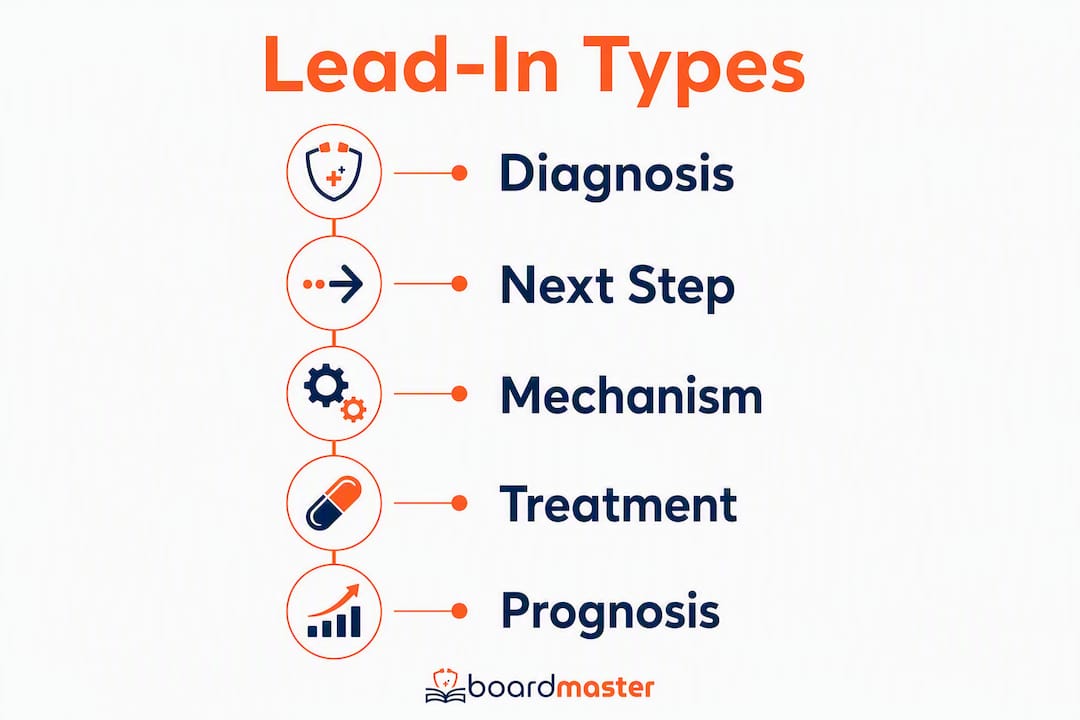
| Lead-in type | Cognitive task | What to prioritize in the stem |
|---|---|---|
| Most likely diagnosis | Pattern recognition | Symptom cluster, timeline, demographics |
| Next best step in management | Decision-making | Current status, what's already been done |
| Best initial test | Diagnostic reasoning | Suspected diagnosis, urgency, cost-effectiveness |
| Best initial treatment | Management | Confirmed or working diagnosis, contraindications |
| Mechanism of action / pathophysiology | Basic science application | Drug class, receptor, disease pathway |
| Prognosis / expected outcome | Prognostic reasoning | Stage, severity markers, treatment response |
| Finding that supports diagnosis | Confirmatory reasoning | Pathognomonic signs, gold-standard tests |
The RCGP's SBA guide reinforces this: the lead-in must specify a single decision and be answerable from the stem alone. If you find yourself needing outside information to answer the question, the item is poorly written. On a well-constructed exam, you won't need it.
How do you read and answer a vignette efficiently under exam pressure?
A five-step reading strategy separates high scorers from average ones. Here it is as a numbered workflow:
- Read the lead-in first. Know your task before you read a single word of the stem. A diagnosis question sends you hunting for pattern clusters. A next-step question sends you looking for what's already been confirmed and what's still missing.
- Identify demographics. Age, sex, ethnicity. Two seconds. These three data points eliminate entire disease categories before you've read the chief complaint.
- Find the buzzword cluster. Scan for the symptom combination, timeline, and any pathognomonic detail. "Painless jaundice + weight loss + palpable gallbladder" is Courvoisier's sign. You don't need to read the rest carefully once you have that.
- Form your answer before looking at the options. This is the single most important habit. Students who read the options first get anchored to the first plausible-sounding choice. Write your answer mentally, then look.
- Eliminate, then confirm. Cross out choices that belong to the wrong drug class, wrong organ system, or wrong timing. If two options remain, go back to the stem for the one detail that distinguishes them.
- Triage. If you've spent more than 90 seconds and you're still stuck, mark it, pick your best guess, and move on. On a 40-question block with 60 minutes, you have roughly 90 seconds per item. Spending 4 minutes on one question costs you three others.
Pro Tip: When two answers both seem correct, ask which one is more specific to this patient's exact situation. The right answer is usually the one that requires you to have read the demographics and timeline, not just the chief complaint.
An alternate framework worth knowing is MASTER: Match the clinical picture, Assess key signs, Screen for red flags, Think through differentials, Evaluate tests, Resolve with management. Use whichever structure you can execute automatically under pressure.

Three annotated USMLE-style vignettes with stepwise reasoning
Vignette 1: Most likely diagnosis
A 22-year-old woman presents with a 3-day history of dysuria, urinary frequency, and suprapubic discomfort. She is sexually active and uses oral contraceptives. Temperature is 37.1°C, BP 118/74 mmHg. Urinalysis shows pyuria and bacteriuria. No costovertebral angle tenderness. Which of the following is the most likely diagnosis?
Reasoning: Lead-in = diagnosis. Demographics: young sexually active woman. Buzzwords: dysuria, frequency, suprapubic pain, pyuria, bacteriuria, NO CVA tenderness. Pre-answer: uncomplicated urinary tract infection. The absence of CVA tenderness rules out pyelonephritis. Pelvic inflammatory disease would require cervical motion tenderness. Answer: Uncomplicated cystitis. Common error: choosing pyelonephritis because it "sounds more serious." The stem explicitly excludes upper tract involvement.
Vignette 2: Next best step
A 67-year-old man with a 40-pack-year smoking history presents with a 3-week cough and hemoptysis. CXR shows a 3 cm hilar mass. He has lost 8 lbs over 2 months. Which of the following is the most appropriate next step in management?
Reasoning: Lead-in = next step. Demographics: older male smoker. Buzzwords: hemoptysis, hilar mass, weight loss. Pre-answer: tissue diagnosis is needed before staging or treatment. CT-guided biopsy and bronchoscopy are both options, but the hilar location makes bronchoscopy with biopsy the preferred first step. Answer: Bronchoscopy with biopsy. Common error: ordering a PET scan first. PET is for staging, not diagnosis. You need tissue before you stage.
Vignette 3: Best initial treatment
A 28-year-old man with no prior medical history presents with a first episode of generalized tonic-clonic seizure lasting 2 minutes. He is now postictal. Glucose is 94 mg/dL. MRI brain is normal. EEG shows generalized spike-wave discharges. Which of the following is the best initial treatment?
Reasoning: Lead-in = treatment. Demographics: young male, first seizure. Buzzwords: generalized spike-wave on EEG, normal MRI, normal glucose. Pre-answer: generalized epilepsy, start an antiepileptic. Valproate covers generalized epilepsy broadly. Phenytoin is better for focal seizures. Levetiracetam is also acceptable but valproate is the classic first-line for generalized. Answer: Valproate. Common error: choosing phenytoin because it's the most familiar antiepileptic. Phenytoin is focal-onset, not generalized.
Common distractor types and the cognitive traps that make them work
Distractors are built to exploit specific reasoning errors. Recognizing the construction is a repeatable skill.
- Partially correct answers: The drug is right for the disease class but wrong for this patient's specific situation (e.g., metformin in a patient with eGFR < 30). These catch students who stop reading after the diagnosis.
- Treatment for a related condition: Pyelonephritis treatment offered when the vignette describes uncomplicated cystitis. The disease is adjacent, the treatment is wrong.
- Wrong test for the organ system: Ordering a V/Q scan when the clinical picture clearly supports PE with a stable patient who has no contrast allergy. CT-PA is first-line; V/Q is the alternative.
- Confounding by severity: Choosing the most dangerous diagnosis rather than the most likely one. A key insight from SBA research is that "most likely" and "most serious" are deliberately different questions. If the lead-in says "most likely," the answer is probabilistic, not catastrophic.
Three cognitive biases drive most wrong answers:
- Availability bias: You just studied meningitis, so every headache looks like meningitis. Counter it by forming your answer from the stem's data, not your recent study session.
- Anchoring: You lock onto the first plausible diagnosis and stop processing new information. Counter it by re-reading the lead-in after you've read the full stem.
- Premature closure: You stop at a working diagnosis without checking whether all the data fits. Counter it by asking: "Does every detail in this stem support my answer, or am I ignoring something?"
For a deeper look at how clinical reasoning errors surface in vignette questions, the pattern of mistakes is consistent enough that you can train against it deliberately.
How do you write a valid board-style vignette?
Whether you're an educator building a question bank or a student creating practice items from lecture notes, the same item-writing rules apply.
Item-writer checklist:
- Align the stem to a single learning objective before writing a word.
- Include only details that affect the answer. Item-writing templates recommend including only tests whose presence changes the reasoning task; a full metabolic panel when only the sodium matters is noise.
- Use discriminators deliberately: the one detail that separates the correct answer from the best distractor should be present in the stem.
- Write the lead-in as a single, specific decision. "What would you do next?" is too vague. "Which of the following is the most appropriate next step in management?" is specific.
- Make answer options homogeneous in length and format. A noticeably longer option is a giveaway.
Do-not list:
- Don't dump extraneous labs. If the sodium is 138 and it doesn't affect the answer, cut it.
- Don't use ambiguous wording ("may," "could," "sometimes") in the lead-in.
- Don't write multi-part questions. One stem, one lead-in, one correct answer.
- Don't make the correct answer the longest option.
Pro Tip: Encode your discriminator in the middle of the stem, not at the end. Students who read quickly often miss a buried detail. If the discriminator is the last lab value before the lead-in, it's too easy to spot. Bury it in the history or physical exam to test whether the student actually read the whole stem.
For more on how AI generates exam-quality questions from lecture materials, the same item-writing principles apply whether a human or an algorithm is drafting the stem.
What's a practical 7-day plan for improving vignette performance?
Consistent, structured practice beats marathon sessions. Here's a week that builds the skill progressively:
- Day 1: Anatomy drill. Take 10 vignettes and annotate each component (demographics, site of care, complaint, etc.) without answering the question. Build the habit of seeing structure.
- Day 2: Lead-in mapping. Do 20 questions, but before reading the stem, categorize the lead-in type and predict what you'll be looking for. Check your prediction after reading.
- Day 3: Pre-answer practice. Do 20 questions. Cover the answer choices. Write your answer on paper before uncovering options. Track how often your pre-answer matches the correct choice.
- Day 4: Timed block. Do a full 40-question timed block at 60 minutes. Don't pause. Practice the mark-and-move triage decision in real time.
- Day 5: Distractor analysis. Review every wrong answer. For each one, identify which distractor type caught you (partially correct, severity bias, wrong organ system). Build a personal error log.
- Day 6: Pharmacology focus. Do 20 management questions specifically. Management questions on Step 2 CK require knowing contraindications and drug class specifics, not just the disease name.
- Day 7: Mixed review + spaced repetition. Review your error log from Days 1–6. Use a spaced repetition tool like RecallOS to lock in the discriminators you keep missing.
For the review phase, learn from both correct and incorrect answers. A correct answer reached by guessing is a gap. An incorrect answer you can fully explain is progress. Annotate your weak-point list after every session, not at the end of the week.
Practice questions accelerate learning most when you treat the explanation as the lesson, not the score.
What vignette formats exist beyond standard multiple choice?
Most board exams use single-best-answer (SBA) multiple choice, but several other formats appear and each requires a slightly different approach.
Extended matching questions (EMQs) present a long list of answer options (sometimes 10–20) and a series of stems that all draw from the same list. The cognitive challenge is that you can't eliminate by process of exclusion the way you can with five options. You need to form your answer from the stem before scanning the list, or you'll spend too long reading every option.
Multiple true-false (MTF) items present a stem and ask you to judge each of several statements as true or false independently. Partial credit structures vary by exam. The trap here is that a statement can be true in general but false for this specific patient. Always apply the statement to the vignette, not to your general knowledge.
Matching questions pair a list of clinical presentations with a list of diagnoses or mechanisms. Speed matters. Work through the presentations you're most confident about first, then use elimination for the remaining ones.
Sequential/multi-step items present a vignette and then ask a series of questions that build on each other (the answer to question 2 depends on what happened in question 1). These appear in some OSCE-style assessments and in certain shelf exam formats. Read each sub-question before committing to an answer on the prior one, since the sequence can reveal information that reframes your earlier reasoning.
Step 1 vs. Step 2 CK: where students go wrong on each
The format is the same. The focus is not.
Step 1 pitfalls:
- Treating every vignette as a management question. Step 1 is asking about mechanism, pathophysiology, and basic science. A patient with symptoms is the vehicle for a question about a receptor, enzyme, or genetic pathway. Students who jump to treatment miss the actual question.
- Ignoring the "why." Step 1 wants to know why the drug works, why the lab is abnormal, why the symptom appeared. The stem's basic science details (cell type, receptor subtype, chromosome) are the answer, not background noise.
Step 2 CK pitfalls:
- Stopping at diagnosis. Step 2 CK assumes you can diagnose. The question is almost always what to do next. Students who spend time confirming the diagnosis in their head lose time they needed for the management decision.
- Confusing "next best step" with "definitive treatment." Stabilize before you treat. A hemodynamically unstable patient gets resuscitation before biopsy, every time.
- Underweighting disposition. Step 2 CK frequently asks whether a patient should be admitted, observed, or discharged. This is a clinical judgment question that Step 1 never asks.
Step 1 emphasizes basic science patterns; Step 2 CK emphasizes next-step management and disposition. Knowing which exam you're preparing for changes how you read every stem.
How do you build a differential diagnosis from a vignette?
Start broad, then narrow using the stem's discriminators. The demographic gives you the prior probability. The symptom cluster gives you the working differential. Each additional detail either supports or eliminates a candidate.
A practical approach: after reading the lead-in and demographics, write down your top three diagnoses mentally before reading the rest of the stem. Then read the stem as a series of tests against that list. Each new detail either keeps a diagnosis alive or kills it. By the time you reach the lead-in again, you should have one or two candidates left.
The most common differential-building error is anchoring on the first diagnosis that fits and ignoring details that don't. A 45-year-old with chest pain and diaphoresis looks like ACS, but if the stem adds a recent URI, pleuritic quality, and a friction rub, you need to pivot to pericarditis. The stem is telling you something. Listen to all of it.
How do you choose when multiple answers all seem right?
This is the most common source of exam anxiety, and it has a reliable solution: go back to the lead-in and ask which answer is most specific to this patient's exact situation.
Three tiebreaker principles:
Specificity over generality. If one answer applies to all patients with this condition and another applies specifically to this patient's age, comorbidity, or presentation, the specific one is usually correct.
Proximate over distal. In next-step questions, the answer that addresses the immediate clinical problem beats the answer that addresses the underlying cause. Stabilize the airway before you treat the infection.
Evidence-based over intuitive. When your clinical intuition says one thing and the standard guideline says another, the exam follows the guideline. USMLE is testing whether you know the standard of care, not whether you'd improvise creatively.
If you've applied all three and you're still stuck, pick the answer that requires the most information from the stem to justify. The correct answer on a well-written vignette is the one that couldn't be chosen without reading the whole stem.
How do clinical vignettes test higher-order thinking?
Bloom's Taxonomy places knowledge recall at the bottom and analysis, synthesis, and evaluation at the top. Clinical vignettes are designed to operate at the top three levels.
A question that asks "What is the mechanism of metformin?" tests recall. A vignette that presents a diabetic patient with CKD stage 4, a recent contrast CT, and a new lactic acidosis asks you to analyze which drug caused the problem, synthesize the contraindication rule, and evaluate whether the presentation fits drug toxicity or disease progression. That's three cognitive operations in one item.
This is why memorizing facts without understanding their clinical application produces diminishing returns on board scores. The vignette format is specifically designed to reward students who can apply knowledge to novel situations, not students who can recite it. The clinical reasoning skills tested by vignettes are trainable, but only through deliberate practice with feedback, not passive reading.
How do you interpret lab and imaging data inside a vignette?
The first rule: if a lab value appears in the stem, it's there for a reason. Normal values are included only when their normalcy is the point (ruling something out). Abnormal values are always discriminators.
For lab data:
- Identify whether the value is high, low, or normal relative to the provided reference range.
- Ask what single diagnosis or drug effect explains this specific abnormality in this specific patient.
- Beware of red herrings: a mildly elevated WBC in a post-surgical patient is expected. The same value in a previously healthy 20-year-old with fever and neck stiffness is the answer.
For imaging:
- The description is the finding. You won't see the actual image on most written exams. "Bilateral hilar adenopathy on CXR" is a text clue, not a visual one. Train yourself to recognize the verbal description of classic findings.
- Timing matters. A CXR showing a new infiltrate in a hospitalized patient on day 5 is hospital-acquired pneumonia until proven otherwise. The same finding on day 1 is community-acquired.
Pro Tip: When a vignette gives you both labs and imaging, they usually point to the same diagnosis from different angles. If they seem to conflict, re-read the demographics. The patient's age and history usually resolve the apparent contradiction.
Key Takeaways
Mastering the clinical vignette question format means reading the lead-in first, forming your answer before seeing the options, and using every demographic and timeline detail as a diagnostic discriminator.
| Point | Details |
|---|---|
| Read lead-in first | Knowing your task before reading the stem changes what you look for and cuts reading time. |
| Demographics are discriminators | Age, sex, and ethnicity narrow the differential before you read the chief complaint. |
| Pre-answer before options | Forming your answer before seeing choices prevents anchoring to the first plausible option. |
| Step 1 vs. Step 2 CK focus | Step 1 tests mechanism and pathophysiology; Step 2 CK tests next-step management and disposition. |
| BoardMaster for targeted practice | BoardMaster generates USMLE-style vignettes from your own lecture notes, aligning practice to what your professors actually test. |
Why format mastery beats memorization every time
There's a persistent myth in medical education: that the student who knows the most facts scores the highest. Board examiners have known for decades that this isn't true, and the vignette format exists precisely to expose the gap.
What actually separates the 90th-percentile student from the 70th-percentile student isn't the size of their pharmacology list. It's the speed and accuracy with which they process a clinical scenario under time pressure. The student who reads the lead-in first, locks onto the demographic discriminator, and forms a pre-answer before touching the options is running a different cognitive process than the student who reads linearly from the first word. The format rewards process, not volume.
The practical implication: time spent drilling the reading strategy on 20 questions beats time spent re-reading a textbook chapter. The checklist in this article isn't a shortcut. It's the actual skill the exam is testing. Apply it on your next timed block and track your accuracy on the first pass versus your accuracy after changing answers. Most students find that their first instinct, formed by a clean pre-answer process, outperforms their second-guessing.
BoardMaster puts your lecture notes to work as vignette practice
The gap between what your professor emphasizes and what a generic question bank tests is where most study hours get wasted. BoardMaster closes that gap by converting your uploaded lecture notes into AI-generated USMLE-style questions that reflect exactly what your course covers.

Beyond AI-generated items, BoardMaster's 5,000+ physician-written board questions include timed block mode and full explanations for both correct and incorrect choices, which maps directly to the 7-day practice plan above. Day 4's timed block, Day 5's distractor analysis, and Day 7's spaced repetition review all have a home in one platform. Students preparing for USMLE Step 1 and Step 2 CK can run the entire plan without switching tools. Visit BoardMaster's USMLE prep page to see the full feature set and start a free trial.
Useful sources and further reading
The following resources support the item-writing standards, lead-in templates, and practice strategies covered in this article:
- Guide to Designing Meaningful Clinical Scenarios (DeSouza Institute / Convergence): Covers standard stem sequence, lead-in rules, and targeted diagnostic data principles. The primary reference for item-writing best practices in this article.
- Sample Lead-In Questions for Clinical Vignette-Based Items (UCNS): A canonical list of board-style lead-in phrasings organized by cognitive task. Use it to recognize lead-in types on sight.
- Understanding SBAs Guide (RCGP): Explains SBA structure, distractor construction, and the "most likely vs. most serious" distinction. Directly applicable to USMLE-style items.
- USMLE Clinical Vignette Strategy Guide (Lorea): Covers the five-step reading method and Step 1 vs. Step 2 CK focus differences. Practical and exam-specific.
- How to Design Exam Questions That Test Clinical Reasoning (Residency Advisor): Explains how distractors are constructed and how to recognize them. Useful for both test-takers and item writers.
- Clinical Vignette Examples (WebPath, University of Utah): Annotated vignette series showing how demographics function as discriminators. Good for anatomy-drill practice.
| Resource | Best for |
|---|---|
| DeSouza Institute stem guide | Item writing and stem anatomy |
| UCNS lead-in list | Recognizing lead-in types on sight |
| RCGP SBA guide | Distractor analysis and "most likely" logic |
| Lorea strategy guide | Reading strategy and Step 1/2 CK differences |
| Residency Advisor reasoning guide | Understanding how distractors are built |
| WebPath vignette examples | Annotated practice with demographic focus |
FAQ
What are clinical vignette questions?
Clinical vignette questions present a brief patient scenario (the stem) followed by a single focused question (the lead-in). They are the standard format on USMLE, COMLEX, and most board-style exams because they test clinical reasoning rather than rote recall.
What does a clinical vignette include?
A standard vignette stem includes demographics, site of care, presenting complaint, duration, relevant history, medications, physical exam findings, targeted diagnostic data, and a lead-in question. Every detail present is there because it affects the answer or functions as a deliberate distractor.
How do you answer a clinical vignette question effectively?
Read the lead-in first to identify your task, note demographics, find the buzzword cluster, form your answer before looking at the options, then eliminate. This five-step process prevents anchoring and reduces time spent on wrong answer choices.
What is an example of a clinical vignette question?
A 22-year-old woman with 3 days of dysuria, urinary frequency, and suprapubic pain, with pyuria on urinalysis and no costovertebral angle tenderness, followed by "Which of the following is the most likely diagnosis?" is a standard vignette item. The correct answer is uncomplicated cystitis; the absence of CVA tenderness rules out pyelonephritis.
How is a Step 1 vignette different from a Step 2 CK vignette?
Step 1 vignettes emphasize basic science, mechanism, and pathophysiology; Step 2 CK vignettes focus on next-step management and disposition decisions. The stem structure is identical, but what you prioritize while reading shifts between the two exams.