
""Physician-written questions" means board-style practice items authored or reviewed by physicians rather than generic test-prep writers, built as clinical vignettes that mirror real exam blueprints. The fastest way to start is to try official sample items from USMLE or COMLEX, then move to faculty-reviewed banks or a platform that generates physician-authored questions from your own coursework.
TL;DR:
- Verify that question banks specify physician authorship and include a review process, especially if they do not disclose who created the questions.
- Use official sample questions from USMLE or NBOME to understand exam format and timing, then supplement with vetted commercial or school-generated banks for volume and variety.
- Incorporate spaced, timed practice sessions across multiple days, pairing multiple choice questions with short answer recall to improve reliability and retention.
- Engage in question writing and peer review workshops to deepen understanding and produce test items closely aligned with your curriculum and exam blueprints.
- Utilize platforms like BoardMaster that generate questions from your lecture notes, ensuring your practice replicates your specific course and exam content.
Table of Contents
- What makes a question physician written and why it matters
- Where to find legitimate physician written questions
- How to judge whether a question bank is worth your time
- Turning physician written questions into a study routine
- How student and faculty question writing workshops build better items
- A personal note on studying with physician written questions
- BoardMaster: physician written questions built around your own lectures
- Primary sources worth bookmarking
- Sources
- FAQ
What makes a question physician written and why it matters
A physician-written question starts with a clinical vignette: a patient presentation, relevant history, exam findings, and sometimes labs—all pointing toward one best answer among plausible distractors. What separates a well-built item from a trivia question is the editorial process behind it. Bodies like the National Faculty at NBOME develop, review, pretest, and periodically reevaluate items using more than 700 active medical professionals, which is why their questions hold up as realistic practice rather than guesswork dressed as medicine.
You will run into a handful of formats across your training:
- Single best answer multiple choice questions, the backbone of most exams.
- Sequential item sets, where later questions depend on your read of an earlier scenario.
- Clinical decision making cases that ask you to order tests or choose next steps rather than name a diagnosis.
- Very short answer questions (VSAQs), which require you to generate a response instead of recognizing one.
Physician authorship matters because a poorly written item can be answered by pattern matching test-taking habits instead of applying clinical reasoning, which defeats the purpose of practicing at all.
Where to find legitimate physician written questions
Not every question bank markets itself the same way, and it helps to know which category you are actually drawing from.
- Official testing bodies: the USMLE offers 100+ interactive sample questions for Step 1 and Step 2 CK, built to match real timing, block structure, and multimedia item types.
- COMLEX candidates have a parallel option in NBOME's own COMLEX-USA sample questions and practice resources, aligned to that exam's specific format.
- School-run programs, sometimes called near-peer or PREP-style partnerships, pair students with faculty to build formative banks tied directly to a course's own exams.
- Vetted commercial QBanks that disclose physician authorship and review, as opposed to banks that never say who wrote the questions or how they were checked.
Each category serves a different purpose. Official samples teach you the interface and pacing. School programs match your specific curriculum. Commercial banks add volume and breadth once you have exhausted the first two, but only if you can verify who actually wrote the items.
How to judge whether a question bank is worth your time
Not all "physician-written" claims mean the same thing, so run new material through a short checklist before you trust it with your study hours.
- Confirm authorship: look for a stated physician or faculty author, not just a vague claim of expert review.
- Check for committee oversight: strong banks describe a review and pretesting process, similar to how NBOME's item development involves writers and review committees editing for cues and confirming distractors are plausible.
- Look for blueprint alignment: the bank should map to the actual content outline of the exam you are studying for, not a generic medical trivia list.
- Read the stem for clarity: a well-built vignette gives you enough information to reason toward an answer without hidden tricks or missing context.
- Watch the distractors: each wrong answer should be plausible enough that only real understanding, not elimination by absurdity, gets you to the right one.
- Check currency: guidelines and first-line treatments change, so a bank citing outdated references is a warning sign.
Pro Tip: If a bank never tells you who wrote its questions or how they were reviewed, treat every item as unverified until proven otherwise.
Turning physician written questions into a study routine
Owning good questions matters less than how you use them. A workflow built around timing, spacing, and honest feedback will get more out of the same question set than passive read-and-check review.
- Run timed blocks that mimic exam pacing, using the actual interactive testing experience from USMLE or COMLEX when it is available so the interface itself is not a surprise on test day.
- Space your practice across multiple sessions instead of one long cram. Research on immediate self-feedback VSAQs found that reliability improves substantially across multiple test occasions, where a single ten-item round needs a larger number of items to reach acceptable reliability, but two occasions with ten items each can be enough.
- Try a hybrid approach: attempt a free recall or VSAQ-style response first, then check yourself against the MCQ version. Comparative research on retrieval practice found no clear winner between formats for retention, though VSAQs can expose specific misconceptions that multiple choice hides.
- Read every explanation, right or wrong, and log which topics keep tripping you up.
- Prioritize remediation on the themes that show up most often in your error log rather than chasing every miss equally.
One weekly review pattern, ten VSAQ-style recall attempts followed by matched MCQs, gives you both the diagnostic value of open recall and the fast feedback of multiple choice in under an hour.
How student and faculty question writing workshops build better items
You do not need to be a physician to help produce physician-quality questions. Published workshop models train students in three stages: instruction on how a valid multiple choice item is built, independent writing against a specific content blueprint, and collaborative review with faculty editing before anything is finalized. One published workshop on training medical students to write and review MCQs found that students spent about an hour and a half producing each finalized item, and participants reported that the writing and editing process itself deepened their understanding of the material.
A lean version of that model for a study group or class cohort looks like this:
- A short training module on vignette structure, cueing, and distractor design.
- A blueprint that assigns topics so the group covers the right content, not just whatever feels interesting.
- A peer review pass where each item gets checked by someone other than its author.
- A faculty sign-off step before any item enters a shared bank.
Programs built this way, sometimes called PREP-style partnerships, tend to produce banks that track a school's actual exams more closely than any outside resource can.
A personal note on studying with physician written questions

The biggest shift I have seen in students is not about finding more questions, it is about trusting the ones they already have. Physician-authored items force you to reason through a vignette the way you will on test day, instead of memorizing isolated facts that fall apart under a slightly different phrasing.
My one habit worth adopting: pick one weekly block for timed physician-written practice, and once a month, try writing a single vignette yourself on a topic you just studied. Writing one forces you to understand it well enough to fool a classmate.
— Dr. Ahmed Abuzoor
BoardMaster: physician written questions built around your own lectures
Most banks give you physician-written questions on generic content. BoardMaster starts from your own lecture notes and generates practice items that match how your specific professor tests, while its QBank of 5,000+ physician-written board questions covers the broader USMLE and COMLEX-style material you need for boards. That combination means you are not choosing between studying for class and studying for boards, the same practice session moves both forward.
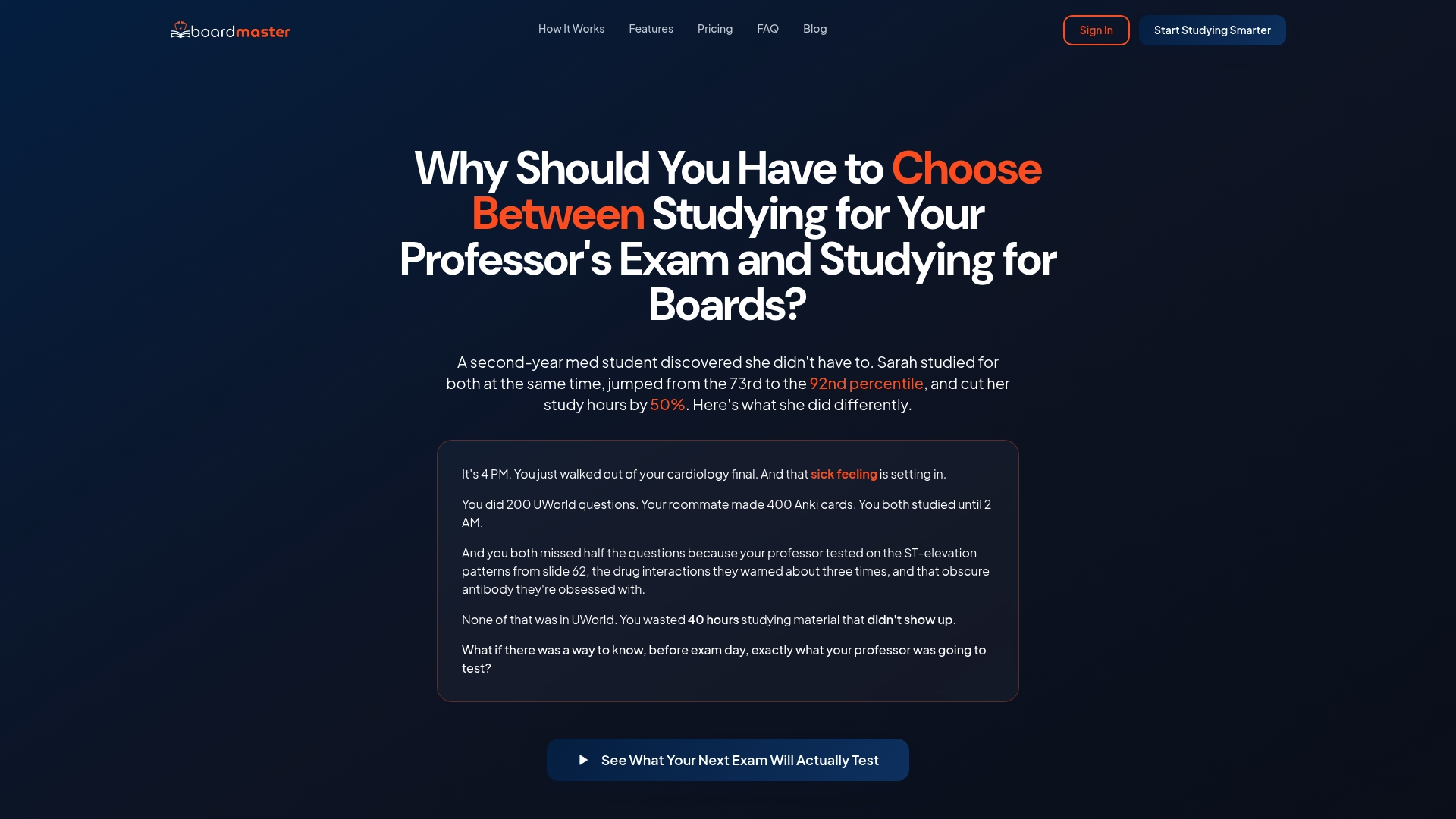
The platform offers flashcards with spaced repetition, OSCE-style clinical simulations, and an AI study assistant for instant explanations. If you want to see how lecture-based generation actually works before committing, the AI question generator demo walks through the process, and you can start on the free tier at Boardmaster.
Primary sources worth bookmarking
Keep these on hand as you plan your practice schedule:
- NBOME National Faculty: explains how COMLEX items are written, reviewed, and pretested.
- USMLE sample test questions: the official interactive practice experience for Step 1 and Step 2 CK.
- Research on VSAQ reliability: the data behind why repeated practice occasions matter more than one long session.
- Student-faculty MCQ writing workshops: a model for co-creating your own high-quality items.
Sources
- NBOME — National Faculty
- USMLE — Step 1/Step 2 sample test questions
- Training medical students to create and collaboratively review multiple‑choice questions
- Development and validation of immediate self‑feedback very short answer questions for medical students
FAQ
What does "physician written questions" mean for exam prep?
It refers to board-style practice items authored or reviewed by physicians, built as clinical vignettes rather than simple fact recall. This authorship and review process is what gives the questions realistic difficulty and blueprint alignment, as seen in how the NBOME's National Faculty develops COMLEX items.
Are official USMLE sample questions physician written?
Yes, official USMLE sample materials are developed through the exam's own item writing and review process, and the USMLE offers 100+ interactive sample questions so you can practice with the real testing interface before exam day. They are a reliable starting point precisely because they come from the exam body itself.
How many practice questions do I need before I feel ready?
There is no universal number, since readiness depends on your baseline and how you review mistakes, not just volume. Research on very short answer formats suggests that repeated practice occasions improve reliability more than a single large session, which supports spacing smaller sets across multiple days over one long cram block.
Does writing my own questions actually help me learn?
Yes, a published workshop model found that students who trained in MCQ writing and then collaboratively reviewed their items reported that the process improved their understanding of the material, with each finalized question taking about 1.5 hours to produce. The effort of building a plausible vignette and distractors forces a deeper level of reasoning than simply answering one.
Can a platform generate physician-style questions from my own class notes?
Yes, BoardMaster's AI question generator creates practice items directly from uploaded lecture notes, matching the emphasis of your specific course while its QBank adds thousands of physician-written items for board-level practice. This lets you prepare for class exams and boards using the same study sessions instead of treating them as separate efforts.