
Start speaking your answers aloud using a point–support–conclusion template today, then run at least two realistic mock vivas before exam day.
- Split your prep into two tracks: content mastery (active recall, spaced repetition) and delivery practice (aloud explanations, timed answers).
- Practice speaking daily — not reading, not highlighting. Verbal retrieval builds the neural pathways you need under pressure.
- Run two full mock vivas in your final week, with a partner who interrupts and asks follow-ups.
- Build an exam-day routine: a 15-minute speaking warm-up, controlled breathing, and a logistics check at least five days out.
- Confirm format details early — single examiner or panel, allowed notes, time per question, and whether it's in-person or on Zoom/Teams.
Table of Contents
- What do oral exams actually test in medical school?
- Core study strategies that actually improve oral performance
- How to run mock exams that actually prepare you
- How should you structure every answer?
- What should you do on exam day?
- Common mistakes that cost marks and how to fix them
- How to use BoardMaster to accelerate oral prep
- Your 2-week oral exam prep plan
- Key Takeaways
- Why separating content and delivery is the real unlock
- BoardMaster cuts prep time and targets what actually gets tested
- Further reading and sources
- FAQ
What do oral exams actually test in medical school?
Written exams reward recall. Oral exams reward something harder: thinking out loud under scrutiny. An examiner can pivot mid-question, probe a weak answer, or ask you to defend a clinical decision you made three sentences ago. That's the core difference, and it's why students who ace written tests sometimes freeze in vivas.
Common oral formats you'll encounter:
- Single-examiner viva: One faculty member asks open-ended clinical questions, often escalating in difficulty.
- Paired examiners: Two examiners, one asking and one scoring — common in final-year clinical assessments.
- OSCE-style questioning: Timed stations where you present a case or answer structured questions, often with a standardized patient or a clinical scenario card.
- Case presentation: You present a patient workup, then defend your differential and management plan.
What examiners are actually looking for comes down to four things: a defined answer (not a ramble), clinical reasoning explained aloud, honest acknowledgment of what you don't know, and professional composure. They're not trying to trick you. As one widely cited insight from medical education puts it:
Timing matters differently here too. In a written exam, you can skip a question and return. In an oral, silence reads as uncertainty. Concise, structured answers — delivered in 60–90 seconds for most questions — signal competence far more than a long, wandering response.
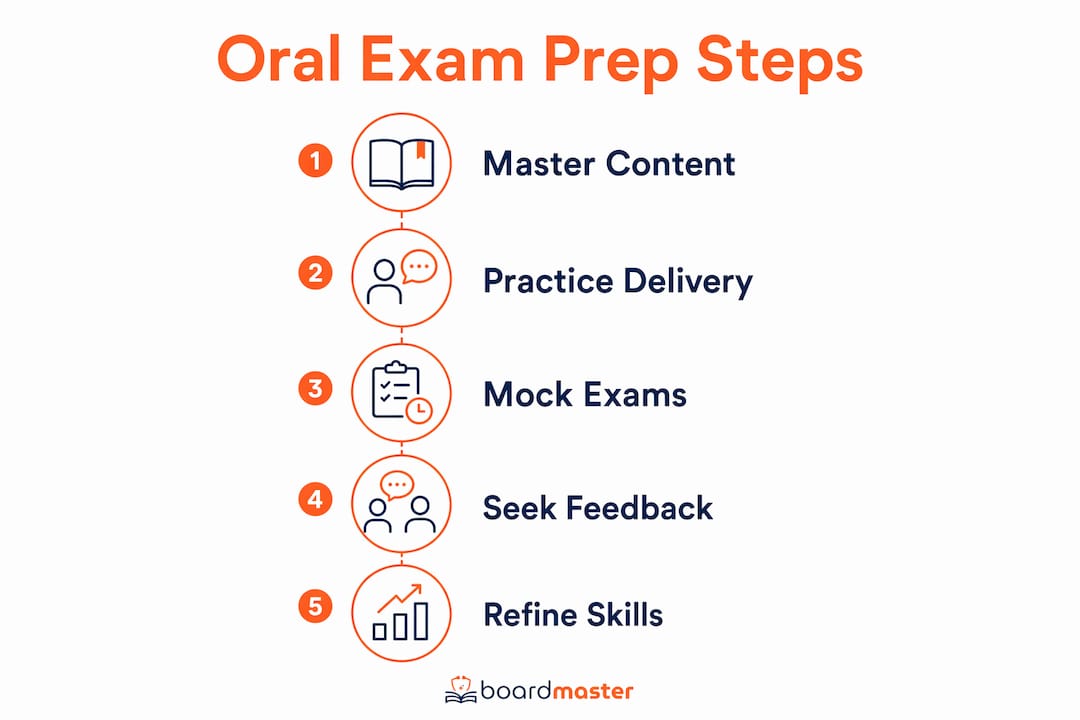
Oral exams are a live dialogue where the examiner can change direction at any moment; success requires adapting and explaining clinical reasoning aloud rather than reciting memorized answers.
Core study strategies that actually improve oral performance
Most students prepare for oral exams the same way they prepare for written ones: reading, highlighting, maybe some flashcards. That approach leaves a critical gap. Active recall and verbalization improve retention and retrieval for oral responses in ways passive review simply doesn't.

Two tracks, not one
Think of your prep as two parallel workstreams:
- Content mastery: Use active recall and spaced repetition to lock in the clinical facts, mechanisms, and differentials. Tools like adaptive retrieval practice can structure this automatically, surfacing weak areas before they cost you in the exam room.
- Delivery practice: Separately, practice speaking those facts aloud. Explain a concept to the wall. Record yourself. Summarize a topic in 90 seconds without notes.
These tracks need to stay distinct. Students who only do content work can know the material cold and still stumble when asked to articulate it under pressure. Training retrieval as speech builds the neural pathways needed to perform when an examiner is staring at you.
The point–support–conclusion template
Active speaking practice combined with a point–support–conclusion format keeps answers concise and clear. Here's how it works in practice:
- Point: State your answer directly. "The most likely diagnosis is community-acquired pneumonia."
- Support: Give two or three reasons. "The patient has productive cough, fever, and a lobar infiltrate on chest X-ray consistent with bacterial infection."
- Conclusion/next step: Close with a clinical action. "I'd start empiric antibiotics covering atypical organisms and confirm with sputum culture."
This template prevents the two most common oral failures: rambling and going blank. You always know where you are in the answer.
Convert notes into speakable summaries
Take one lecture's notes and condense them to a single page of bullet points you can speak from memory. Then close the page and explain the topic aloud. Check yourself. Repeat. This is more effective than re-reading the full notes three times, and it directly mirrors what the exam will ask of you.
Pro Tip: Deliberately practice with interruptions. Ask your study partner to cut you off mid-sentence and ask a follow-up. This simulates examiner behavior and forces you to hold your structure under pressure.
Recording yourself and listening back reliably surfaces vague reasoning, circular definitions, and pacing issues you won't notice while speaking live. Do it at least once a week.
How to run mock exams that actually prepare you
The gap between students who perform well in orals and those who don't usually comes down to one thing: how many realistic mocks they ran. Start speaking practice 2–3 weeks out and run at least two full mock exams in your final week.
Three high-value mock formats
1. Peer viva (reciprocal) You and a classmate take turns as examiner and candidate. The examiner uses a question list drawn from lecture material or past exam topics. Roles switch every 20 minutes. This is the easiest to set up and the most repeatable.
2. Tutor or senior-led viva Ask a resident, attending, or faculty member to run a 20–30 minute session. They'll naturally ask follow-ups you haven't anticipated, which is exactly the point. Even one session with a senior clinician is worth three peer sessions for realism.
3. OSCE-style timed stations Set a timer for 8–10 minutes per station. Use a clinical scenario card. Practice presenting the case, stating your differential, and defending your management — all before the timer ends. Viva-style practice transfers directly to OSCEs and specialty interviews, so this format pays dividends beyond a single exam.
Timing template for a 20-minute mock
| Phase | Duration | Focus |
|---|---|---|
| Candidate answer | 10 min | Case presentation + initial questions |
| Examiner follow-up | 7 min | Interruptions, probing, curveballs |
| Feedback | 3 min | Structured debrief (see checklist below) |
Run at least two full mocks in your final week. Debrief immediately after each one — memory of what went wrong fades fast.
Feedback checklist (use after every mock)
- Content gaps: What facts were missing or wrong?
- Clinical reasoning: Did the candidate explain why, not just what?
- Structure: Was the answer organized? Did it have a clear opening and close?
- Language: Any filler words, excessive hedging, or jargon the examiner might not follow?
- Confidence and recovery: How did the candidate handle being interrupted or challenged?
Mock format comparison
| Format | Realism | Feedback depth | Setup effort | Best use case |
|---|---|---|---|---|
| Peer viva | Moderate | Moderate | Low | Daily practice, early prep |
| Tutor/senior-led | High | High | Medium | Final week, weak areas |
| OSCE-style stations | High | Low–Moderate | Low | Timed answer practice |
How should you structure every answer?
The single biggest mistake in oral exams is preparing full scripts. Examiners will interrupt. When they do, a memorized script collapses. Prepare structure and key points instead so you stay flexible when probed.
Primary template — use this for most questions:
- Point: State the answer in one sentence.
- Support: Provide two or three pieces of evidence, mechanisms, or clinical findings.
- Conclusion: Close with a next step, management decision, or summary.
For differential diagnosis questions: Lead with your most likely diagnosis and your top two alternatives. State the distinguishing features. Offer the first investigation you'd order.
For clinical management questions: Open with immediate priorities (airway, breathing, circulation if relevant), then investigations, then definitive treatment. Signpost each step.
Phrases that help
To open: "The most likely diagnosis is…" / "My approach would be to…" / "There are three key points here…"
To signpost: "First…" / "The second reason is…" / "To summarize…"
To buy time: "That's a good question — let me think through the mechanism." / "I want to make sure I address that correctly."
To admit uncertainty: "I'm not certain of the exact dose, but my reasoning would be…" / "I'd want to confirm that with a senior before acting."
Dos and don'ts:
- Do reason aloud even when unsure — examiners credit the thought process.
- Do use structured answer frameworks like thesis plus three or four supporting arguments.
- Don't monologue for more than 90 seconds without pausing for examiner input.
- Don't say "I don't know" and stop. Always offer your best reasoning or next step.
Pro Tip: Practice your opening sentence for ten common question types. A strong first sentence sets the tone for the whole answer and prevents the blank-mind freeze that hits when nerves spike.
What should you do on exam day?
Logistics check (5–7 days out)
- Confirm format: single examiner, panel, or OSCE stations.
- Verify allowed materials: notes, reference cards, or nothing.
- Test your tech if it's remote: Zoom or Teams, camera angle, microphone, lighting.
- Know the ID requirements and where to be (or log in) and when.
Pre-exam routine (morning of)
- Wake at your normal time — don't disrupt sleep for extra cramming.
- Eat a real breakfast. Blood glucose affects verbal fluency more than most students realize.
- Do a 15-minute speaking warm-up: talk through two or three clinical topics aloud, not silently.
- Run a 60-second breathing exercise (4 counts in, hold 4, out 6) to lower heart rate before entering.
- Review your one-page speakable summaries — not full notes.
On-the-spot tactics
- Slow your first sentence. Nerves speed up speech. Deliberately pace your opening line.
- Use signposting immediately. "There are two main causes here…" buys you a second to think.
- Control your pace throughout. If you feel rushed, pause briefly before answering.
- Handle interruptions calmly. Stop, listen to the new question, and restart your structure.
- Correct yourself without drama. "Actually, let me revise that — the mechanism is…" reads as clinical maturity, not weakness.
Pro Tip: Make eye contact with the examiner, not your notes or the floor. Confident eye contact signals that you believe what you're saying, which matters as much as the content itself.
In-room presence rubric
| Element | What good looks like |
|---|---|
| Eye contact | Consistent, not fixed or darting |
| Tone | Measured, clear, not monotone |
| Posture | Upright, still hands, no fidgeting |
| Language | Concise, signposted, no excessive filler |
| Reasoning | Aloud, step-by-step, even under pressure |
Common mistakes that cost marks and how to fix them
1. Scripted answers What happens: The examiner interrupts at sentence three and the student loses the thread entirely. Fix: Practice openings and structures, not full scripts. Know your point and two supporting facts — the words will follow.
2. Silence or bluffing when stuck What happens: The student either freezes or invents a confident-sounding answer that's wrong. Fix: Reason aloud. "I'm not certain, but given the presentation I'd consider X because…" Examiners credit the thought process. Reasoning aloud and showing your thought process often earns partial credit and signals medical maturity.
3. Ignoring feedback from mocks What happens: Students run a mock, get feedback, and move on without changing anything. Fix: After each mock, extract exactly two or three target improvements. Write them down. Address them in the next session.
4. Cramming content in the final 48 hours What happens: Students spend the last two days reading new material instead of consolidating what they know. Fix: Shift entirely to aloud practice and quick consolidation review 48–72 hours before the exam. No new content. Sharpen delivery, not breadth.
5. Skipping the debriefing step What happens: The mock ends and everyone moves on. The feedback evaporates. Fix: Debrief immediately. Use the feedback checklist from the practice formats section. Ask your partner to score each dimension, not just give a general impression.
How to use BoardMaster to accelerate oral prep
The most efficient workflow combines structured aloud practice with targeted question generation. Here's how it maps end-to-end:
Recommended workflow:
- Upload your lecture notes to BoardMaster.
- Generate a set of AI-powered, professor-aligned practice questions.
- Answer each question aloud and record yourself.
- Run a peer mock or BoardMaster's OSCE/AI viva simulation.
- Use the physician-written qbank to drill weak areas identified in the mock debrief.
BoardMaster features mapped to oral prep
| Feature | How it supports oral prep |
|---|---|
| AI question generator | Turns your lecture notes into USMLE-style questions focused on what your professor emphasizes |
| OSCE/AI viva practice | Simulates clinical questioning with AI-driven follow-ups — mirrors the live examiner dynamic |
| Physician-written qbank | 5,000+ board-style questions for targeted drilling after mock debriefs |
| Spaced-repetition flashcards | Locks in content mastery so delivery practice isn't undermined by gaps |
| Study podcasts | Converts lectures into short spoken episodes — ideal for passive review during commutes |
| AI study assistant | Instant explanations when a concept doesn't click after a mock |
Sarah's result
Sarah was scoring at the 73rd percentile and spending long hours studying material that didn't match her professors' emphasis. After switching to BoardMaster's targeted question sets, she reached the 92nd percentile while cutting her study hours in half. The shift wasn't about working harder — it was about practicing the right content in the right format.
Pro Tip: Use BoardMaster's AI question generator the same day you cover a lecture. Answering questions aloud within 24 hours of the material dramatically improves retention compared to reviewing notes days later.
Combine BoardMaster with low-tech practice: record your answers on your phone, run peer mocks with classmates, and bring your BoardMaster question sets to tutor sessions. The platform handles question targeting and OSCE simulation; your peers and seniors handle the unpredictable follow-up questions that no AI fully replicates yet.
Your 2-week oral exam prep plan
Day-by-day schedule
| Days | Focus | Daily time | Key activity |
|---|---|---|---|
| 1–3 | Content audit | 2–3 hrs | Identify weak topics; build one-page speakable summaries |
| 4–6 | Content + delivery | 3 hrs | Active recall on weak areas; 20 min daily aloud practice |
| 7 | First full mock | 2 hrs | 20-min peer viva + debrief; extract 3 improvement targets |
| 8–10 | Targeted drilling | 2–3 hrs | BoardMaster qbank on weak areas; aloud practice with feedback |
| — | Delivery focus | 2 hrs | OSCE-style timed stations; answer structure drills |
| — | Second full mock | 2 hrs | Senior-led or peer viva; full debrief; finalize logistics |
| — | Light consolidation | 1 hr | Review speakable summaries; speaking warm-up only; sleep early |
72-hour checklist
- No new content — consolidate only.
- Confirm exam format, location/link, and ID requirements.
- Review your one-page summaries for the highest-yield topics.
- Run one short (10-minute) speaking drill per day.
- Prepare your exam-day nutrition and sleep schedule.
- Test your tech if the exam is remote.
- Do your 15-minute warm-up the morning of.
A lean, consistent study workflow in the final two weeks beats a frantic all-nighter every time. The goal in the last 72 hours is sharpening delivery, not adding breadth.
Key Takeaways
Oral exam performance improves most when you separate content mastery from delivery practice and run at least two realistic mock vivas in your final week.
| Point | Details |
|---|---|
| Speak aloud daily | Verbal retrieval builds the pathways needed to perform under examiner pressure. |
| Use point–support–conclusion | This template prevents rambling and keeps answers within the 60–90 second target. |
| Run two full mocks | Schedule one mid-prep and one in the final week; debrief immediately after each. |
| Shift to delivery at 72 hours | Stop adding new content; consolidate and sharpen spoken answers only. |
| BoardMaster targets the right content | Sarah moved from the 73rd to the 92nd percentile while halving study hours using BoardMaster's professor-aligned question sets. |
Why separating content and delivery is the real unlock
Most students treat oral prep as an extension of written exam prep — more reading, more flashcards, more time at the desk. The evidence points in a different direction. The students who perform well in vivas aren't necessarily the ones who know the most. They're the ones who've practiced saying what they know, under conditions that resemble the actual exam.
The failure mode I see most often is the student who can write a perfect answer but freezes when asked to say it aloud to another person. That freeze isn't a knowledge gap. It's a practice gap. The fix is deliberate: speak your answers out loud, every day, starting weeks before the exam — not the night before.
There's also a subtler issue with feedback. Most students get one piece of feedback from a mock ("you were a bit vague on the mechanism") and move on. The students who improve fastest extract two or three specific targets from every session and address them in the next one. Feedback without a follow-up action is just noise.
The two-track approach — content mastery and delivery practice running in parallel — isn't complicated. It's just rarely done with enough discipline. Students who commit to both tracks, run realistic mocks, and debrief honestly tend to walk into oral exams with something most of their peers don't have: genuine confidence, because they've already done it.
BoardMaster cuts prep time and targets what actually gets tested
Studying for oral exams is hard enough without spending hours on material your professor won't test. BoardMaster solves that directly: upload your lecture notes and the platform generates USMLE-style practice questions focused on what your specific professors emphasize — not a generic question bank's best guess.
For oral prep specifically, BoardMaster's OSCE simulation and AI viva practice give you a realistic questioning environment you can access any time, without needing to schedule a peer session. The physician-written qbank with 5,000+ board-style questions lets you drill weak areas after every mock debrief. And the study podcast feature turns your lectures into short spoken episodes — useful for passive review on the go. Sarah's jump from the 73rd to the 92nd percentile, while cutting her study hours in half, came from targeting the right content in the right format. Start with the free tier at BoardMaster and see how many of your lecture topics translate directly into practice questions today.
Further reading and sources
- How to Take an Oral Exam | Hamilton College — Practical framework for structuring oral answers, including the thesis-plus-arguments model.
- Evidenced-Based Study Strategies for Medical School | ACP — Evidence-backed case for active recall and verbalization over passive review.
- How to Study for an Oral Exam | Sidetracked Day — Covers active speaking practice, mock formats, and the value of recording yourself.
- How to Prepare for an Oral Exam | iTutorOnline — Two-track prep method and signposting techniques for oral answers.
- Medical Viva Exam Preparation | Geeky Medics — Viva-specific tips applicable to OSCEs and specialty interviews.
- Oral Exam Tips | TU Berlin — Reasoning aloud as a strategy for earning partial credit and demonstrating clinical maturity.
- HOW TO DRINK FROM A FIRE-HOSE | UCSD School of Medicine — Comprehensive guide to organizing, memorizing, and applying medical school material.
- BoardMaster AI Question Generator — Demo of how BoardMaster converts lecture notes into targeted practice questions.
- BoardMaster USMLE Prep — Full overview of BoardMaster's tools for USMLE and COMLEX preparation.
FAQ
What is the best way to prepare for an oral exam?
Split your prep into two tracks: master content using active recall and spaced repetition, then practice delivering answers aloud daily using a point–support–conclusion structure. Run at least two full mock vivas in your final week and debrief immediately after each one.
How is an oral exam different from a written exam?
Oral exams test real-time clinical reasoning and adaptability — examiners can interrupt, probe follow-ups, and change direction mid-question. Unlike written exams, silence reads as uncertainty, so concise, structured answers delivered in 60–90 seconds are the target.
What is the hardest year in med school?
Most students find the first two years hardest because of the sheer volume of foundational science, but third year's clinical rotations introduce a different kind of pressure: performing clinical reasoning and oral presentations in front of attendings and residents in real time.
How do I handle a question I don't know the answer to in a viva?
Reason aloud rather than going silent or guessing confidently. State your thought process, offer your best clinical reasoning, and acknowledge the limit of your knowledge. Examiners credit the reasoning pathway, and showing medical maturity under uncertainty often earns partial credit.
Can BoardMaster help with oral exam preparation?
Yes. BoardMaster generates professor-aligned practice questions from your lecture notes, offers OSCE/AI viva simulations, and provides a physician-written qbank for targeted drilling after mock debriefs — all of which map directly to the content and delivery tracks this guide recommends.