
Read the final task sentence first, before rereading the vignette. That single sentence tells you whether you're hunting for a diagnosis, a next step, or a mechanism, which changes what counts as relevant. Then build a one-line problem representation and try to answer it before you look at the options. Doing this cuts wasted rereading and pulls your attention straight to the discriminating details that actually decide the answer.
TL;DR:
- Answer first by formulating a provisional response based on the vignette, then systematically eliminate choices that do not fit the timeline or physiology.
- Focus on creating a one-line problem representation using a fixed template to improve speed and accuracy during timed practice.
- Use targeted drills, including micro-drills, block simulations, and official practice interfaces, to develop fast and reliable stem-reading skills under exam conditions.
- Avoid premature closure by questioning whether unusual findings would be contradicted by the answer choices and running last-minute checks on timeline, physiology, and stability.
- Practice questions from lecture-based or course-specific sources, as exam success depends on recognizing discriminating details relevant to your curriculum.
Table of Contents
- Reading Long Question Stems: A Step-by-Step Workflow
- Micro-Skills for Fast, Accurate Stem Reading
- Timed Drills That Build Real Stem-Reading Speed
- Catching Premature Closure Before You Lock an Answer
- What a Strategy-Focused Instructor Sees in Student Mistakes
- Why the Standard Advice on Long Stems Falls Short
- Practice the Workflow With Questions Built From Your Own Lectures
- Sources
- FAQ
Reading Long Question Stems: A Step-by-Step Workflow
Long stems overwhelm students not because the medicine is harder, but because the reading strategy is backwards. Most people start at word one and plow forward, hoping the answer reveals itself by the last sentence. It rarely does. A clinical case strategy review recommends flipping that order entirely, and the workflow below turns that recommendation into something you can run on autopilot during a timed block.
- Read the task sentence first. Skip to the final question ("What is the most likely diagnosis?" or "What is the next best step?") before touching the body of the vignette. This sets your goal and tells you which details matter.
- Read the vignette selectively. Scan for age, sex, time course, chief complaint, decisive positive and negative findings, and the one or two key test results. Ignore filler details that don't change the answer.
- Condense to a one-line problem representation. Something like: "62-year-old man, three days of fever and right-upper-quadrant pain, jaundice, elevated alkaline phosphatase." Tailor it to the task, because a diagnosis question needs a syndrome, while a management question needs a stability status.
- Generate a provisional answer before viewing the options. If you can't commit to one answer, form an answer category (infectious versus structural, medical versus surgical) and use the options only to eliminate what clearly doesn't fit.
- Compare the remaining choices against the timeline and physiology. Run a fast contradiction check: does this option fit the time course? Does it fit what you'd expect physiologically? Would the patient's stability change your answer?
This sequence is close to what the USMLE itself recommends: generate an answer, then look for it among the choices, and eliminate systematically only when you can't.
Pro Tip: Cover the answer choices with your hand or a scratch sheet during your first pass. It sounds trivial, but it physically stops you from anchoring on option A before you've even finished reading the stem.
Micro-Skills for Fast, Accurate Stem Reading
The workflow above only works if the underlying reading habits are fast. Three skills make the difference between a 40-second stem and a 2-minute one.
Build the one-line summary with a fixed template. Age and sex, time course, dominant syndrome, then one or two discriminators. A stem about acute abdominal pain with fever, jaundice, and leukocytosis compresses to: "Older adult, acute abdominal pain, febrile, jaundiced, leukocytosis." That single line is what you compare against every answer choice instead of rereading four paragraphs five times.
Reconstruct the timeline in chart-based stems. Tabular and chart-format items are common on COMLEX and increasingly on USMLE. Scan headings, dates, vital sign trends, medications given, and clinician actions in that order, and look specifically for the one change that answers the task. The NBOME's own format guidance confirms these chart and tabular presentations are a standard, testable format, not an occasional curveball.
Know what counts as a discriminating abnormality. A mildly elevated white count in a postoperative patient is often noise. A white count that doubled over six hours is a signal. Train yourself to ask "does this number change my answer?" rather than cataloging every abnormal value.
- Images and audio clips (heart sounds, ECGs, X-rays) only matter when the task sentence points at them directly. If the question asks about management and the image confirms a diagnosis you already suspected, spend five seconds confirming and move on.
One study comparing question formats found that well-constructed stems drive expert-level reasoning regardless of how many answer choices are listed. In other words, the stem is where the exam actually tests you. The options are secondary.
Timed Drills That Build Real Stem-Reading Speed
Strategy without repetition under time pressure doesn't transfer to test day. Build practice around three drill types.
- Micro-drills. Pull 5 to 10 items and give yourself a strict 60 to 90 seconds each, forcing task-first reading and a one-line summary before you look at answer choices. This is where the workflow becomes reflexive instead of effortful.
- Block simulations. Run 20 to 40 item blocks at real exam pace, then stop and review every miss immediately afterward rather than days later. Alternate a timed block with a slower review session so speed and accuracy get trained separately.
- Official interface practice. Complete the USMLE's own sample items and NBOME's CDM tutorials before test day. Sequential item sets on Step 2 CK sometimes require answering in order without going back, and COMLEX's CDM interface has its own navigation quirks. Learning those constraints during practice, not during the real exam, saves real minutes.
Pro Tip: After every simulated block, flag your misses by cause, not just topic. "Misread the timeline" and "didn't know the physiology" are two different fixes, and lumping them together wastes your review time.
Close the loop with spaced re-testing: revisit flagged items a week later to confirm the fix stuck, not just that you memorized the one question.
Catching Premature Closure Before You Lock an Answer
The single biggest error separating stronger from weaker test-takers isn't knowledge. A mixed-methods study of test-taking behavior found that higher Step 2 CK performers more often rule out alternatives and admit uncertainty, while lower performers lock onto the first plausible answer and stop thinking. That's premature closure, and it's fixable with a habit, not more studying.
- Premature closure check: before locking in, ask "what finding would be unusual if this answer were correct?" If you can't answer, you probably haven't ruled out the alternatives.
- Anchoring check: if you generated a provisional answer and it's not among the choices, don't force it. Let the options guide you back to the vignette's discriminators.
- Timeline, physiology, and stability checks: run all three in the last 15 to 20 seconds. Does the timeline fit? Does the physiology fit? Would an unstable patient change the answer?
- Decision rule: if two checks pass and one is ambiguous, flag it and move on rather than burning two extra minutes you'll need later in the block.
What a Strategy-Focused Instructor Sees in Student Mistakes
Dr. Ahmed Abuzoor has spent his career training medical students and residents on clinical reasoning and board exam performance, with a focus on the gap between what students know and what they can retrieve fast enough under exam pressure. In his review of student test-taking patterns, the same failure shows up again and again: strong content knowledge undone by reading habits that waste 30 to 40 seconds per stem on irrelevant detail.
BoardMaster's AI question generator builds USMLE-style vignettes directly from a student's own lecture notes, and its QBank adds over 5,000 physician-written items with timed practice modes that mirror the drills above. Timed clinical skills simulations extend the same task-first thinking to oral and practical scenarios. A workable weekly cadence: two lecture-based blocks plus one QBank block run under strict timing can keep the workflow sharp for both course exams and boards.
Why the Standard Advice on Long Stems Falls Short
Most advice about long question stems tells students to "read carefully" or "practice more," which is true and useless in equal measure. The real lever is sequence: what you read first determines what you notice, and most students read in the wrong order. Reading the vignette top to bottom before the task sentence guarantees you'll absorb irrelevant detail and then panic when four answer choices all seem partially right.
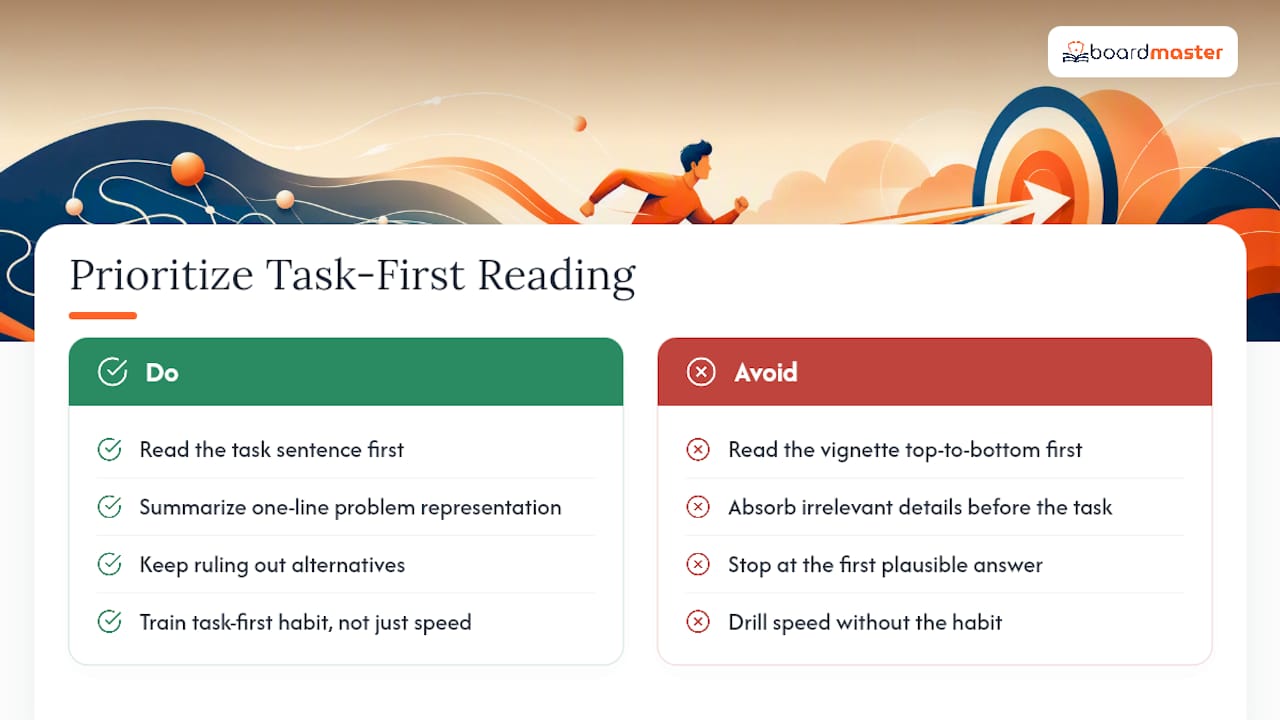
The research on Step 2 CK performance makes an underrated point: the gap between strong and weak performers isn't raw knowledge, it's whether they keep ruling out alternatives instead of stopping at the first plausible fit. That's a trainable habit, not a talent.
If you take one thing from this article, prioritize the one-line problem representation over everything else. It forces task-first reading, it exposes premature closure immediately (you can't summarize what you didn't actually understand), and it transfers cleanly from course exams to boards. Drilling speed without that habit just makes you fast at being wrong.
— Dr. Ahmed Abuzoor
Practice the Workflow With Questions Built From Your Own Lectures
BoardMaster turns your uploaded lecture notes into USMLE-style practice questions that match how your specific professors test, so the task-first workflow above gets trained on material that's actually going to be on your class exam, not just generic board content. That's the practical edge over a standard question bank: you're rehearsing stem-reading speed on the exact syndromes and discriminators your course is emphasizing this week.
Start with the free tier or watch the AI question generator demo to see how a lecture becomes a timed practice block in minutes. Then run a 20-item lecture-based block under strict timing and apply the one-line summary technique from the very first question. Monthly access runs $39.99, or $399.96 billed annually, through BoardMaster.
Sources
Verify these strategies directly against the exam bodies that set them. The USMLE Step 1 formats page explains the standard vignette-plus-options structure and official guidance on generating answers before checking choices. The NBOME COMLEX-USA format page details paragraph and chart-based item types along with CDM case mechanics. For the underlying research, the PMC strategy review and the mixed-methods test-taking study both support the task-first, elimination-based approach covered above.
- A strategic approach to succeed on clinical case-based multiple-choice exams
- Step 1 formats & questions | USMLE
- COMLEX-USA examination format | NBOME
FAQ
What Is the Fastest Way to Read a Long Question Stem?
Read the final task sentence first, then reread the vignette selectively for age, time course, and discriminating findings. This focuses your attention before you form a one-line problem representation, which is faster than rereading the whole stem multiple times.
Should I Try to Answer Before Looking at the Choices?
Yes. USMLE's own guidance recommends generating an answer first and then searching for it among the options, falling back to elimination only when no answer comes to mind.
How Do I Handle Negative or "Except" Questions?
Reread the task sentence twice for negative and "except" wording, since these formats flip your usual filter and are easy to misread under time pressure. Circle or mentally flag the negative word before evaluating any option, so you're not accidentally hunting for the "correct" finding instead of the wrong one.
How Many Practice Questions Should I Do to Build Speed?
Run short micro-drills of 5 to 10 items under strict per-item timing, then progress to 20 to 40 item timed blocks that mirror real exam pacing. BoardMaster's QBank and lecture-based question generator both support this kind of timed, targeted repetition.
Does BoardMaster Help With Board Exam Stem Reading Specifically?
BoardMaster's question bank includes physician-written, USMLE-style items with timed practice modes, and its AI generator can build additional practice directly from lecture material for course-specific review. Pricing starts with a free tier, with paid access at $39.99 per month or $399.96 per year through BoardMaster.