
TL;DR:
- Dual-purpose studying involves preparing for course exams and the USMLE simultaneously by integrating test questions into every lecture. It enhances retention, reduces burnout, and aligns effort with both immediate and future exam success through active recall and spaced repetition. Using tools like BoardMaster, students generate targeted USMLE-style questions from lecture notes to improve efficiency and performance.
Dual-purpose studying means preparing for your course exams and the USMLE at the same time, not sequentially. Instead of cramming for block exams and then pivoting to boards later, you treat every lecture as both a class assignment and a board question in waiting. Clinical educators consistently note that students who integrate these two goals from day one retain more, burn out less, and arrive at Step 1 without the panic of starting over.
The role of dual-purpose studying in med school comes down to one core insight: the material overlaps almost entirely. Pathophysiology you master for your renal block is the same pathophysiology Step 1 tests. Separating those two goals wastes time you do not have.
Key benefits at a glance:
- Prevents knowledge gaps that accumulate when course and board prep are siloed
- Reduces burnout by eliminating the "study everything twice" trap
- Improves long-term retention through consistent active recall rather than last-minute cramming
- Aligns daily effort with both immediate grades and future USMLE performance
- Supports clinical readiness by building pattern recognition early
Tools like BoardMaster are built specifically for this approach, generating USMLE-style questions directly from your lecture notes so every study session serves both masters at once.
Table of Contents
- How to implement dual-purpose studying effectively
- How BoardMaster supports dual-purpose studying for U.S. medical students
- Common challenges in dual-purpose studying and how to beat them
- Dual-purpose studying pays off across your entire medical career
- BoardMaster turns every lecture into board prep
- Key Takeaways
- FAQ
How to implement dual-purpose studying effectively
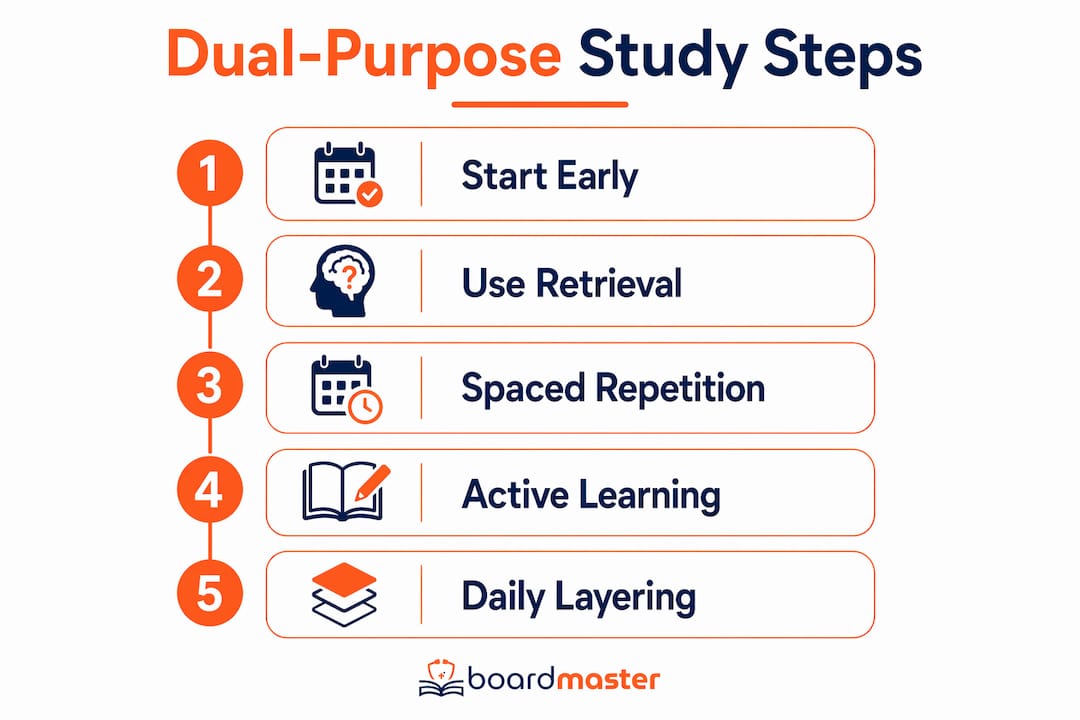
The two techniques that matter most are retrieval practice and spaced repetition, and the evidence behind them is hard to argue with. Repeated retrieval practice outperforms passive re-reading significantly, with recall at six months reaching 39% for active recall versus 26% for passive re-reading. Spaced repetition compounds that advantage by scheduling review at the exact moment forgetting begins.

Beyond those two anchors, active learning strategies like interleaving and elaboration push understanding deeper than any single-pass review. Interleaving means mixing topics within a session rather than blocking them, which forces your brain to discriminate between conditions. Elaboration means asking "why does this mechanism work this way?" rather than accepting the fact at face value.
Dual coding adds another layer: pairing a textual description with a diagram or your own hand-drawn sketch increases recall over text alone, particularly for complex preclinical topics like cardiac physiology or renal handling.
Scheduling matters as much as technique. A practical framework:
- Morning (30–45 min): New Anki cards or BoardMaster questions tied to that day's lecture
- Afternoon (20 min): Due Anki reviews, no skipping
- Evening (15 min): One-paragraph elaboration on the day's highest-yield concept
- Weekly: One timed practice block of 20–40 USMLE-style questions
Pro Tip: Layer techniques daily rather than rotating them weekly. Spaced repetition without active recall is less effective; active recall without elaboration leaves gaps. Students who combine all three consistently see the biggest gains.
For a deeper look at building this into a daily routine, the lean study workflow guide for medical students lays out a practical schedule you can adapt to your block structure.
How BoardMaster supports dual-purpose studying for U.S. medical students
Most question banks are built around a generic content outline. BoardMaster works differently: you upload your lecture notes, and its AI generates USMLE-style questions targeting the specific concepts your professor emphasized. That distinction matters because the biggest study mistake in preclinical years is studying the wrong material at the right depth.
The result is a study session that simultaneously prepares you for Thursday's block exam and builds your Step 1 foundation, without requiring two separate study plans.
Features that make this work in practice:
- Lecture-aligned question generation: Questions reflect your professor's framing, not just First Aid bullet points
- USMLE-style formatting: Every question trains the clinical reasoning Step 1 and Step 2 CK demand
- Progress tracking: Identifies weak content areas before they become exam-day surprises
- Personalized practice: Adjusts to your performance so you spend time where it counts
The case of Sarah is the clearest illustration. Using BoardMaster's targeted questions, she moved from the 73rd to the 92nd percentile on her boards while cutting her study hours in half. The efficiency gain came from eliminating low-yield review and replacing it with questions that matched exactly what her courses and boards both tested.
For a live demonstration of how the question generator works with real lecture content, the AI question generator demo walks through the process step by step.
Pro Tip: Upload notes within 24 hours of a lecture while the content is still fresh. The questions BoardMaster generates will reinforce encoding at the optimal moment, right before the forgetting curve drops.
Common challenges in dual-purpose studying and how to beat them
The biggest trap is the fluency illusion: re-reading notes feels productive because the material looks familiar, but familiarity is not recall. When you close the notes and try to retrieve the information, the gap becomes obvious. Students who mistake passive re-reading for mastery consistently miss critical knowledge gaps that Step exams expose.
Other common obstacles:
- Cognitive overload: Trying to cover too many systems at once fragments attention and reduces retention
- Time constraints: Clinical rotations compress study windows, making low-efficiency methods unsustainable
- Burnout: Studying the same material twice, once for class and once for boards, doubles the load unnecessarily
Strategies that work:
- Chunking: Break each organ system into 3–4 high-yield themes rather than trying to cover every detail
- Illness scripts: Integrating illness scripts in preclinical study builds the pattern recognition that accelerates diagnostic reasoning on boards
- SIP and GMO cycles: Self-Assessment, Identification of Gaps, and Targeted remediation keeps study plans responsive to actual performance rather than gut feeling
- Adaptive scheduling: Use MedSchoolPilot or similar tracking tools to monitor progress and shift focus dynamically
"The students who struggle most are those who study hard but not deliberately. Individualized, intentional study plans, adjusted regularly based on performance data, are what separate good scores from great ones." — Dr. Ahmed Abuzoor
Balancing clinical duties with study demands requires the same logic. During rotations, consistent daily board exam practice in short focused blocks outperforms marathon weekend sessions that try to compensate for a week of nothing.
Dual-purpose studying pays off across your entire medical career
The benefits of integrating preclinical and board prep extend well past Step 1. Students who build this habit early arrive at clerkships with stronger clinical reasoning, faster pattern recognition, and less anxiety about shelf exams. The practice questions approach that serves your block exams also trains the case-based thinking that Step 2 CK demands.
Core takeaways for putting this into practice:
- Start dual-purpose habits in your first preclinical block, not the month before dedicated study
- Prioritize retrieval practice and spaced repetition over any passive review method
- Use tools that align your course content with board-style questions, not generic question banks
- Adjust your plan regularly based on performance data, not on how confident you feel
- Protect study consistency during rotations with short daily sessions rather than sporadic long ones
BoardMaster turns every lecture into board prep
Most students spend preclinical years studying for class and then spend dedicated study time re-learning the same material for boards. BoardMaster eliminates that redundancy by generating USMLE-style questions from your actual lecture notes, so your daily study session covers both goals at once.
Sarah's jump from the 73rd to the 92nd percentile while halving her study hours is what this looks like in practice. If you are in preclinical years and still running two separate study tracks, that is the inefficiency BoardMaster is built to fix. See exactly how it works with your own notes at the AI question generator demo, or explore the full suite of AI study tools designed for U.S. medical students preparing for both course exams and the USMLE.
Key Takeaways
Dual-purpose studying works because it treats course exams and board prep as one continuous challenge, using retrieval practice and spaced repetition to build retention that lasts through Step 1 and beyond.
| Point | Details |
|---|---|
| Start early | Begin dual-purpose habits in your first preclinical block, not during dedicated study. |
| Retrieval beats re-reading | Active recall at six months reaches 39% versus 26% for passive re-readers. |
| Illness scripts accelerate reasoning | Integrating illness scripts in preclinical study builds pattern recognition for boards. |
| Adapt based on data | Use SIP and GMO cycles to adjust your plan to actual performance gaps, not gut feeling. |
| BoardMaster aligns both goals | Lecture-aligned USMLE-style questions helped one student substantially improve percentile ranking while significantly reducing study hours. |
FAQ
What is dual-purpose studying in medical school?
Dual-purpose studying means preparing for course exams and board exams simultaneously using the same study sessions, rather than treating them as separate phases. It relies on retrieval practice and spaced repetition to build retention that serves both goals.
How does retrieval practice improve USMLE performance?
Active retrieval produces significantly higher recall at six months compared to passive re-reading—39% vs. 26%—and the volume of unique practice questions completed correlates with up to 66% of variance in USMLE Step 1 outcomes.
How can I balance dual-purpose studying during clinical rotations?
Short daily active recall sessions, 20–30 minutes of USMLE-style questions tied to your current rotation, outperform sporadic long study blocks and keep board readiness building without overwhelming your clinical schedule.
How does BoardMaster support dual-purpose studying?
BoardMaster generates USMLE-style questions from your uploaded lecture notes, aligning your daily course study with board prep so you are not maintaining two separate study tracks. Students using this approach have seen substantial percentile gains while reducing total study time.
What is the fluency illusion and why does it matter?
The fluency illusion is the mistaken sense of mastery that comes from re-reading familiar material. Because the content looks recognizable, students assume they know it, but effortful retrieval quickly reveals the actual gaps that Step exams will expose.