
Pathophysiology gives you the cause-and-effect framework that turns board questions from memory tests into logic problems you can actually solve. When you understand why a failing heart causes pulmonary edema, you do not need to memorize that symptom in isolation. You derive it. That shift from recall to reasoning is exactly what the role of pathophysiology in board questions demands, and it separates students who plateau at the 70th percentile from those who break through.
Here is what strong pathophysiology knowledge does for your exam performance:
- Replaces rote memorization with mechanistic logic, so you can work through unfamiliar presentations without panic
- Builds differential diagnoses from first principles, the core skill tested in complex clinical vignettes
- Reduces vulnerability to test-wise guessing, because multiple-choice formats inflate scores through recognition and elimination rather than true understanding
- Sharpens clinical prioritization, letting you identify the most urgent problem in a vignette before reading the answer choices
- Transfers across systems, so mastering heart failure mechanics helps you reason through renal compensation, pulmonary hypertension, and hepatic congestion simultaneously
What pathophysiology actually covers and why it matters for exams
Pathophysiology is the study of functional changes that occur in the body when disease or injury disrupts normal physiology. It sits between basic science and clinical medicine, and that position is precisely why it bridges the gap between what you learned in your first two years and what boards actually test.
Three terms often get confused, and the distinction matters on exams:
- Pathogenesis covers cellular events during disease development
- Pathology focuses on structural defects in tissues and organs
- Pathophysiology explains the functional consequences of those structural changes
Boards test the third one most aggressively, because functional consequences are what clinicians manage.
The key components you need to command for exam success:
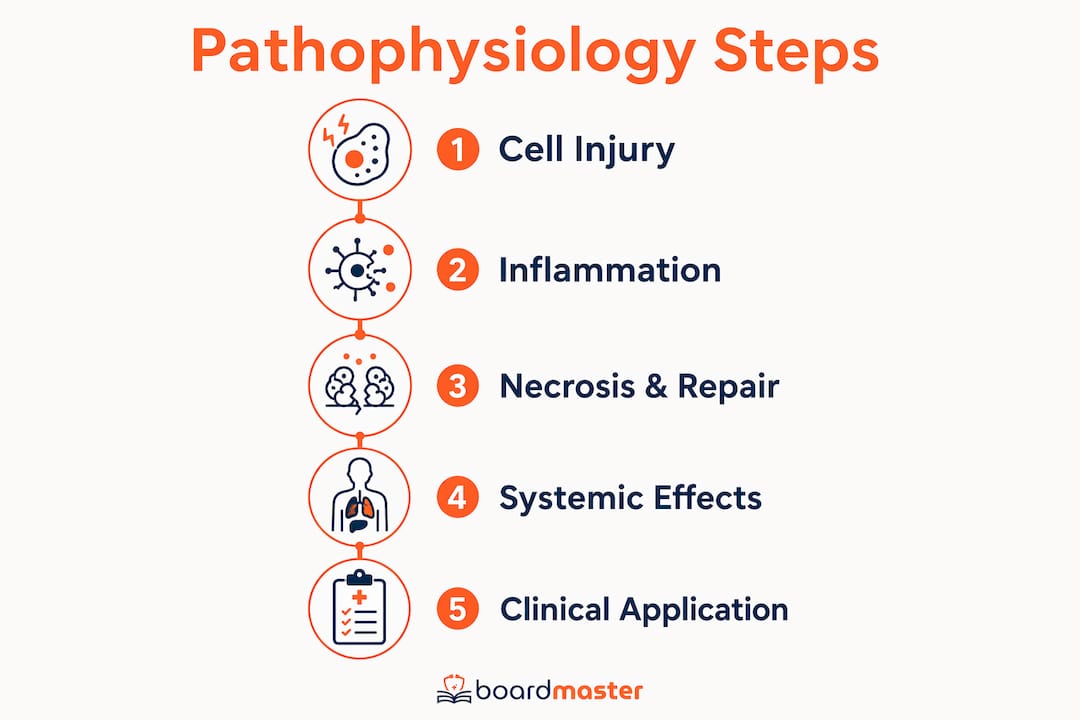
- Cellular injury and adaptation: hypertrophy, atrophy, metaplasia, and when cells cross the point of no return
- Inflammation: acute versus chronic cascades, mediators, and how they produce the signs you see in vignettes
- Necrosis and apoptosis: the morphological and biochemical differences that explain why a myocardial infarct looks different at 6 hours versus 48 hours
- Repair and regeneration: why some tissues heal cleanly and others scar, with direct implications for question stems about complications
- Systemic integration: how a single molecular defect, say an ion channel mutation, produces organ-level and population-level disease patterns
This integrated biological view across molecular, cellular, organ, and systemic levels is what the International Society for Pathophysiology describes as the foundation of evidence-based clinical reasoning.
That integration is not academic. On a USMLE Step 1 vignette asking why a patient with chronic kidney disease develops anemia, you need to trace erythropoietin production from the renal cortex through bone marrow response to peripheral red cell counts. Students who memorized "CKD causes anemia" without the mechanism get tripped up the moment the question adds a twist, such as a concurrent iron deficiency or a patient on ACE inhibitors.
How pathophysiology shapes your clinical prioritization on boards
Board exams do not just test what you know. They test what you do first. Clinical prioritization, deciding which problem is most urgent and which intervention comes next, is a skill that pathophysiology trains directly.
A framework for mechanism-based prioritization:
- Identify the primary lesion. What organ or system is failing, and what is the underlying mechanism? Ischemia, inflammation, obstruction, or dysregulation?
- Trace downstream consequences. What compensatory responses has the body activated, and are they helping or causing secondary harm?
- Locate the tipping point. At what stage does compensation fail and the patient decompensate? That is usually where the question is set.
- Match the intervention to the mechanism. The correct answer almost always targets the primary lesion or the most dangerous downstream effect.
This four-step process works across systems. A patient in septic shock: the primary lesion is pathological vasodilation from cytokine release, the downstream consequence is tissue hypoperfusion, the tipping point is multi-organ failure, and the intervention targets volume resuscitation and source control. A student who understands that chain does not need to memorize a sepsis protocol verbatim.
Pathophysiology also helps you interpret labs and vitals within a vignette rather than treating them as isolated data points. A rising creatinine in a patient started on an ACE inhibitor after an MI is not a random finding. It reflects efferent arteriolar dilation reducing glomerular filtration pressure, a direct pharmacological consequence of the drug's mechanism. Recognizing that connection tells you whether to stop the drug, adjust the dose, or simply monitor.

Pro Tip: When you read a vignette, write out the mechanism chain before you look at the answer choices. Students who do this consistently report fewer "I knew that" wrong answers, because the chain forces you to commit to a mechanism before the distractors can pull you toward a plausible-sounding but incorrect option.
Examiners deliberately avoid linguistic cues in question stems, so test-wise strategies like process of elimination are far less reliable than a solid pathophysiological model. The student who can reconstruct the mechanism from scratch will outperform the student who is hunting for grammatical hints every time.
Applying pathophysiology to actual board-style questions
Theory only gets you so far. Here is how mechanism-based reasoning plays out in practice.
Sample board-style question:
A 58-year-old man with a history of hypertension presents 4 hours after onset of crushing chest pain. ECG shows ST elevation in leads II, III, and aVF. Troponin is elevated. Which of the following findings is most likely to develop over the next 24–48 hours?

A student relying on memorization might recall "MI causes arrhythmia" and guess. A student applying pathophysiology reasons through it: inferior MI from right coronary artery occlusion causes ischemia to the inferior wall and often the right ventricle. The SA and AV nodes receive their blood supply from the RCA in most people. Ischemia to the AV node produces conduction delays. The most likely finding is a new AV block, and the mechanism tells you exactly why.
How pathophysiology drives differential diagnosis on exams:
- Start with the presenting symptom or lab abnormality
- List the mechanisms that could produce it (e.g., dyspnea from decreased cardiac output, pulmonary edema, airway obstruction, or impaired gas exchange)
- Use additional vignette details to eliminate mechanisms that do not fit the full clinical picture
- Arrive at the most mechanistically consistent diagnosis
This approach is what understanding disease mechanisms enables: building a logical differential from first principles rather than pattern-matching to a memorized list.
Pathophysiology-to-management connections boards test frequently:
| Clinical Scenario | Underlying Mechanism | Management Logic |
|---|---|---|
| Heart failure with reduced ejection fraction | Neurohormonal activation (RAAS, SNS) | Beta-blockers and ACE inhibitors target the mechanism, not just the symptom |
| Type 2 diabetes with hyperglycemia | Insulin resistance plus beta-cell dysfunction | Metformin reduces hepatic glucose output; GLP-1 agonists target incretin deficiency |
| Septic shock | Cytokine-mediated vasodilation and capillary leak | Fluids restore preload; vasopressors restore vascular tone |
| Nephrotic syndrome | Glomerular basement membrane damage, protein loss | Treat the cause; albumin loss drives edema through oncotic pressure drop |
| COPD exacerbation | Air trapping, V/Q mismatch, hypercapnia | Bronchodilators reduce obstruction; controlled O2 avoids hypoxic drive suppression |
"To understand pathophysiology is to understand cause-effect relationships in disease, and guide methods and strategies that stop or reverse the disease process, therefore healing a patient." — Cleveland Clinic Research
The table above illustrates a pattern you will see repeatedly on boards: the correct management answer is almost always the one that targets the mechanism, not the one that merely addresses the symptom. Students who master cause-and-effect relationships in disease can derive treatment logic rather than memorize drug-disease pairings in isolation.
One common pitfall: students who memorize clinical presentations without the mechanism often pick the answer that sounds most familiar rather than the one that is mechanistically correct. If a question describes a patient with hypercalcemia and you only memorized "sarcoidosis causes hypercalcemia," you will miss the question that asks why and asks you to select the mechanism (activated macrophages converting 25-OH vitamin D to its active form). The mechanism is the answer.
Key strategies for using pathophysiology to boost your board score
Knowing pathophysiology matters is not enough. You need a study approach that builds the right kind of knowledge.
- Master core conditions mechanistically, not as lists. For each high-yield disease, trace the path from molecular or cellular origin through organ dysfunction to clinical presentation and complications. Three to four logical causal steps per condition build durable memory that holds up under exam pressure.
- Integrate pathophysiology with vignette practice from day one. Reading a mechanism in a textbook and then immediately applying it to a clinical vignette question cements the connection in a way passive review never does.
- Categorize your wrong answers. When you miss a question, determine whether you had a recall gap (you simply did not know the fact) or a mechanism gap (you knew the facts but could not connect them). Mechanism gaps require going back to the pathophysiology, not doing more practice questions on the same topic.
- Avoid the memorization trap. Isolated fact memorization produces fragile knowledge. A question that presents the same disease from a different angle, a different patient demographic, an atypical presentation, or a complication rather than the primary diagnosis, will expose that fragility immediately.
- Use tools aligned with your actual coursework. Generic question banks test average content. Your professors emphasize specific mechanisms and clinical applications that will appear on your course exams and, through those, on boards. Studying material your professors actually teach is a force multiplier.
- Practice clinical prioritization explicitly. After reading each vignette, before selecting an answer, ask yourself: what is the most urgent problem, and what mechanism is driving it? That habit trains the prioritization skill boards test directly.
Pathophysiology is the foundation that connects every other subject. Pharmacology makes sense when you know the mechanism the drug targets. Microbiology becomes memorable when you understand how a pathogen's virulence factors exploit specific physiological vulnerabilities. Even anatomy questions on boards often hinge on understanding what happens functionally when a structure is damaged.
How BoardMaster uses AI to build pathophysiology-focused exam prep
Most question banks are built around average curricula. BoardMaster works differently. You upload your lecture notes, and the platform generates USMLE-style questions targeting the specific mechanisms and clinical applications your professors emphasized. That alignment matters because your course exams and board exams are not as separate as they feel.

BoardMaster's AI does not just generate questions. It generates questions that test mechanistic reasoning, the same cognitive level that boards actually assess. A question built from your cardiology lecture on heart failure will ask you to apply the Frank-Starling relationship or trace the RAAS cascade, not just recall that furosemide is a loop diuretic.
"AI-generated, targeted questions aligned with individual lecture content optimize study efficiency and deepen understanding of pathophysiology concepts for better exam outcomes." — BoardMaster
The results speak for themselves. One student, Sarah, moved from the 73rd to the 92nd percentile on her boards while cutting her study hours in half. The mechanism behind that outcome is straightforward: she stopped studying generic content and started studying the high-yield material her professors actually tested. BoardMaster made that possible by converting her lecture notes into a personalized question bank.
How to get the most from BoardMaster's AI-generated questions:
- Upload lecture notes immediately after each class, while the material is fresh.
- Complete the generated questions within 48 hours, before the next lecture cycle begins.
- Review every wrong answer by tracing the mechanism, not just reading the correct answer explanation.
- Flag questions where you understood the mechanism but still chose incorrectly. Those reveal test-taking strategy gaps, not knowledge gaps.
- Revisit flagged questions one week later to confirm retention before your exam.
Pro Tip: Use BoardMaster's QBank alongside your lecture uploads. The combination of professor-specific questions and a broader bank of physician-written questions covers both your course exam and the board-level content that sits just beyond your syllabus.
For nursing students, the same principle applies to NCLEX preparation. The NCLEX exam increasingly tests clinical judgment, which is grounded in pathophysiology. Understanding why a patient with heart failure develops crackles, not just that crackles are a finding, is what next-generation NCLEX questions demand.
Common mistakes that undermine pathophysiology-based board prep
Even students who understand the importance of pathophysiology make predictable errors in how they study it. Recognizing these patterns early saves weeks of misdirected effort.
Treating pathophysiology as a separate subject. Pathophysiology is not a standalone module you complete and move on from. It is the connective tissue running through pharmacology, microbiology, physiology, and clinical medicine. Students who compartmentalize it miss the cross-system connections that boards exploit in complex vignettes.
Memorizing mechanisms without testing them. Reading a mechanism and understanding it are not the same thing. If you cannot explain why a patient with liver cirrhosis develops ascites without looking at your notes, you do not actually know the mechanism. Testing yourself with custom practice questions is the only reliable way to confirm that understanding is real.
Skipping the "why" on management questions. When you learn that a treatment is correct, always ask why it works at the mechanistic level. Students who skip this step can answer straightforward management questions but fail when the question adds a complication, a contraindication, or an atypical patient.
Confusing recall accuracy with mechanism mastery. Getting a question right does not mean you understood the mechanism. Multiple-choice formats, as research on the American Board of Pathology's certification exams confirms, inflate scores through guessing and recognition. If you cannot explain your correct answer in plain language, the knowledge is fragile.
Ignoring error analysis. Most students review wrong answers by reading the explanation and moving on. The more useful habit is categorizing each error: was it a recall slip, a mechanism gap, or a misread of the question stem? Mechanism gaps require returning to the source material. Recall slips just need spaced repetition. Treating them the same way wastes time on the wrong fix.
Over-relying on mnemonics without the underlying logic. Mnemonics are useful scaffolding, but they collapse under pressure when a question presents the same concept from an unfamiliar angle. A student who knows "MUDPILES" for anion gap acidosis but cannot explain why methanol produces a gap will miss the question that asks about the toxic metabolite or the treatment rationale.
Key Takeaways
Pathophysiology is the single most transferable skill in board exam preparation, because it converts memorized facts into reasoned clinical decisions that hold up under any question format.
| Point | Details |
|---|---|
| Mechanism over memorization | Tracing 3–4 causal steps from disease origin to presentation builds durable knowledge that survives unfamiliar question angles. |
| Prioritization is testable | Identifying the most urgent problem in a vignette requires understanding which mechanism is causing the most dangerous downstream effect. |
| Multiple-choice formats can mislead | Boards inflate scores through recognition and guessing; deep mechanistic knowledge is the only protection against that inflation. |
| Error analysis guides study | Distinguish recall slips from mechanism gaps before deciding whether to do more practice or return to core pathophysiology. |
| Targeted questions outperform generic banks | Questions built from your actual lecture content align course exam prep with board prep, reducing total study time without sacrificing depth. |
FAQ
What are the four main components of pathophysiology?
The four core components are cellular injury and adaptation, inflammation, necrosis and repair, and systemic integration across molecular, organ, and whole-body levels. Together they form the mechanistic framework that explains how disease initiates, progresses, and produces clinical signs.
What is the role of pathophysiology in clinical medicine?
Pathophysiology bridges basic science and clinical medicine by explaining the functional changes that produce disease states, enabling clinicians to move beyond symptom management toward treatments that target the underlying cause.
What is the most important aspect of pathophysiology for board exams?
Understanding cause-and-effect relationships is the most critical skill. Boards test whether you can trace a mechanism from its origin through its clinical consequences, not whether you can recall isolated facts about a disease.
What is the purpose of studying pathophysiology as a medical or nursing student?
Studying pathophysiology builds the clinical reasoning foundation that every other subject depends on. It equips you to interpret patient presentations, construct differential diagnoses, and select treatments logically, skills that are tested on every board exam and used in every clinical encounter.