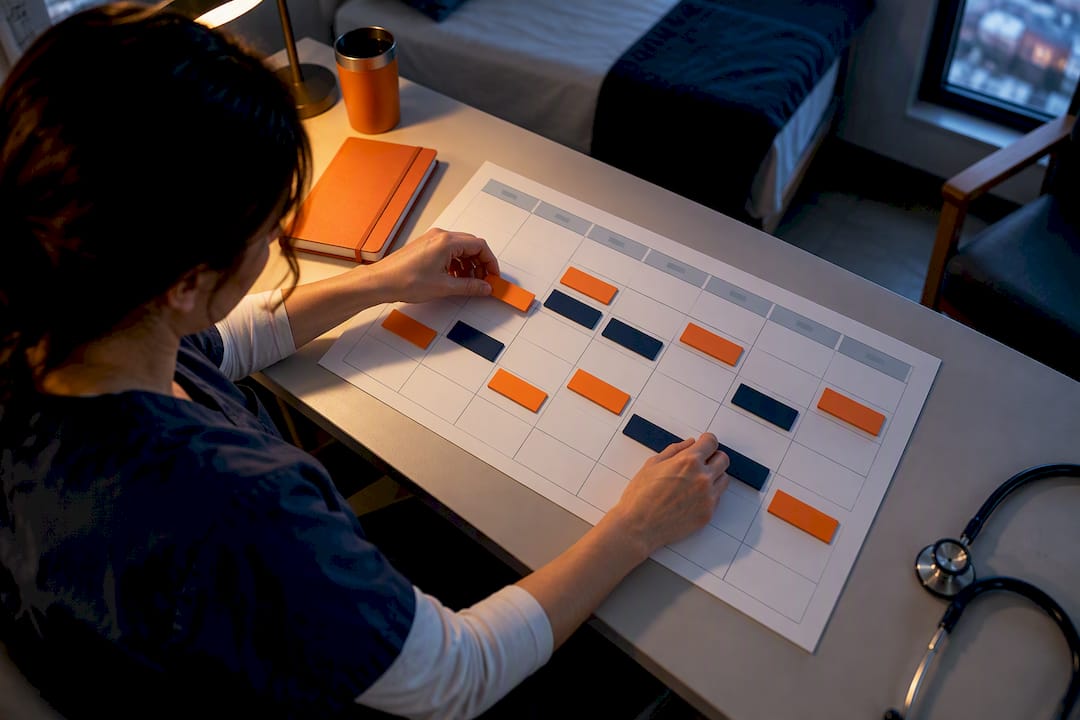
Aim for 1.5 to 3 hours of focused study on a normal clinical day, 30 to 90 minutes on a heavy or long-call day, and 3 to 6 hours broken into blocks on days off. The single best move you can make is questions first: run a short block of USMLE-style questions, review every miss immediately, then push weak points into spaced repetition tied to patients you actually saw that day.
TL;DR:
- Study for 1.5 to 3 hours on regular days and 3 to 6 hours on off days, focusing on active question practice linked to recent patients.
- Prioritize question review and immediate mistake correction over lengthy sessions, ensuring consistent daily blocks for better long-term retention.
- Tailor study hours and content focus based on rotation type, emphasizing high-yield topics your specific clerkship curriculum stresses most.
- Incorporate targeted practice by uploading lecture notes into question generators and converting missed questions into flashcards to optimize study efficiency.
- Protect sleep, schedule flexible study blocks around your energy levels, and treat clinical encounters as learning opportunities to integrate patient care into your study routine.
Table of Contents
- What a Realistic Study Plan for Rotations Actually Looks Like
- Adjusting Your Study Plan for Each Core Rotation
- The Study Habits That Return the Most Learning Per Minute
- The Shelf Ramp: Your Last 7 to 21 Days
- An Applied Workflow: How Targeted Practice Changed One Student's Numbers
- Protecting Sleep So You Don't Burn Out Mid-Rotation
- Fitting Study Time Around Clinical Duties Instead of Fighting Them
- When Your Schedule Falls Apart, Here's How to Recover
- Getting the Most Out of Group Study and Peer Discussion
- Beyond Anki: Other Tools Worth Building Into Your Routine
- How to Prioritize Topics When Every Rotation Tests Something Different
- Author Perspective: Three Behaviors That Matter Most to Attendings and Evaluators
- Turn Your Lecture Notes Into a Study Plan That Actually Matches Your Exams
- Sources
- FAQ
What a Realistic Study Plan for Rotations Actually Looks Like
Most students overcorrect in one of two directions on rotations. They either try to replicate their dedicated-study-period schedule inside a 12-hour clinical day, which is a fast route to exhaustion, or they abandon structured practice entirely and hope osmosis from rounds will carry them through the shelf. Neither works. The research on realistic study hours for MS3s settles on a middle path: short, protected blocks on clinical days, longer blocks on off days, and a hard floor of 60 to 90 minutes daily that almost never gets skipped.
That floor matters more than any single marathon session. Protecting a consistent daily block, even a modest one, beats occasional cramming for long-term retention, because spaced exposure to material sticks in a way that a six-hour Sunday binge does not.
Here's a template you can drop straight into Google Calendar this week.
The non-negotiable daily study block (about an hour):
- Several minutes of Anki or spaced-review flashcards.
- A focused set of timed practice questions on rotation-relevant topics.
- Time reviewing misses, tagging concepts, and converting them into flashcards.
Between patients, in elevators, during a slow afternoon clinic, you have 15 to 30 minute pockets that most students waste on their phones. Use them for a single Anki deck review or to look up one thing tied to the patient you just saw. This isn't extra studying bolted onto your day. It's studying that happens inside the day you already have.
Normal week template:
- Monday to Friday: one 60 to 90 minute evening block (questions + review), plus two or three 15 minute Anki pockets during downtime.
- Saturday: 3 to 4 hours, split into two sessions, focused on the week's weak topics.
- Sunday: 2 to 3 hours, lighter, mostly spaced review and light reading tied to next week's rotation.
Heavy-call week template:
- Call days: 30 to 90 minutes total, often just Anki and a handful of questions, done whenever you have a window, even at 11 p.m.
- Post-call day: skip the marathon session; do the bare 30 minute floor and sleep.
- One off day that week: extend to 4 to 5 hours to make up ground.
| Day type | Focused study target | Primary activity |
|---|---|---|
| Normal clinical day | 1.5 to 3 hours | Questions + immediate review |
| Heavy/long-call day | 30 to 90 minutes | Anki + minimal questions |
| Off day/weekend | 3 to 6 hours (blocked) | Weak-topic questions, NBME-style review |
Adjusting Your Study Plan for Each Core Rotation
The base template holds across clerkships, but the hour ranges and the resources you lean on shift with each rotation's rhythm.
- Internal Medicine: Aim for 2 to 3 hours on typical days since IM has the heaviest shelf and the broadest content. Favor long clinical vignette questions over isolated facts. Off days should run 4 to 6 hours, split between question blocks and reading tied to your actual patients.
- Surgery: Weekday study hours during surgery may be shorter because of early rounds and operating room time. Use a consistent evening study block. Focus on anatomy-based questions and management algorithms. Post-call days require minimal study time.
- Pediatrics: 1.5 to 2.5 hours on weekdays works well. Prioritize vaccine schedules, developmental milestones, and growth chart interpretation, since these show up disproportionately on the shelf relative to how often they come up on rounds.
- OB/GYN: Weekday targets run 1.5 to 2.5 hours, but labor and delivery call makes timing unpredictable. Build flexibility into your block, doing it right after morning rounds if you know you're on call that night. Focus on labor and delivery flow, common obstetric complications, and gynecologic oncology basics. A lecture-mapped approach to the OB/GYN shelf can help you triage which of these topics your specific course actually tests.
- Psychiatry: This rotation typically allows more predictable hours, so 2 to 3 hours on weekdays is realistic. Lean into diagnostic criteria questions and psychopharmacology, since the shelf rewards precision on drug classes and side effect profiles more than clinical intuition alone.
- Family Medicine: Clinic schedules vary block to block, so treat this rotation like a flexible 1.5 to 2.5 hour weekday target. Cast a wide net across specialties since Family Medicine shelves pull from IM, Peds, and OB/GYN content you may have already studied.
Across every rotation, the tactic that saves the most time is matching your question bank practice to what your clerkship director actually tested last year rather than grinding generic content in the order a question bank presents it.
The Study Habits That Return the Most Learning Per Minute
Not all study time pays the same return. A passive hour of rereading a review book is nowhere close to an active hour of question practice, and the evidence on effective clinical study workflows is consistent on this point: application beats passive review, especially when it's tied to a real patient.
Here's how to run your daily block so every minute counts:
- Set a hard timer for your question set. Thirty to fifty minutes, no pausing to look things up mid-question. Answer as if it's the real exam.
- Review every single miss the same day, not tomorrow. For each one, ask what you actually didn't know versus what you misread under time pressure. Those are different fixes.
- Tag the concept, not just the question. If you missed a question on hyponatremia workup, tag "hyponatremia," not "question 14."
- Convert the miss into an Anki card within the same session. Waiting until later means you'll never do it.
When using Anki during rotations, organize decks by rotation, reduce new cards on heavy-call days to avoid overload, use filtered decks before exams to focus on weak areas, and keep new daily cards to a manageable number to maintain retention when tired.
The highest-yield habit of all might be the one most students skip: turning a single patient into a study asset. Pick one patient you saw that day, identify one or two differentials you didn't fully nail, one diagnostic test worth reviewing, and one management point you're unsure about. Spend 10 to 20 minutes turning that into two or three questions and a flashcard. This single habit does more for retention than an extra hour of generic reading, because your brain already has a real face and a real chart attached to the concept.
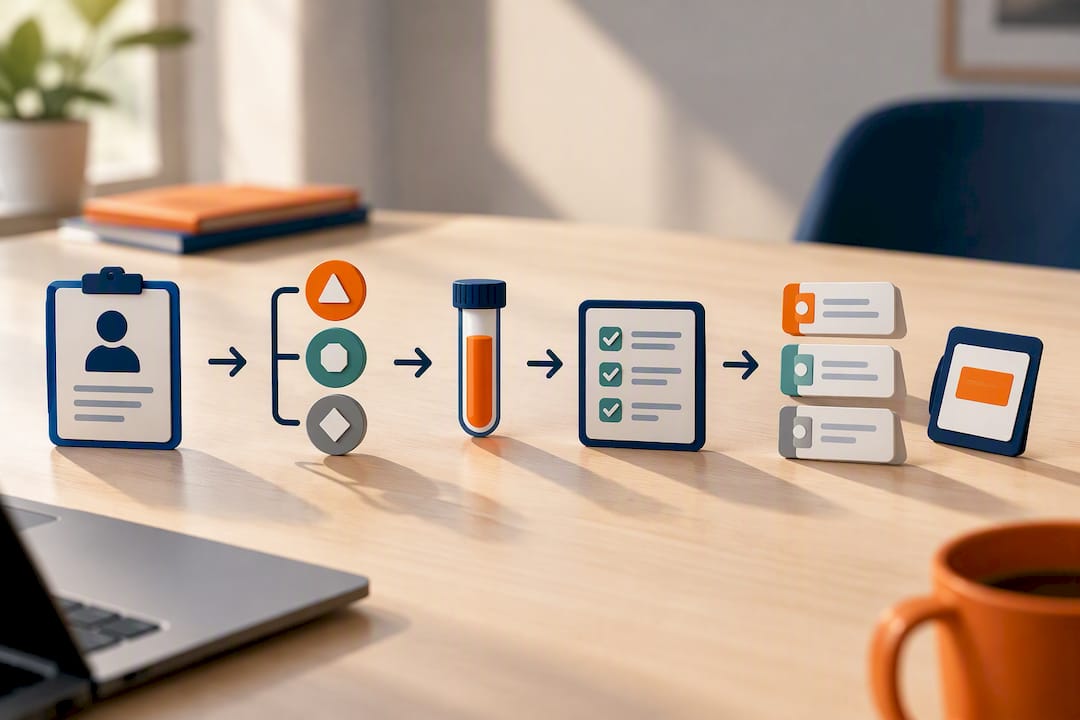
Pro Tip: Keep a running note on your phone titled "today's patient lesson." Even on your worst call day, jot one line. By the end of the rotation, you'll have a built-in review sheet written in your own words.
The Shelf Ramp: Your Last 7 to 21 Days
Shelf prep isn't about studying more. It's about studying more precisely, with a clear countdown that tells you exactly what to prioritize each week.
Around 21 days out, take a baseline NBME practice exam if you haven't already. This tells you where you stand and which organ systems or content areas need the most attention. The recommendation on NBME timing calls for at least one full-length practice exam within 7 to 10 days of the actual shelf, close enough to calibrate your pace and stamina, far enough out that you can still act on what you find.
In the two to three weeks before the exam, bump your weekday target modestly, maybe 30 minutes more than your normal rotation load, and load your off days heavier, 5 to 6 hours instead of 3 to 4. The extra time goes almost entirely into NBME-style questions and fixing whatever your practice exam exposed, not new content.
Pre-shelf checklist for the final week:
- Take your calibration NBME 7 to 10 days out and spend a full session reviewing every wrong answer, not just skimming the score report.
- Identify your two or three weakest tagged topics and run a filtered Anki deck plus a targeted question set on those alone.
- Protect sleep in the final 48 hours; a rested brain outperforms a crammed one on test day.
- Confirm exam logistics (location, ID, timing, any accommodations) at least two days ahead so exam morning has zero surprises.
- Do a mental run-through of exam-day timing: when you'll eat, when you'll leave, how you'll pace the blocks.
Skip generic full-content review in this window. If a topic wasn't flagged by your NBME or your own question performance, it's not worth your remaining hours.
An Applied Workflow: How Targeted Practice Changed One Student's Numbers
The gap between studying more and studying the right material shows up clearly in one internal case. A BoardMaster student named Sarah moved from the 73rd percentile to the 92nd percentile while cutting her study hours roughly in half, by uploading her actual lecture notes and generating questions built around what her specific professors emphasized rather than working through a generic bank in sequence.
That result lines up with a broader pattern: mapping lecture emphasis to practice questions cuts wasted study time because it removes the guesswork of which topics your specific course, not a generic syllabus, actually tests.
A reproducible version of the workflow looks like this:
- Upload a lecture's notes or slides into a question generator built for that purpose.
- Generate a targeted question set built around what that lecture actually emphasized, not a generic organ-system chapter.
- Schedule a daily micro-block, 20 to 30 minutes, to run that set the same day or the next.
- Convert every missed question into a flashcard the same session, feeding it into spaced review rather than letting it disappear into a notebook you'll never reopen.
Three numbers are worth tracking as you run this: daily questions completed, retention rate on spaced cards after a week, and your NBME practice trend over the rotation. If questions completed stays flat while your NBME trend climbs, your targeting is working. If both stall, the content mix, not your effort, is probably the problem.
Protecting Sleep So You Don't Burn Out Mid-Rotation
Sleep debt compounds faster on rotations than almost any other kind of debt you'll carry as a student. Aim for a floor of six hours on most nights, and treat five hours as an emergency measure, not a routine. Dropping below that for more than a night or two measurably hurts your ability to retain anything from the questions you're grinding through, which makes the lost sleep a worse trade than the lost study time.
Build in bare-minimum days on purpose, not as a failure state. After a 28-hour call or a brutal week, give yourself explicit permission to do nothing but the 15 to 20 minute Anki floor and go to sleep. Trying to force a full question block on zero sleep produces low-quality studying that you'll likely have to redo anyway once you're rested.
Watch for the early signs of burnout specific to rotations: dreading patient encounters you used to find interesting, snapping at teammates over minor things, or noticing your question accuracy drop even when you're putting in the same hours. Any one of those is a signal to scale back intensity for a few days, not push harder. The goal across an entire rotation is sustainable output, not a single heroic week that leaves you unable to function for the next two.
One underused fix: align your non-negotiable study block with your actual energy, not an idealized schedule. If mornings are when you're sharpest, do your block before your shift starts rather than forcing it into an exhausted 10 p.m. slot. Matching study timing to your circadian rhythm, especially on surgery or heavy-call rotations, makes the same 60 minutes noticeably more productive.
Fitting Study Time Around Clinical Duties Instead of Fighting Them
The instinct to treat clinical duties and study time as competitors is the wrong frame. Clinical rotations exist to move you from theory into hands-on patient care, and evaluations during this period are often subjective, built as much on how engaged you seem on the floor as on any test score.
Treat every patient encounter as raw material for later study rather than a distraction from it. When you see a patient with a condition you're shaky on, jot a one-line note (diagnosis, key finding, question mark on management) and turn it into your evening's question set. This does double duty: it makes you sharper on rounds today and gives you higher-yield material tonight than a random chapter would.
The practical mechanics matter too. Keep a phone-based Anki deck synced so a five-minute wait between patients becomes review time instead of scroll time. Ask your resident, when appropriate, if you can step away for 10 minutes during a genuinely slow stretch to knock out a quick question set. Most residents respect a student who's honest about needing to study over one who disappears without explanation.
The rotations where students burn out fastest are usually the ones where they mentally split their day into "work mode" and "study mode" and resent the transition between them every single time. Collapsing that split, treating patient care as the source of your study material rather than the obstacle to it, removes most of that friction.
When Your Schedule Falls Apart, Here's How to Recover
Rotations do not respect study plans. A code blue eats your lunch block, a resident asks you to stay late, or an add-on OB delivery blows up your evening. The fix is not a better plan; it's a plan that already assumes disruption.
Build your weekly template with one deliberate buffer day, a day with lighter clinical demands where you intentionally under-schedule, so a bad Tuesday can borrow from Thursday's slack without collapsing your whole week. If you don't have an obviously lighter day, treat your weekend block as that buffer by default.
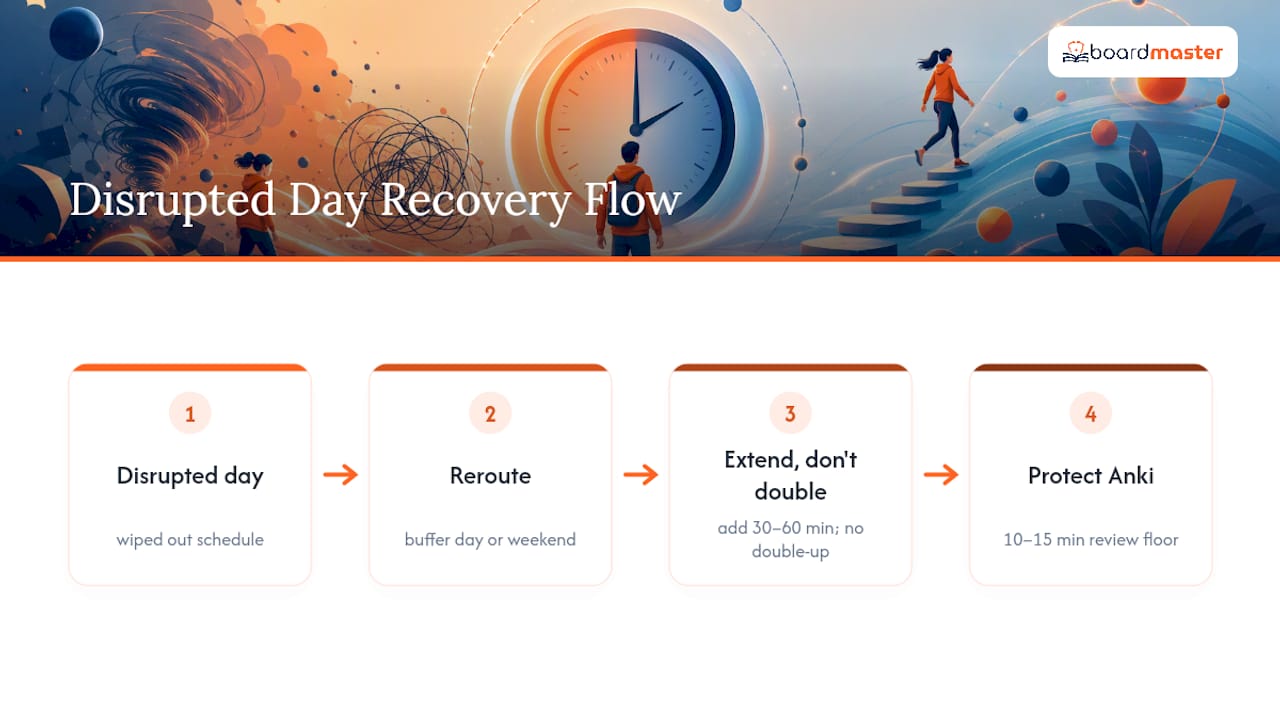
When a single day gets wiped out entirely, resist the urge to double up the next day to "catch up." That usually produces two mediocre study sessions instead of one good one. Instead, drop that day's questions entirely and simply extend your next off-day block by 30 to 60 minutes. The math works out close to even, and you avoid the burnout spiral of chronically playing catch-up.
Keep your Anki queue as the one thing that survives chaos. Even on the day everything falls apart, the 10 to 15 minute review floor is almost always still possible, whether that's in a stairwell or the last five minutes before you fall asleep. Protecting that one small habit, even when the rest of the day is unsalvageable, keeps your spaced repetition schedule from collapsing along with everything else.
Getting the Most Out of Group Study and Peer Discussion
Group study on rotations works best when it's short, structured, and tied to real cases rather than an open-ended review session that drifts into complaining about the attending. The most useful format is a 20 to 30 minute post-rounds huddle where two or three students each present one case from that day and the group works through the differential and management together out loud.
This kind of case-based discussion mirrors how attendings actually question you on rounds, which makes it better preparation for oral pimping than silent flashcard review. It also surfaces gaps fast. If you can't explain your reasoning to a peer in plain language, you've found a weak spot before the shelf does.
Avoid the trap of turning group study into a marathon reading session where everyone takes turns reading slides aloud. That format wastes everyone's limited time. Instead, assign each person a narrow topic before you meet (one person covers a drug class, another covers a lab interpretation pattern) and have them teach it in under five minutes. Teaching a concept exposes whether you actually understand it or just recognize it.
Peer discussion also works well for triaging what to study next. If three people in your group all missed the same tag on their last question set, that's a strong signal the whole cohort should push more time toward it before the exam.
Beyond Anki: Other Tools Worth Building Into Your Routine
Anki dominates spaced repetition, but it's not the only tool worth a slot in your daily rotation. Question banks remain the backbone of active recall, and a dedicated QBank with physician-written board-style questions gives you volume and clinical-vignette practice that flashcards alone can't replicate.
Clinical skills need their own practice format, since reading about a physical exam maneuver is not the same as performing one under pressure. Structured OSCE practice sessions let you rehearse history-taking and exam technique in short bursts, which matters most on rotations like Family Medicine and Pediatrics where clinical skills exams carry real weight.
For the commute or the gym, audio-based review fills dead time that would otherwise go to waste; a lecture-based study podcast turns a 20 minute drive into a passive review pass on that week's high-yield topics. And when you hit a concept mid-shift that you can't fully explain to yourself, an AI study assistant that gives an instant, plain-language explanation beats stopping to dig through a textbook you don't have time to open.
How to Prioritize Topics When Every Rotation Tests Something Different
Not every topic on a shelf carries equal weight, and studying them as if they do wastes your limited hours. The fastest way to prioritize is to look at what your own course has emphasized in lecture, since shelf exams at most schools track reasonably closely with the material your specific faculty chose to teach in depth.
Within that, lean toward common conditions over rare ones. Shelf exams reward recognizing classic presentations of common diseases far more often than they test zebra diagnoses, even though zebras are more memorable on rounds. If you're deciding between reviewing one more page on a rare vasculitis or running 10 more questions on community-acquired pneumonia, the pneumonia questions are almost always the better use of your remaining 20 minutes.
Use your own question bank performance as a live weighting system. If you're consistently missing questions tagged to a particular organ system or mechanism, that system deserves more of your next few study blocks than a system where you're already scoring well. This turns your practice data into a personalized high-yield list, often a more accurate one than a generic "high-yield topics" list built for the average test taker rather than for you specifically.
Author Perspective: Three Behaviors That Matter Most to Attendings and Evaluators
The gap between a strong evaluation and an average one rarely comes down to who knew more pathophysiology. It comes down to a handful of visible behaviors that most students underrate while they're heads-down in a question bank.
Walking into pre-rounds with a clean one-minute summary of your patient, overnight events, vitals trend, assessment, plan, signals more competence to an attending than almost anything else you'll do that week. Practice compressing a chart into 60 seconds; it's a skill, and most students never deliberately train it.
Notes matter more than students think. A concise, accurate note that another provider can act on without calling you for clarification builds trust fast. Follow through on the small tasks you're given (checking a lab, calling a consult back) without being reminded twice.
The best use of your study time isn't hiding from the team to cram. It's using what you study to ask a sharper question on rounds or catch something on your differential the team missed. That visible connection between study and patient care is what actually shapes how attendings rate you.
— Dr. Ahmed Abuzoor
Turn Your Lecture Notes Into a Study Plan That Actually Matches Your Exams
BoardMaster is built around the exact problem this article has been solving: studying broad, generic content when your actual exam only rewards what your specific professors emphasized. Instead of grinding through a question bank in a fixed order, you upload your lecture notes and get a question set built around what your course actually tested, which is how a student like Sarah cut her study hours while climbing from the 73rd to the 92nd percentile.

The platform covers the full workflow described above in one place: an AI question generator that maps directly to your lectures, flashcards with spaced repetition for the misses you rack up, a QBank of physician-written board questions for broader shelf and board coverage, and OSCE practice for clinical skills reps between patients. A free tier lets you try the core workflow before committing to a plan, and the MONTHLY plan runs $39.99 per month if you want ongoing access across every rotation.
Start small tonight: upload one lecture, generate one question set, and run a single 60-minute block using the method above. That one session will tell you more about where your gaps actually are than another week of generic review ever could.
Sources
For deeper detail on the hour targets and rotation templates referenced throughout this piece, see ResidencyAdvisor's guidance on realistic MS3 study hours. For broader clinical prep and evaluation context, read Osmosis's guide to thriving in clinical rotations and the AMA's basics on starting clinical rotations. For lecture-mapping specifics, see BoardMaster's OB/GYN shelf resource guide and its lean study workflow guide.
- How Many Hours a Day Should MS3s Realistically Study on Rotations?
- The Osmosis Ultimate Guide to Thriving in Clinical Rotations
FAQ
What is the hardest rotation in med school?
Most students rank Internal Medicine or Surgery as the hardest, largely because IM carries the broadest shelf content and Surgery combines long physical hours with early rounds and OR time that squeeze study windows tight. Difficulty also depends on your own strengths; a student who thinks well on their feet may find Surgery's pace easier than IM's dense content load.
What is bird dogging in surgery?
Bird dogging refers to a student closely shadowing a specific attending or resident throughout the day, following their patients and cases rather than being assigned a broader rotation schedule. It's most common in surgical subspecialties where operative caseloads and continuity with one surgeon matter more than rotating through a general service.
Do medical students on rotation get paid?
No, core clinical rotations during medical school are unpaid, since they're part of the required curriculum rather than employment. Some away rotations or specific elective programs occasionally offer a small stipend for housing or travel, but this varies widely by school and rotation site.
What is the hardest year in med school?
Third year is widely considered the hardest because it combines the physical demands of full clinical days with shelf exams and, often, early board exam prep layered on top. A protected daily study block of 60 to 90 minutes, paired with question practice tied to your actual patients, is what makes that year manageable rather than overwhelming.