
TL;DR:
- Question exposure through repeated practice improves board exam success more effectively than total study hours. Active recall, immediate feedback, spaced repetition, and timed practice build memory, reasoning skills, and pacing for exams. Using focused, chapter-based question sets aligned with core content enhances learning and performance.
Question exposure is defined as the deliberate, repeated practice of answering board-style questions as a primary study method. Medical education research positions it as a stronger predictor of board exam success than total study hours. Organizations like USMLE and NBME design exams that reward rapid, accurate recall, and that skill builds through practice, not passive reading. Students who understand the role of question exposure in board prep gain a concrete advantage: they train the exact cognitive process the exam tests.
How does question exposure improve learning and exam performance?
Active recall is the mechanism behind question exposure's power. When you retrieve an answer from memory, you strengthen the neural pathway to that fact. Practice testing outperforms restudying with an effect size of g = 0.67 in classroom settings. That number means the gap between students who test themselves and those who reread is large and consistent.

Immediate feedback closes reasoning errors before they calcify. Reviewing an explanation after a wrong answer teaches you why the distractor was tempting, not just why the correct answer is right. Rapid feedback helps students learn the logic behind distractors, which is the exact skill boards test. Without that feedback loop, students repeat the same reasoning mistakes across hundreds of questions.
Spaced repetition multiplies the benefit further. A meta-analysis of 21,000 learners shows a large effect size (SMD = 0.78) favoring spaced repetition over massed study. Returning to the same topic across multiple sessions, rather than in one marathon block, produces memory that holds under exam pressure.
Timed practice adds a fourth layer. Students who practice under timed conditions adjust better to the approximately 90-second-per-question constraint of real board exams. Pacing is a skill. It degrades without practice and improves with it.
- Active recall strengthens memory retrieval far beyond passive review
- Immediate explanation review corrects faulty reasoning patterns
- Spaced question practice builds durable, long-term retention
- Timed sets train the pacing fluency boards demand
- Volume matters: 2,000+ practice questions consistently predicts superior board performance
Pro Tip: Review every wrong answer's explanation before moving to the next question block. Skipping explanations to hit a higher question count is the most common and costly mistake in board prep.
What question types and schedules maximize board prep benefits?
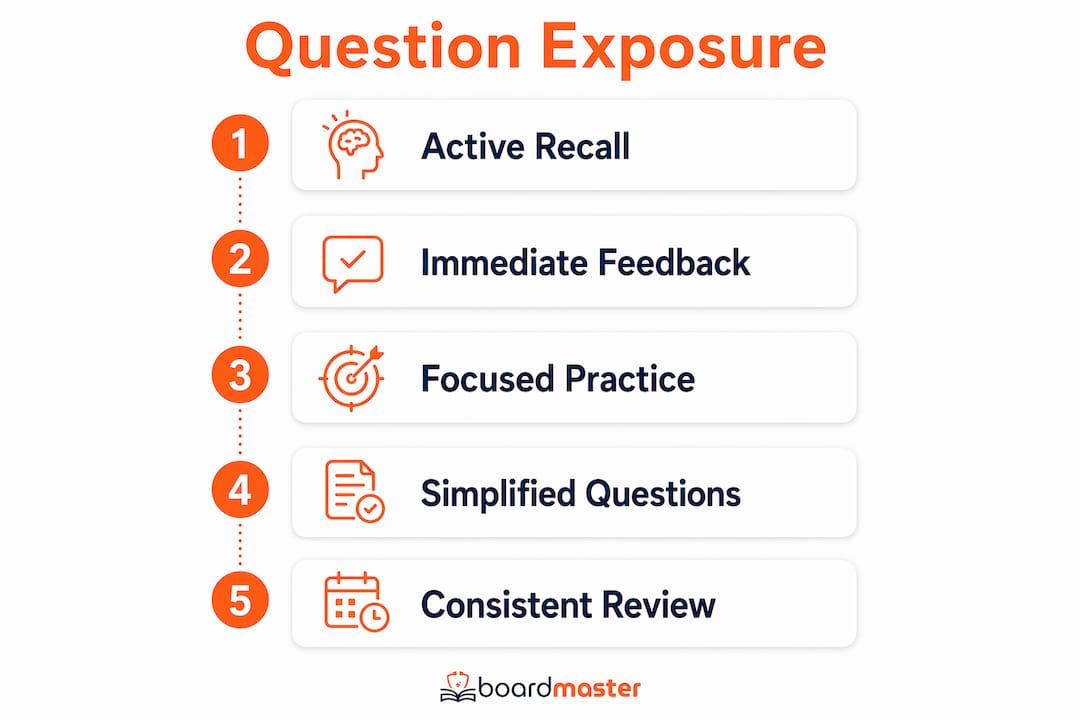
Structure beats volume every time. Answering questions chapter by chapter improves exam scores by about 2 percentage points, moving students from the 25th percentile range to meaningfully higher ground. Two percentage points sounds small. On a board exam, it can shift a borderline pass to a comfortable one, or move a student from the 50th to a higher percentile band.
The most effective question schedules follow a clear progression:
- Start with focused, single-topic sets. Bite-sized sessions of 5–10 questions on one topic build retention without cognitive overload. This approach is more efficient than random 40-question blocks pulled from every system at once.
- Sequence difficulty deliberately. Begin each new topic with straightforward questions to confirm baseline understanding. Introduce harder, clinically integrated questions once you can answer the basics without hesitation.
- Add timed blocks as exam day approaches. Simulate real exam conditions with 40-question timed sets in the final four to six weeks. This trains both accuracy and pacing simultaneously.
- Schedule delayed review of missed questions. Return to flagged questions 48–72 hours after the initial attempt. This spacing forces genuine retrieval rather than short-term recognition.
- Practice daily, not in weekend marathons. Consistent daily exposure beats cramming. The spaced repetition effect requires time between sessions to consolidate memory.
Segmenting practice into focused, repeatable units around specific learning objectives achieves deeper retention than untargeted bulk completion. The goal is not to finish a question bank. The goal is to change what you know.
Pro Tip: Set a daily minimum of 20–30 carefully reviewed questions rather than a raw count of 100 rushed ones. Depth of review per question predicts score improvement more reliably than total questions answered.
Why does complex questioning hurt multiple-choice board scores?
This finding surprises most medical students. Complex, exploratory questioning benefits creative projects but negatively impacts standardized multiple-choice exam performance. Students who habitually ask open-ended, multi-layered questions perform better on essays and research projects. They perform worse on boards.
The reason is cognitive mode. Board exams require rapid convergence on one correct answer. Complex questioning trains divergent thinking, which generates multiple plausible interpretations. On a multiple-choice question, that habit becomes a liability. You talk yourself out of the right answer by generating reasons every option could be correct.
| Questioning style | Best suited for | Effect on board scores |
|---|---|---|
| Convergent (single correct answer) | Multiple-choice board exams | Positive |
| Divergent (exploratory, open-ended) | Research, creative projects | Negative |
| Complex, multi-layered | Case analysis, essays | Neutral to negative |
Early complex questioning before foundational knowledge is solid compounds the problem. A student who has not yet mastered basic pathophysiology cannot benefit from asking "why does this mechanism exist?" They need to first answer "what does this mechanism do?" Align your question practice style to the exam format you are preparing for, not the format that feels intellectually satisfying.
The practical takeaway is direct: during board prep, practice closing down options, not opening them up. Train yourself to identify the single best answer quickly and move on.
How can medical students implement effective question exposure today?
The gap between knowing this research and acting on it is where most students lose ground. These steps close that gap.
- Use physician-written, board-aligned questions. Generic question banks built for general test prep do not reflect USMLE or COMLEX clinical reasoning patterns. The quality of your question bank directly determines the quality of your preparation.
- Track weak areas systematically. After every session, note which topics produced the most wrong answers. Build your next session's question set around those topics. Reviewing your strengths feels productive but does not move your score.
- Incorporate mixed, timed blocks in the final stretch. Random mixed sets simulate the unpredictability of the real exam. They prevent the false confidence that comes from topic-specific drilling alone.
- Use custom question sets tied to your lectures. Generic banks cover broad content. Your professor's lectures signal what will actually appear on your course and shelf exams. Questions built from your own notes close the gap between class performance and board performance.
- Review practice test performance data after every session. Patterns in your errors reveal reasoning habits, not just knowledge gaps. A student who consistently misses questions about drug mechanisms has a different problem than one who misses questions about clinical presentations.
BoardMaster addresses the custom question gap directly. The platform generates USMLE-style questions from uploaded lecture notes, targeting the concepts your professors emphasize. A student named Sarah moved from the 73rd to the 92nd percentile while cutting her study hours in half by using BoardMaster's targeted question sets. That result reflects what the research predicts: focused, relevant question exposure outperforms generic high-volume study.
Pro Tip: Upload your lecture slides to BoardMaster at the start of each unit, not the week before the exam. Building question exposure throughout the course means you arrive at board prep with the foundation already in place.
Key Takeaways
Consistent, focused question exposure predicts board exam success more reliably than total study hours, because it trains active recall, corrects reasoning errors, and builds the pacing fluency that boards demand.
| Point | Details |
|---|---|
| Volume with review beats volume alone | Completing 2,000+ questions with explanation review predicts superior board performance. |
| Structure your question schedule | Chapter-by-chapter practice improves scores by about 2 percentage points over random sets. |
| Match questioning style to exam format | Convergent, single-answer practice outperforms open-ended questioning for multiple-choice boards. |
| Bite-sized daily sets beat cramming | Sessions of 5–10 focused questions build retention and reduce burnout more than large random blocks. |
| Custom questions close the course-to-board gap | Questions built from your lectures target high-yield content your professor signals, not just broad content. |
What I've learned about question exposure after years of watching students prepare
The students who improve the most are not the ones who study the longest. They are the ones who treat every question as a diagnostic tool, not a test of whether they already know the answer.
The most common mistake I see is treating a wrong answer as a failure. A wrong answer with a fully reviewed explanation is the most efficient learning event in board prep. It tells you exactly where your reasoning broke down and gives you a corrected model to replace it. Students who skip explanations to hit a higher question count are trading the most valuable part of the process for a number that does not predict their score.
The second mistake is starting with complex, integrative questions before the foundation is solid. Students who try to reason through advanced clinical vignettes before they can recall basic mechanisms spend most of their time confused rather than learning. Build the foundation with focused, single-topic sets first. Mixed and timed sets come later, when you have something to integrate.
Consistency matters more than intensity. Thirty focused questions reviewed carefully every day for three months produces better results than 200 rushed questions the week before the exam. The spaced repetition effect is real, and it requires time to work. You cannot compress it.
Finally, align your question source to your actual exam. If your shelf exam reflects your professor's lectures, generic board questions are only partially useful. Questions built from your own course material are the most efficient preparation you can do for both class and board exams simultaneously.
— Dr. Ahmed Abuzoor
BoardMaster's question tools for focused board prep
Medical students who want to put these strategies into practice immediately have a direct path forward with BoardMaster.
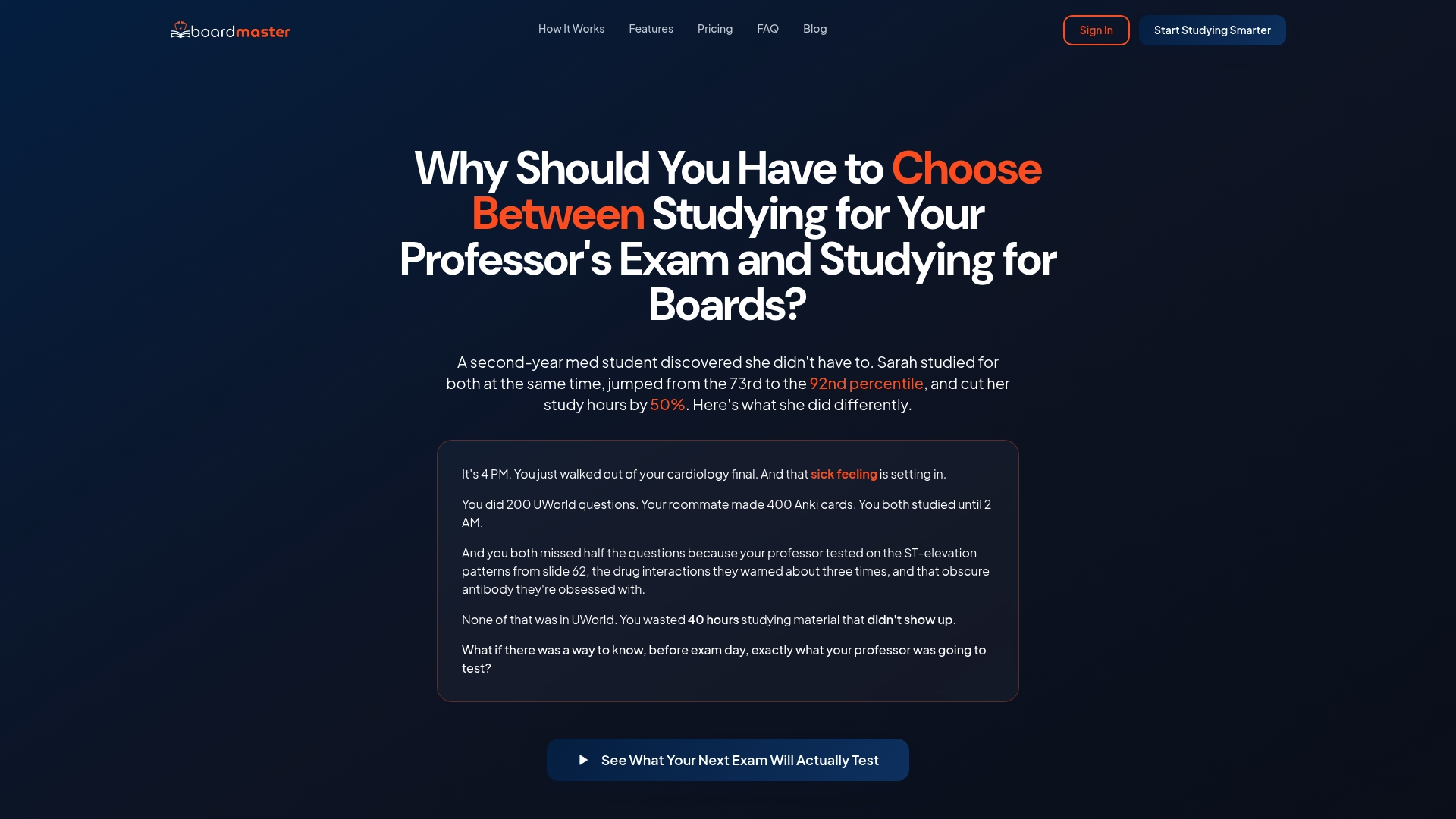
BoardMaster's physician-written question bank gives you access to 5,000+ board-aligned questions built for USMLE and COMLEX preparation. Every question includes detailed explanations designed to correct reasoning, not just confirm right answers. The AI question generator takes your uploaded lecture notes and produces custom USMLE-style questions tied to what your professor actually teaches. That means your daily question practice prepares you for class exams and board exams at the same time. See how BoardMaster's AI-powered prep tools work before committing to a full study plan.
FAQ
How many practice questions should I complete before boards?
Completing at least 2,000 practice questions is a stronger predictor of superior board performance than total study hours. Quality of review per question matters as much as volume.
Does question order affect board prep outcomes?
Answering questions chapter by chapter, rather than randomly, improves exam scores by about 2 percentage points. Structured sequencing targets learning objectives more precisely than random mixed sets early in prep.
Why do timed practice questions improve board scores?
Practicing under timed conditions trains students to work within the approximately 90-second-per-question constraint of real board exams. Pacing is a learnable skill that degrades without deliberate practice.
Can complex questioning hurt my board exam performance?
Research shows that complex, exploratory questioning improves creative project scores but negatively impacts multiple-choice exam performance. Board prep requires convergent thinking, not divergent reasoning.
How does BoardMaster differ from a standard question bank?
BoardMaster generates USMLE-style questions directly from your uploaded lecture notes, targeting the concepts your professors emphasize. Standard question banks cover broad content without aligning to your specific course or professor's focus areas.