
A USMLE question stem is defined as the clinical vignette plus the lead-in question that together test your ability to apply medical knowledge to a patient scenario. Every question on USMLE Step 1 and Step 2 CK follows this format, and your ability to dissect it quickly and accurately separates high scorers from average ones. This guide covers what is USMLE question stem breakdown in full, from the anatomy of a stem to a five-step analysis method you can use on every question. Tools like UWorld and Boardmaster are built around this format, and understanding it is the foundation of any serious USMLE question strategy.
What is USMLE question stem breakdown?
A USMLE question stem breakdown is the systematic process of identifying and interpreting each functional component of a clinical vignette question to extract the information needed to answer correctly. The term "question stem" is the recognized exam vocabulary for the full question unit, which includes the clinical scenario and the lead-in. Breaking it down means reading with purpose rather than reading passively.
USMLE Step 1 contains 280 questions divided into 7 blocks of 40 questions each, with 60 minutes per block. That gives you roughly 90 seconds per question, which means a slow or unfocused reading approach will cost you points before you even consider the answer choices.

The clinical vignette is the patient story. It presents demographics, history, physical exam findings, and lab data in a dense paragraph format. The lead-in is the final sentence: "What is the most likely diagnosis?" or "What is the next best step in management?" Every word in the vignette is placed there to either support the correct answer or distract you. USMLE question stem analysis is the skill of telling those two categories apart in under two minutes.
What are the components of a USMLE question stem?
Understanding USMLE stems starts with recognizing their consistent internal structure. Every stem contains the same building blocks, and once you can identify them on sight, your reading speed and accuracy both improve.
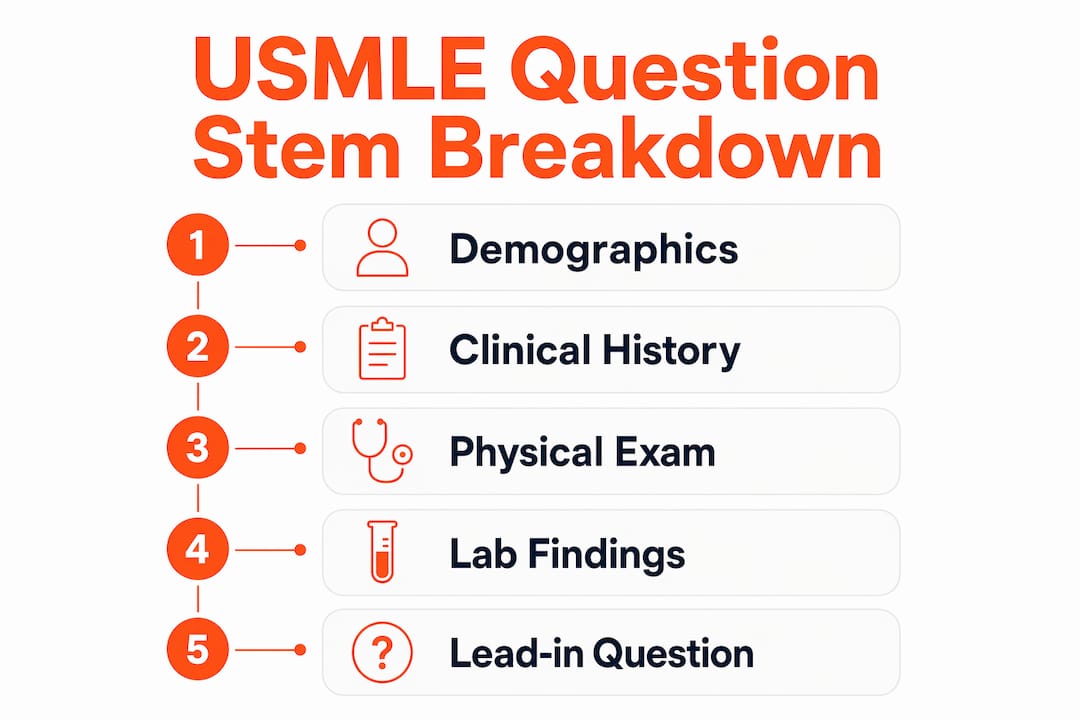
The clinical vignette is the core narrative. It typically opens with patient demographics, moves through the chief complaint and history of present illness, then presents physical exam findings and relevant lab or imaging results. Each of these layers carries diagnostic weight.
The lead-in question is always the final sentence. It specifies the cognitive task: diagnose, explain the mechanism, choose the next step, or select the best treatment. The lead-in determines which parts of the vignette matter most.
Common question types include:
- Diagnosis questions: "What is the most likely diagnosis?"
- Next best step questions: "What is the most appropriate next step in management?"
- Mechanism questions: "What is the underlying pathophysiologic mechanism?"
- Treatment questions: "Which medication is most appropriate?"
- Prognosis or complication questions: "Which complication is this patient at greatest risk for?"
Patient demographics like age, sex, and ethnicity are key diagnostic clues embedded at the start of the vignette. A 65-year-old male with weight loss and painless jaundice points you in a completely different direction than a 25-year-old female with the same jaundice. Demographics narrow your differential before you finish the first sentence.
Pro Tip: Read the physical exam and lab findings with your differential already forming. By the time you reach the lead-in, you should have a working hypothesis, not a blank slate.
How to break down USMLE question stems in 5 steps
A structured approach to how to break down USMLE questions removes guesswork and builds the kind of pattern recognition that high scorers use to read vignettes efficiently. Here is the method, step by step.
Read the lead-in first. Reading the last sentence first tells you exactly what the question is asking before you process a single detail of the vignette. If the question asks for a mechanism, you read for pathophysiology. If it asks for the next step, you read for clinical status and urgency. This single habit changes how you filter every word that follows.
Identify patient demographics immediately. Return to the first line and extract age, sex, and any stated ethnicity or occupation. A 45-year-old African American male with hypertension and a new headache is not the same clinical picture as a 45-year-old white female with the same complaint. Demographics activate the right diagnostic framework before you read further.
Hunt for buzzword clusters. Buzzword clusters in vignettes point to a likely diagnosis through pattern recognition. Painless jaundice plus a palpable gallbladder equals Courvoisier sign and pancreatic cancer. Malar rash plus joint pain plus renal involvement equals systemic lupus erythematosus. Train yourself to spot these clusters rather than reading every sentence with equal weight.
Form your answer before looking at the choices. Formulating your hypothesis before reviewing options reduces susceptibility to distractors. The USMLE writes answer choices that are designed to be plausible. If you arrive at the options without a working answer, the distractors will pull you off course. Commit to a hypothesis first, then confirm it against the choices.
Eliminate with confidence. Typically 2 to 3 options can be eliminated quickly using basic science knowledge. Elimination is not guessing. It is the application of what you know to rule out what cannot be correct, which narrows a five-option question to a two-option decision.
Pro Tip: The USMLE places distractors that are correct in a different clinical context. A treatment that works for one condition will appear as a wrong answer for a similar condition. Ask yourself not just "is this true?" but "is this true for this patient right now?"
How question type changes your reading strategy
Different question types require distinct reading approaches focused on specific vignette details. Recognizing the question type from the lead-in tells you which layer of the vignette to prioritize. This is one of the most underused tips for USMLE question stems.
| Question type | What to prioritize in the vignette | Core reasoning skill |
|---|---|---|
| Most likely diagnosis | Demographics, buzzword clusters, hallmark findings | Pattern recognition |
| Next best step | Current clinical status, stability, urgency | Clinical decision-making |
| Underlying mechanism | Pathophysiology keywords, disease stage | Basic science application |
| Best treatment | Confirmed diagnosis, contraindications, patient factors | Pharmacology and guidelines |
| Most likely complication | Disease trajectory, risk factors, timeline | Predictive reasoning |
A diagnosis question rewards you for reading the vignette broadly and spotting the pattern. A next-best-step question rewards you for reading the vignette narrowly and assessing the patient's immediate status. The same vignette with two different lead-ins requires two different reading strategies. This is why reading the lead-in first is not optional. It is the lens through which everything else is filtered.
Handling long question stems is about focusing on details aligned with the lead-in and ignoring the rest. Normal lab values, background social history, and filler clinical data are placed in stems to simulate real clinical noise. You do not need to process all of it. You need to process the right parts of it.
Practical study tools and techniques for mastering stems
Knowing the theory of USMLE question stem analysis is not enough. You need repeated, deliberate practice with feedback to build the pattern recognition that makes the five-step method automatic under exam conditions.
- Practice with AI-generated vignette questions. Boardmaster generates USMLE-style clinical vignettes from your own lecture notes, which means you practice stem breakdown on content your professors actually emphasize. This closes the gap between class exams and board prep.
- Review every question explanation, not just wrong answers. When you get a question right, confirm that your reasoning was correct and not just lucky. Correct answers reached by flawed logic will fail you on harder questions.
- Time yourself by block, not by question. USMLE Step 1's 60-minute blocks reward pacing over perfection. Practice completing 40-question blocks within the time limit to build the stamina and rhythm the real exam demands.
- Build a buzzword log. After each practice session, write down every buzzword cluster you encountered and the diagnosis it pointed to. Courvoisier sign, Charcot's triad, Virchow's triad: these are the shortcuts the USMLE rewards you for knowing cold.
- Use question bank comparisons to find your gaps. Different question banks emphasize different stem styles. Rotating between resources exposes you to a wider range of vignette formats and prevents you from over-fitting to one style.
- Practice active reading, not passive reading. Underline or mentally flag the demographic, the chief complaint, the key finding, and the lead-in on every question. Passive reading is the single most common reason students miss questions they "knew."
Pro Tip: Repeated practice with feedback is the mechanism behind pattern recognition. You are not memorizing vignettes. You are training your brain to recognize clinical signal in clinical noise.
Key takeaways
Mastering USMLE question stem breakdown requires reading the lead-in first, identifying diagnostic patterns in the vignette, forming a hypothesis before viewing answer choices, and practicing with feedback until the process is automatic.
| Point | Details |
|---|---|
| Read the lead-in first | Knowing the question before reading the vignette filters every detail you process. |
| Demographics are diagnostic | Age, sex, and ethnicity narrow your differential before the clinical story unfolds. |
| Buzzword clusters signal diagnosis | Recognizing hallmark finding combinations is faster and more reliable than linear reading. |
| Hypothesis before options | Forming an answer before viewing choices reduces distractor susceptibility significantly. |
| Question type drives strategy | Diagnosis, mechanism, and next-step questions each require a different reading focus. |
Why stem reading matters more than you think
I have reviewed hundreds of practice sessions from students who score in the 220s and students who plateau in the 200s. The difference is almost never raw knowledge. The students who plateau know the material. What they cannot do is extract the right information from a dense vignette under time pressure.
The uncomfortable truth about USMLE prep is that most students spend 90% of their time acquiring facts and almost no time practicing how to read. They memorize First Aid cover to cover and then sit down for a UWorld block and miss questions on content they reviewed the day before. The stem broke them, not the content gap.
Strategic reading is a trainable skill, and it responds to deliberate practice faster than most students expect. When you commit to the five-step method on every single practice question, including the easy ones, you are not just answering questions. You are building a reading reflex. By test day, the process runs in the background while your conscious attention focuses on the clinical reasoning.
The students I have seen improve the most are the ones who treat every practice question as a reading exercise first and a knowledge test second. That shift in mindset is what separates a 230 from a 215.
— Adeeb
How Boardmaster helps you practice stem breakdown at scale

Boardmaster is built specifically for the problem this article describes. Most students practice on generic question banks that have no connection to what their professors actually teach. Boardmaster lets you upload your lecture notes and generates USMLE-style clinical vignettes tailored to your course content, so every practice question reinforces both board prep and class exam prep at the same time. The AI question generator produces stems in the same clinical vignette format as the real USMLE, complete with demographics, buzzword clusters, and lead-in questions that mirror exam difficulty. One student, Sarah, moved from the 73rd to the 92nd percentile while cutting her study hours in half by focusing on high-yield targeted questions instead of reviewing everything equally.
FAQ
What is a USMLE question stem?
A USMLE question stem is the full question unit on the exam, consisting of a clinical vignette and a lead-in question. The vignette presents a patient scenario with demographics, history, exam findings, and labs, while the lead-in specifies what you need to determine.
Why should you read the lead-in question first?
Reading the lead-in first tells you what the question is asking before you process the vignette, which allows you to filter relevant details and ignore distractors. This approach improves both accuracy and reading speed under timed conditions.
How long is a typical USMLE question stem?
USMLE vignettes vary in length but are consistently dense with clinical data. Step 1 allocates roughly 90 seconds per question across 40-question blocks, so efficient stem reading is a core time management skill.
What are buzzword clusters in USMLE stems?
Buzzword clusters are combinations of symptoms, signs, or findings that together point to a specific diagnosis. Painless jaundice plus a palpable gallbladder, for example, indicates pancreatic cancer via Courvoisier sign and is a classic USMLE pattern.
How does Boardmaster help with USMLE question stem practice?
Boardmaster generates USMLE-style clinical vignette questions from your own lecture notes, giving you targeted practice on high-yield content your professors emphasize. This approach builds the pattern recognition needed to break down stems quickly and accurately on exam day.