
Question practice should anchor your USMLE prep, not lecture videos. The strongest available evidence ties higher question volume to better Step 1 performance, while heavy video watching correlates with lower scores. That doesn't mean videos are useless. It means they belong in a supporting role, deployed only to patch a specific knowledge gap before you go straight back to answering questions. If you haven't run a diagnostic question set yet this week, that's the first move to make, before you queue up another lecture.
TL;DR:
- Completing more practice questions significantly improves USMLE Step 1 scores, while excessive video watching correlates with lower performance, especially if used as the primary study method.
- Question bank practice provides critical feedback on reasoning failures and develops exam skills, whereas videos mainly build initial understanding or visual comprehension.
- When struggling with a concept, targeted short videos are effective only after diagnosing whether the issue is knowledge, interpretation, or speed, and should be followed by immediate question retests.
- A study routine should start with diagnostic questions, classify errors, address knowledge gaps with brief videos, and then test again to reinforce learning and simulate exam conditions.
- Watching full lectures before question practice wastes valuable prep time; instead, focus on diagnosis first, then use concise resources for quick targeted review.
Table of Contents
- Videos vs Questions USMLE: What the Research Shows
- Why Question Banks Usually Beat Passive Video Review
- How to Build a Questions-First Study Routine
- When Videos Are Actually the Right Call
- Common Mistakes That Waste Study Time
- An Educator's View on Closing the Gap Between Watching and Doing
- What the Evidence Actually Tells You to Do
- A Faster Way to Turn Lecture Notes Into Question Practice
- Sources
- FAQ
Videos vs Questions USMLE: What the Research Shows
The best data point available comes from a 2023 Cureus cohort study that tracked actual usage logs, not self-reported study habits, across two student cohorts. The number of practice questions completed positively predicted Step 1 scores in both groups. Video-watching volume moved the opposite direction, showing a negative correlation in both cohorts and reaching statistical significance as a negative predictor in one of them.
That's a correlation, not proof that videos hurt you or that questions alone build competence. Students who watch excessive video likely do so because they feel behind, and feeling behind predicts weaker outcomes regardless of study method. Students burning hours on video probably aren't also burning hours on questions, so some of that negative signal may simply reflect lost practice time. Still, the direction of the relationship lines up with decades of learning-science research on retrieval versus passive review.
The numbers: In the Cureus cohort, practice-question completion was a significant positive predictor of Step 1 performance (β=0.141, p=0.017 in one cohort; β=0.133, p=0.015 in the other), while video-watching volume correlated negatively with scores (r=-0.294 and r=-0.175), reaching significance as a negative predictor in one cohort (β=-0.118, p=0.034).
A separate 2019 study comparing rewatching class recordings against retrieval practice found something worth sitting with: retrieval practice produced equivalent long-term retention to rewatching, but took roughly a third of the time. Rewatching boosted immediate recall, but that edge evaporated by the delayed test. A related study on students who knew they had future access to recorded lectures found that just knowing the recording existed reduced initial retention, and rewatching later cost significantly more time than the retrieval gains justified.
A few practical facts about the exam itself also shape how you should practice:
- Step 1 is pass/fail, but the underlying content and question format still reward the same skills question banks train: application, discrimination among plausible answers, and speed under pressure.
- Starting in May 2026, the USMLE is rolling out test delivery software updates that change Step 1 block structure to 30-minute blocks of up to 20 items.
- The official USMLE Step 1 page provides sample items and an interactive testing experience examinees should practice with directly, especially given the format change.
If your test date falls after May 2026, don't wait until test week to encounter the new interface. Run at least one timed block inside the actual interactive testing tool before then.
Why Question Banks Usually Beat Passive Video Review
Retrieval practice is the mechanism doing most of the work here, and it's worth understanding precisely what it does. Retrieval practice means pulling an answer out of memory under conditions that resemble the real test: a clinical vignette, several plausible distractors, and a clock running. Watching a video, by contrast, hands you the information. You never have to reconstruct it, so your brain never builds the retrieval pathway the exam will actually demand.
The diagnostic value of this gap matters more than most students realize. A missed question tells you the exact decision point where your reasoning broke down. Did you not know the fact? Did you know it but misapply it? Did you misread the vignette? Answer explanations, when you actually read them, expose that failure point and show you why each wrong distractor is wrong. That's information a lecture video simply can't give you, because a lecture doesn't know what you don't know.
None of this means video has zero place in your prep. It does real work in a narrower lane:
- Building an initial mental model for a topic you've never encountered, where a question bank explanation alone would feel like being dropped into the middle of a conversation.
- Demonstrating a visual or dynamic process, such as cardiac conduction pathways or renal filtration mechanics, where a diagram in a text explanation loses the motion that makes it click.
- Repairing a specific, identified gap after a missed question, rather than serving as your first exposure to the topic.
Where video review typically falls short is anything resembling exam performance. You can watch four hours of a lecture series and still freeze on a vignette that tests the exact same content, because recognizing information passively and retrieving it under pressure are different skills. This is exactly the mechanism research on how practice questions accelerate learning for medical students keeps circling back to.
That's a signal you're using video as a substitute for studying rather than as a study method. Close it and go answer five questions on the same topic instead.*
How to Build a Questions-First Study Routine
You don't need a complicated system to make this work, just a sequence you follow consistently. Here's the loop that converts video from a time sink into a targeted repair tool.
- Start with a small, untimed diagnostic set. Pull 10 to 20 questions on a topic before you've reviewed anything. This tells you where you actually stand, which is far more useful than finishing an entire lecture series and hoping you absorbed it.
- Classify every miss. Was it a knowledge gap (you didn't know the fact), an interpretation error (you knew the fact but misapplied it), a misread (you rushed the vignette), or a timing issue (you ran out of clock)? Each of these needs a different fix, and lumping them together wastes your review time.
- Match the repair to the diagnosis. Only true knowledge gaps justify watching a video. Interpretation errors and misreads need more question reps and slower, more deliberate vignette reading, not more lecture content.
- If it's a knowledge gap, watch a short, targeted clip. Not a 45-minute lecture. Find the specific segment covering the concept you missed, take brief notes, and stop once you've got it.
- Immediately answer a new, related question. Don't let the video be the last thing you do on that topic. Test whether the repair actually worked before moving on.
- Progress from untimed singles to timed mixed blocks. As your accuracy climbs, increase block length and mix topics, simulating the actual pressure and topic-switching demands of test day.
- Schedule spaced review. Revisit missed concepts a few days later, then again a week or two after that, rather than assuming one correction sticks permanently.
A few habits make this loop tighter:
- Read every explanation, even for questions you got right. Understanding why the other four answers are wrong builds the discrimination skill the exam actually tests.
- Turn each corrected misconception into a flashcard rather than a mental note. Notes fade; a spaced-repetition card forces the retrieval practice again automatically.
- Keep a running list of topics that keep resurfacing as misses. That list is more informative than any study calendar template, because it's built from your actual performance.
Pro Tip: Cap every video session with a timer before you press play. Fifteen minutes, then you're back to questions. If the topic genuinely needs more than that, it's usually a sign you need a different, more focused resource, not a longer video.
This same logic scales to general exam prep beyond board exams. A workflow guide on converting exam-style question practice into a repeatable system, built for IB students, follows nearly identical logic: diagnose first, review narrowly, then retest immediately rather than re-reading broadly.
When Videos Are Actually the Right Call
Videos earn their place when you're missing a mental model, not when you're missing exam reps. If a topic keeps tripping you up across multiple question sets and you genuinely can't explain the underlying mechanism to yourself, that's a real trigger. Same goes for anything inherently visual, like a signaling cascade or an EKG waveform pattern, where seeing the motion or spatial relationship does something text can't. And if a specific professor's exam leans hard on their own framing of a concept, a short clip from their own lecture may be more useful than a generic explanation, since it matches how the material will actually be tested.
The trigger list, concretely:
- You've missed the same concept type across three or more separate questions.
- You can't sketch or verbally explain the process from memory, even roughly.
- The concept depends on visualizing movement, sequence, or spatial structure.
- The material is emphasized in a way that's specific to your course or instructor, not a board-standard framing.
When you do watch, time-box it hard. Find the narrowest clip that covers just the gap, not the whole lecture. Take notes as you go, close the video, and go answer a fresh question on that exact topic before you do anything else. The notes you take should feed directly into your flashcard system for spaced review, not sit in a separate document you never reopen. Passive rewatching of the same recording later in the week defeats the purpose entirely, since research on lecture recording access shows rewatching mainly buys short-term recall at a real time cost.
Common Mistakes That Waste Study Time
Most inefficient prep comes down to a handful of repeatable errors, and each one has a specific fix.
- Watching an entire lecture series before touching questions. Fix: run a diagnostic set first, even a rough one, so you know what actually needs review before you spend hours on content you may already know.
- Skipping the explanation when you got the answer right. Fix: read it anyway. The reasoning behind correct and incorrect distractors is where discrimination skill gets built.
- Pushing timed practice off until the final weeks. Fix: start mixed, timed blocks earlier, even short ones, so pacing becomes automatic instead of a last-minute panic.
- Letting a generic bank replace your actual course material. Fix: fold your lecture notes and instructor-specific emphasis into your question practice so you're prepping for the class exam and the board exam simultaneously, not treating them as separate tracks.
For a longer breakdown of these patterns, see this guide on common Step 1 preparation mistakes.
An Educator's View on Closing the Gap Between Watching and Doing
Most students I've watched struggle with Step 1 prep aren't struggling because they lack information. They're struggling because they've mistaken recognition for retrieval. They watch a lecture, nod along because it sounds familiar, and assume that familiarity will translate to a testable answer three weeks later. It rarely does.
The fastest way to shorten the gap between "I studied this" and "I can apply this under pressure" is to compress the loop between exposure and testing. Generating practice questions directly from a student's own lecture material, rather than a generic bank, cuts out the mismatch between what was taught and what gets tested, and it forces retrieval on the exact content a professor actually emphasized.
That's the core problem tools built around lecture-note question generation are trying to solve: not replacing question banks, but making sure the questions you're answering reflect what you were actually taught, not a generic approximation of it.
— Dr. Ahmed Abuzoor
What the Evidence Actually Tells You to Do
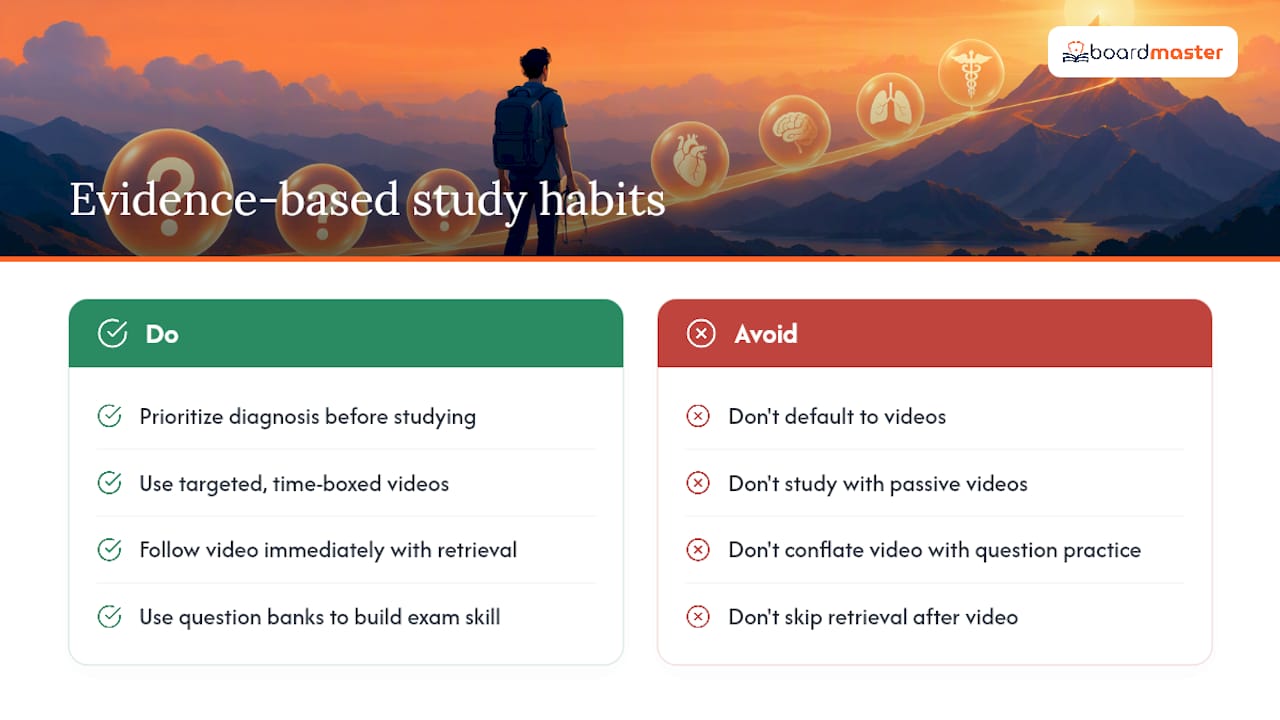
The conventional advice floating around most study forums treats videos and question banks as roughly interchangeable inputs, differing mainly in how "engaging" they feel. The Cureus data and the retrieval-practice literature don't support that framing. They point to something more specific: questions build the skill the exam tests, videos build the knowledge questions require you to have first, and conflating the two roles is where students lose the most time.
Where most guides overcorrect is telling students to abandon video entirely. That's not what the evidence supports either. It supports a narrower claim: video works when it's targeted, time-boxed, and immediately followed by retrieval. Video fails when it becomes the default study mode because it feels more comfortable than getting questions wrong.
If you take one thing from this, prioritize diagnosis over content consumption. Know what you don't know before you decide how to learn it. That single habit shift does more for efficiency than any resource swap.
A Faster Way to Turn Lecture Notes Into Question Practice
An AI Question Generator tool can automate the creation of USMLE-style practice questions from uploaded lecture notes, generating diagnostic sets that better reflect course content rather than generic approximations.
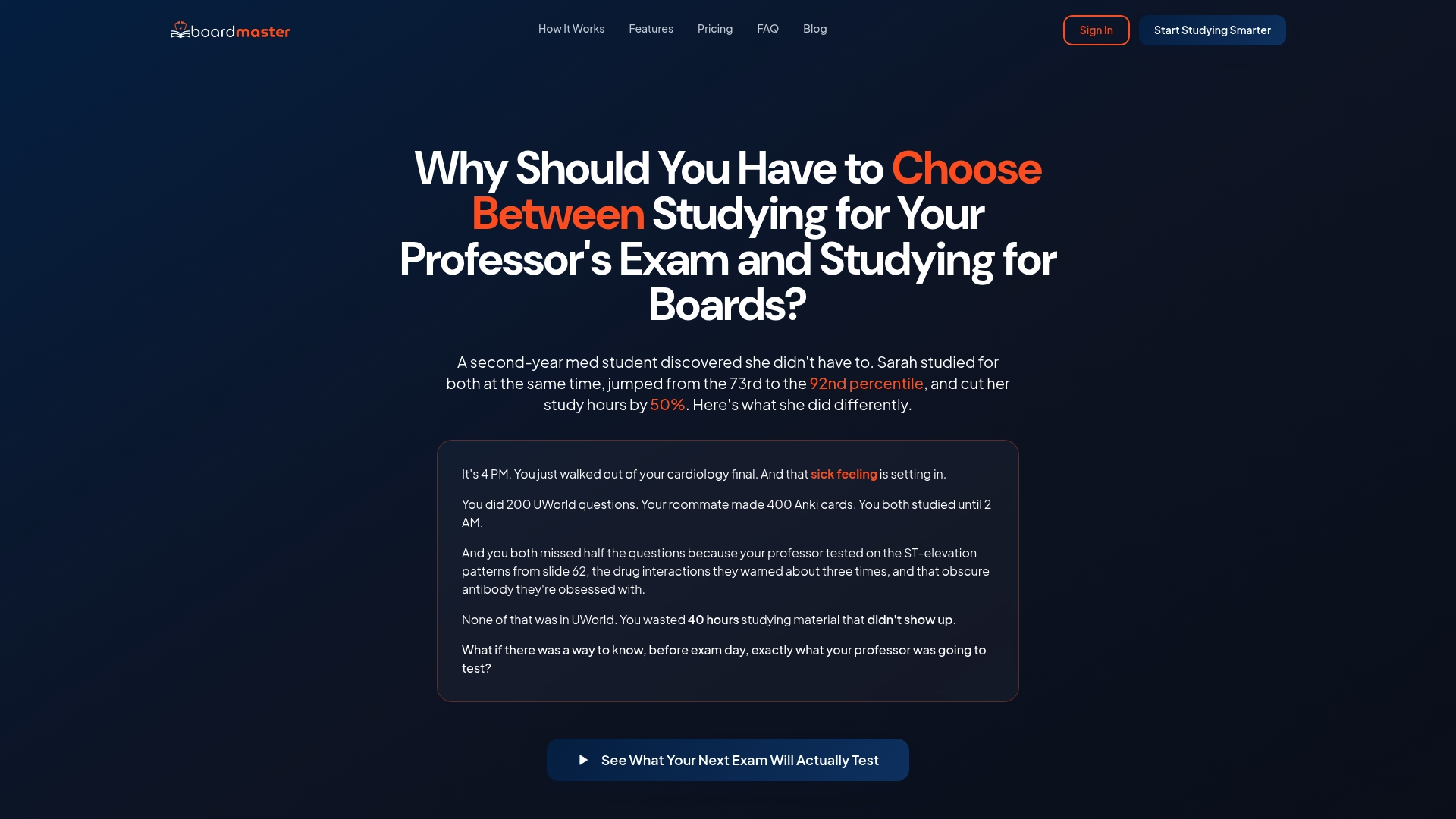
Pair that with the QBank's physician-written board-style questions for broader board coverage, Cortex AI when you need an instant explanation instead of a full video detour, and spaced-repetition flashcards to lock in the concepts you corrected. One user moved from the 73rd to the 92nd percentile while cutting study hours in half using this targeted approach instead of working through lecture content sequentially. If you want to see how the question generator works with your own notes, try the AI question generator demo or start with the full QBank to build your questions-first routine today.
Sources
- Educational Videos Versus Question Banks: Maximizing Medical Student Performance on the United States Medical Licensing Examination Step 1 Exam (Cureus, 2023)
- Comparison of rewatching class recordings versus retrieval practice as post-lecture learning strategies (2019)
- Test delivery software updates for Step 2 CK and Step 1 coming May 2026 | USMLE
FAQ
Is 240 a good score on USMLE Step 1?
Step 1 has been reported as pass/fail rather than a three-digit score, so there's no numeric benchmark to hit. What matters now is passing on your first attempt, since a fail carries real weight on residency applications, which is exactly why the questions-first approach to diagnosing and closing gaps matters more than chasing a specific number.
Is Step 1 changing to 20-question blocks?
Starting in May 2026, the USMLE is updating its test delivery software for both Step 1 and Step 2 CK, moving to 30-minute blocks containing up to 20 items. If your exam date falls after that rollout, practice inside the official interactive testing experience before test day so the new format isn't a surprise.
What are common USMLE Step 1 mistakes?
The biggest ones are watching full lecture series before testing yourself, skipping explanations on questions you got right, delaying timed practice until the final weeks, and relying entirely on a generic question bank instead of folding in your own course material. Each mistake wastes study time that targeted question practice would use more efficiently.
What is the Step 1 fail rate?
Exact current fail rates aren't published on this page, and the number shifts based on cohort and testing conditions, so check the official USMLE Step 1 page for the most current pass statistics. Regardless of the exact figure, the same evidence applies: higher question-practice volume correlates with stronger performance, which is the most controllable factor in your prep.
Are videos helpful for USMLE prep, or should I skip them entirely?
Videos are helpful, but only for a specific job: building or repairing a mental model when you have a genuine knowledge gap, not as your primary study method. The research points to question practice as the stronger driver of performance, with videos working best as a short, targeted follow-up to a diagnosed gap rather than a first-pass study tool.