
TL;DR:
- Clinical reasoning involves gathering key data, forming a differential diagnosis, and choosing the best next step under time pressure. Practicing this process with deliberate reflection, bias management, and micro-skill drills enhances exam performance and clinical safety. Using targeted question banks and verbalizing reasoning prepares students for both SBAs and OSCEs effectively.
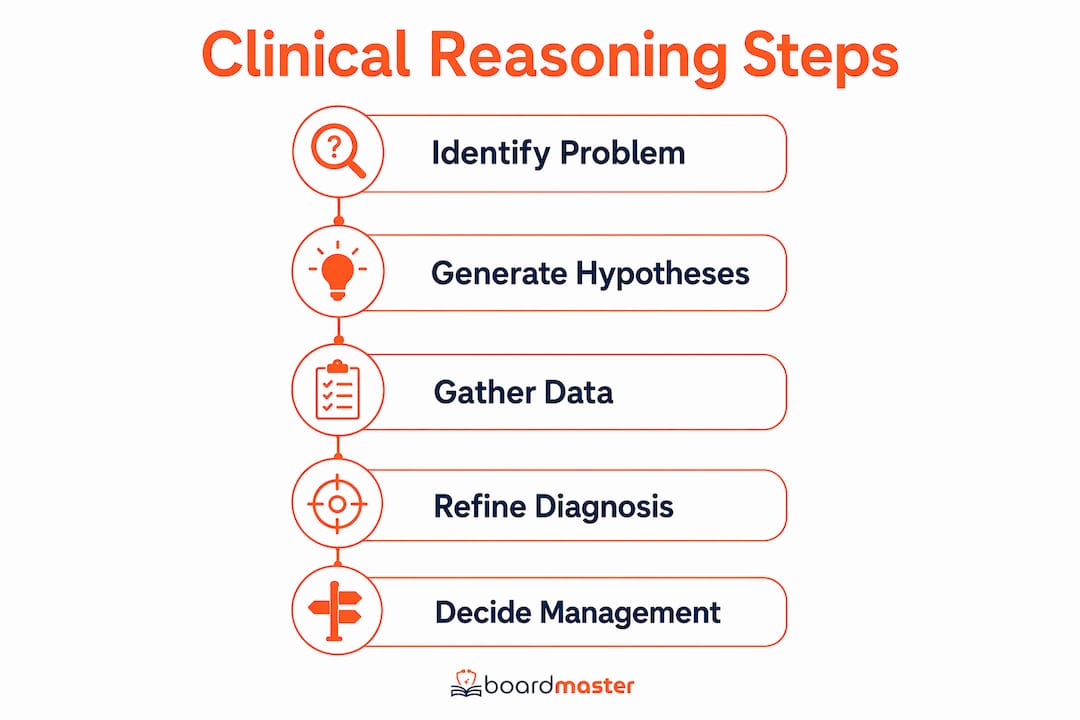
Clinical reasoning in medical exams is the process of collecting key data from a vignette or patient encounter, synthesizing it into a prioritized differential, and selecting the single best next action — all under time pressure. In SBAs, that means reading a stem and picking the most defensible answer from the lead-in. In OSCEs, it means showing an examiner, out loud, how you move from complaint to hypothesis to plan. Your immediate action: identify the chief problem → state your leading hypothesis → name the single next-best step. That three-move sequence works in both formats.
The skill plays out differently depending on the station or question type, so the sections below walk through SBAs and OSCEs separately before giving you a unified framework you can rehearse until it's automatic.
Examiners test clinical reasoning because it predicts safe practice more reliably than factual recall alone. A student who memorizes every cause of chest pain but cannot prioritize them for a 45-year-old smoker with diaphoresis is a liability in a clinical setting. Medical schools know this, which is why clinical reasoning assessment now appears in nearly every high-stakes format: SBAs, key-feature questions, OSCEs, and short-case clusters.
What examiners actually want to see is a set of observable behaviors: a focused, hypothesis-driven history; a succinct problem representation ("This is a middle-aged man with acute-onset pleuritic chest pain and recent long-haul travel"); a prioritized differential with the most dangerous diagnosis listed first; an appropriate next step; and the ability to update the plan when new data arrive. Memorizing facts gets you to the door. Demonstrating that sequence gets you through it.
Table of Contents
- How does clinical reasoning show up in SBA questions?
- What do OSCE examiners actually look for?
- A repeatable framework you can run through under pressure
- Which cognitive biases trip students up most in exams?
- How do you actually practice clinical reasoning before exams?
- What does the research say about clinical reasoning assessment?
- Key Takeaways
- The part of clinical reasoning practice most students skip
- BoardMaster makes targeted reasoning practice faster
- Useful sources
- FAQ
How does clinical reasoning show up in SBA questions?
The lead-in tells you the cognitive task before you read a single word of the stem. "What is the most likely diagnosis?" tests pattern recognition. "What is the next best step in management?" tests prioritization and safety reasoning. "Which test would most likely confirm the diagnosis?" tests data interpretation. Knowing the task first lets you read the vignette with the right filter.
Walking through an SBA vignette
Consider this stem: A 28-year-old woman with no past medical history presents with three days of productive cough, fever to 38.8°C, and right lower lobe dullness to percussion. She works in a daycare. Chest X-ray shows a lobar consolidation. What is the most appropriate initial antibiotic?

The discriminating features are: young, healthy, community-acquired, lobar pattern. The context modifier is daycare exposure (atypical organisms are less likely here than in a college dorm). The distractor is her age — students sometimes jump to atypical coverage because she is young. The correct answer is amoxicillin or a beta-lactam, not azithromycin alone, because the lobar pattern and dullness point to typical bacterial pneumonia. The vignette structure is designed to force exactly this discrimination.
Fast vs. deliberate thinking in SBAs
Both cognitive modes appear in SBA sets, and knowing which to deploy saves time and prevents errors.
| Mode | When it helps | When it hurts |
|---|---|---|
| Fast / pattern recognition | Classic presentations, high-confidence diagnoses | Atypical modifiers, context-specific traps |
| Deliberate / analytic | Ambiguous stems, "next-best-step" leads | Overthinking clear presentations, wasting time |
Dual-process theory frames this as System 1 (automatic, pattern-based) versus System 2 (slow, analytical). Neither is always right. The exam-smart move is to default to pattern recognition for classic presentations, then consciously shift gears when the stem includes an age, setting, or social-history detail that doesn't fit your first read.
Pro Tip: Cover the answer choices before you read the stem. Answer the lead-in question from the vignette alone, then look for your answer in the options. This prevents the options from anchoring your thinking before you've reasoned independently.
One more trap worth naming: the "gold standard vs. next-best-step" confusion. Examiners frequently offer the definitive test as a distractor when the correct answer is the safer, faster, or more immediately available action. Next-best-step questions are specifically designed to catch students who reach for the definitive answer before stabilizing the patient. Ask yourself: "What fixes the immediate risk?" before "What confirms the diagnosis?"
What do OSCE examiners actually look for?
OSCEs assess clinical reasoning as a process, not just an outcome. The examiner is watching how you gather information, not only what conclusion you reach. That distinction changes everything about how you should perform.
The observable behaviors that score marks are: asking focused, hypothesis-driven questions (not a shotgun history); performing targeted exam maneuvers that test your leading diagnosis; stating a succinct problem representation before your differential; listing your differential with the most dangerous condition first; and communicating your plan with explicit signposting.
A worked OSCE case
Station: You have eight minutes with a 55-year-old man who presents with sudden-onset severe headache. He rates it 10/10. He has never had a headache like this before.
What to say aloud:
"My leading diagnosis is subarachnoid hemorrhage because this is a thunderclap headache — maximum intensity at onset — in a middle-aged patient with no prior similar episodes. I want to rule out meningitis and hypertensive emergency as well. I'm going to ask about neck stiffness, photophobia, and any recent trauma, and I'll check his blood pressure and perform a fundoscopic exam."
That script does three things simultaneously: it signals your hypothesis, it explains your reasoning, and it previews your exam plan. Examiners call this a shared mental model, and collaborative reasoning research confirms it is increasingly central to how observed assessments are scored.
If you run short on time, prioritize safety. State your leading diagnosis and the single most urgent management step. Examiners consistently award marks for safety-first decisions even when the full workup is incomplete. For deeper station-by-station strategy, the OSCE preparation guide covers timing and communication in detail.
A repeatable framework you can run through under pressure
This five-step sequence works for both SBAs and OSCEs. Rehearse it until it takes under 30 seconds.
- Read for the chief problem. Identify the single most important clinical fact in the stem or opening complaint.
- Write a one-line problem representation. "This is a [age/sex] with [time course] of [key symptom] and [key finding]."
- Generate three prioritized hypotheses. List the most dangerous first, then the most likely, then a must-not-miss alternative.
- Select the next-best test or action. Ask: "What fixes the immediate risk or best discriminates between my top two diagnoses?"
- Reassess with new data. When the question gives you a lab result or the examiner adds information, update your leading hypothesis explicitly.
Quick phrases for OSCE stations
These phrases signal reasoning to examiners without slowing you down:
- "My leading diagnosis is… because…"
- "I want to rule out… given…"
- "The most urgent next step is… to address…"
- "If [finding] is present, I would revise my diagnosis to…"
Framework applied: one SBA, one OSCE mini-case
SBA: A 67-year-old man with atrial fibrillation on warfarin presents with sudden left-sided weakness and slurred speech for 45 minutes. His INR is 3.2. Lead-in: "What is the next best step?"
Step 1: Chief problem — acute neurological deficit, possible stroke. Step 2: "Elderly man on anticoagulation with acute focal deficits, 45-minute duration." Step 3: Ischemic stroke (most likely), hemorrhagic stroke (most dangerous, INR elevated), Todd's paralysis (less likely, no seizure history). Step 4: Non-contrast CT head — rules out hemorrhage before any further intervention. Step 5: If CT shows no bleed, reassess for thrombolysis eligibility.
OSCE: Same patient walks into your station. Say aloud: "My leading concern is hemorrhagic stroke given the supratherapeutic INR and acute focal deficits. I'm prioritizing a stat non-contrast CT head before anything else." That sentence alone earns marks for hypothesis generation, safety reasoning, and appropriate next step.
Which cognitive biases trip students up most in exams?
Four biases account for the majority of reasoning errors on SBAs and OSCEs. Knowing their names is less useful than knowing their triggers.
Premature closure is stopping the diagnostic process after the first plausible diagnosis. In SBAs, it looks like picking the first answer that fits without checking whether a better fit exists. Fix: after identifying your leading diagnosis, spend five seconds asking, "What else could this be?"
Anchoring means over-weighting the first piece of information in the stem. A student who reads "diabetic patient" and anchors to hyperglycemia may miss a concurrent MI. Fix: re-read the stem after forming your hypothesis and look for features that don't fit.
Availability bias leads you toward diagnoses you've seen recently or studied heavily. If you just finished a cardiology block, everything looks like a cardiac problem. Fix: use a structured differential that forces you across organ systems.
Confirmation bias is selectively reading the stem for evidence that supports your first hypothesis. Context specificity makes this especially dangerous: a small change in age, setting, or social history can shift the intended diagnosis entirely, and confirmation bias makes you miss that shift.
Pro Tip: When a question feels ambiguous or you've already changed your answer twice, that's your signal to switch deliberately from pattern recognition to analytic reasoning. Stop, restate the chief problem in one sentence, and rebuild your differential from scratch. This forced reset takes 20 seconds and catches most anchoring errors.
Avoiding common exam prep misconceptions — like assuming pattern recognition alone is sufficient — is part of building bias resistance before exam day.
How do you actually practice clinical reasoning before exams?
The answer is not "do more questions." It's doing questions with deliberate reflection on the reasoning process, not just the answer key.
Weekly practice rhythm:
- Three days per week: Mixed question blocks of 20–40 SBAs, timed. After each block, review every wrong answer for the reasoning error, not just the factual gap. Ask: "Did I anchor? Did I miss a context modifier? Did I confuse next-best-step with gold standard?"
- Two days per week: OSCE-style case practice with a peer or in front of a mirror. State your reasoning aloud for every case. Use the five-step framework from the section above.
- One session per week: Focused micro-skill drill. Pick one skill — problem representation, discriminating feature identification, or data interpretation — and run 10 cases targeting only that skill.
Using question banks purposefully:
Generic question banks build knowledge. Targeted question banks build reasoning. When you use a USMLE-style question bank, filter by lead-in type (next-best-step, diagnosis, interpretation) rather than by topic. That trains the cognitive task, not just the content.
Reflection prompts after each session:
- What did I assume that turned out to be wrong?
- Which discriminating features did I miss or ignore?
- Did I confuse the most dangerous diagnosis with the most likely one?
- What would have changed my answer?
A practical drill called three-hypothesis mapping sharpens discriminators fast: read the stem, write a one-line problem representation, list three competing diagnoses, then identify the single most discriminating test or sign for each. This case-based practice method directly targets premature closure and builds the habit of holding multiple hypotheses simultaneously. Finding a clinical preceptor or rotation partner for live case discussion adds the feedback layer that solo question practice cannot replicate.
What does the research say about clinical reasoning assessment?
The dual-process model is the most widely used theoretical framework in clinical reasoning research, and its exam implications are direct: System 1 thinking is fast and pattern-based; System 2 is slow and analytical. Neither is superior. Experts switch between them fluidly depending on case complexity. Students who rely exclusively on System 1 make anchoring errors; those who default to System 2 for every question run out of time.
Context specificity compounds this. Research confirms that altering a single detail — the patient's age, occupation, or travel history — can change the intended diagnostic path entirely. This is why studying "classic presentations" alone is insufficient. You need exposure to varied vignettes that test the same diagnosis in different contexts.
REACT reliability metrics
The REACT tool (Rapid Evaluation Assessment of Clinical Reasoning Tool) was developed to assess clinical reasoning in simulated urgent scenarios. Its psychometric properties matter for understanding what formative feedback in OSCE-like settings can reliably capture.
| REACT Metric | Value | What it means for students |
|---|---|---|
| Internal consistency (Cronbach's α) | 0.86 | The tool measures a coherent construct — feedback from simulated OSCEs is reliable |
| Inter-rater reliability (weighted κ) | ~0.56 | Moderate agreement between raters — structured checklists reduce scoring variance |
The REACT items hang together as a coherent measure of reasoning, and the tool shows moderate agreement between raters, which is typical for complex performance assessments. The practical takeaway: when you receive structured feedback from a simulated OSCE, it is meaningful data, not just one examiner's opinion.
Item-writing guidelines from a Delphi consensus study reinforce this: well-constructed vignettes with explicit lead-ins outperform any single question format for assessing reasoning. The format matters less than the quality of the cognitive task the question forces. Multiple evaluation methods — checklists, direct observation, oral presentations — used together give the most complete picture of a student's reasoning.
Key Takeaways
Clinical reasoning in medical exams requires a repeatable five-step process, active bias management, and deliberate practice targeting micro-skills rather than content volume alone.
| Point | Details |
|---|---|
| Five-step framework | Chief problem → problem representation → three hypotheses → next-best step → reassess with new data. |
| SBA lead-in first | Read the lead-in before the stem to know the cognitive task; cover answer choices until you've reasoned from the vignette. |
| OSCE signposting | State your leading diagnosis and reasoning aloud; examiners score the process, not just the conclusion. |
| Bias reset | When a question feels ambiguous, switch to System 2: restate the chief problem and rebuild the differential from scratch. |
| BoardMaster practice | Upload your lecture notes to BoardMaster to generate targeted SBA-style questions aligned to your course and board exams. |
The part of clinical reasoning practice most students skip
Most students treat clinical reasoning as something that improves automatically with more question volume. It doesn't. Volume without reflection is just expensive repetition.
The students who improve fastest share one habit: they debrief every wrong answer at the reasoning level, not the fact level. They don't just look up the right answer — they reconstruct the reasoning path that would have led there and identify exactly where their thinking diverged. That's a different cognitive activity than reading an explanation, and it's the one that transfers to the next question.
There's also a tendency to treat OSCE preparation as separate from SBA preparation. It isn't. The same five-step framework, the same bias checks, the same problem representation skills — they all apply. The only difference is that OSCEs require you to perform the process aloud. Students who practice verbalizing their reasoning during SBA review are better prepared for OSCEs than those who treat the two formats as entirely different skills. A sustainable study system that integrates both formats from the start is worth more than two separate cramming sprints.
Setbacks are part of this. Missing a "next-best-step" question because you chose the definitive test over the immediate action is not a knowledge failure — it's a reasoning pattern that needs one targeted correction, not a full content review. Identify the pattern, drill the correction, move on.
BoardMaster makes targeted reasoning practice faster
Most question banks give you questions. BoardMaster gives you questions built from your actual lecture notes, targeting the concepts your professors emphasize and the reasoning micro-skills boards test most heavily.

Upload your lecture slides and BoardMaster generates USMLE-style SBA questions aligned to your course, with lead-ins that force next-best-step and diagnostic reasoning — not just recall. The physician-written question bank covers 5,000+ high-yield cases across disciplines, and the AI question generator creates custom practice sets from your own material. For students who want to close the gap between class exams and board performance without doubling their study hours, BoardMaster is the most direct path. Start with the AI question generator demo to see how your notes become targeted practice in minutes.
Disclosure: This article is published by BoardMaster.
Useful sources
- Advancing the Assessment of Clinical Reasoning — PMC — Definitional and methodologic recommendations; best for understanding assessment design and validity frameworks.
- Clinical Reasoning Assessment Methods: A Scoping Review — Academic Medicine — Practical guidance on multiple assessment methods; useful for understanding how SBAs, OSCEs, and WBAs compare.
- Understanding Clinical Reasoning from Multiple Perspectives — NCBI Bookshelf — Dual-process theory overview and context specificity; foundational theory reading.
- REACT: Rapid Evaluation Assessment of Clinical Reasoning Tool — Journal of General Internal Medicine — Reliability metrics (Cronbach's α 0.86, weighted κ ~0.56); best for understanding formative OSCE feedback quality.
- Guidelines for Creating Written Clinical Reasoning Exams — ScienceDirect — Delphi consensus on item-writing; best for understanding what exam writers are actually testing.
- How to Evaluate Trainees' Clinical Reasoning Skills — MDPI — Workplace-based tools and multiple evaluation methods; relevant for clinical rotations and direct observation.
- How to Design Exam Questions That Actually Test Clinical Reasoning — Residency Advisor — Practical item-writing guidance and micro-skill targeting; best for understanding next-best-step question construction.
FAQ
What is clinical reasoning in medical exams?
Clinical reasoning in exams is the process of collecting key data from a vignette or patient encounter, forming a prioritized differential, and selecting the best next action. In SBAs it produces a single best answer; in OSCEs it is demonstrated aloud through hypothesis-driven history, exam, and management.
What are the main components of clinical reasoning?
The core components are information gathering, hypothesis generation, problem representation, differential diagnosis, selection of a leading diagnosis, diagnostic justification, and management planning — as defined in the clinical reasoning assessment literature.
How do you study for clinical reasoning in exams?
Practice with timed, mixed question blocks and debrief every wrong answer at the reasoning level — identify whether you anchored, missed a context modifier, or confused next-best-step with the gold standard. Add weekly OSCE-style case verbalization and use the three-hypothesis mapping drill to sharpen discriminators.
What is another name for clinical reasoning?
Clinical reasoning is also called diagnostic reasoning, clinical judgment, or medical decision-making, depending on the context. All terms describe the cognitive process of moving from patient data to a diagnosis and management plan.
How does context specificity affect exam performance?
A single change in a vignette — the patient's age, occupation, or travel history — can shift the intended diagnosis entirely. Relying on pattern recognition for "classic" presentations without reading every stem detail is one of the most common sources of avoidable errors on SBAs.