
Why clinical vignettes dominate board exams: the core reasons
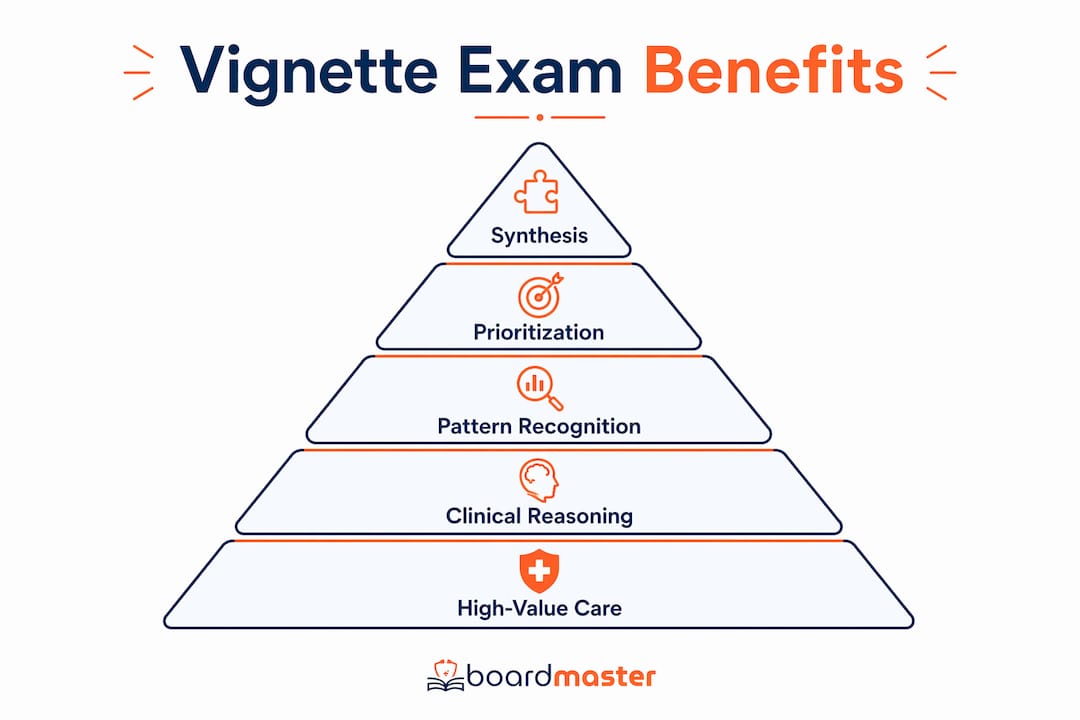
Clinical vignettes dominate board exams because they replicate real patient encounters in a controlled, standardized format that tests whether you can actually think like a clinician, not just recall facts. A question that reads "Which drug decreases preload?" tests memory. A question that opens with a 65-year-old man presenting with orthopnea, bilateral crackles, and an S3 gallop tests whether you can synthesize a clinical picture and act on it. That difference is the entire point.
Licensure-style questions are carefully designed to assess clinical reasoning rather than rote knowledge, and the vignette format is the vehicle that makes that possible. By embedding a question inside a patient scenario, exam writers can evaluate higher-order thinking skills that simple recall items simply cannot reach.
Here is why this format has become the standard across USMLE, COMLEX, ABFM, and virtually every other major licensing exam:
- Vignettes simulate real patient encounters by integrating demographics, symptoms, physical exam findings, and diagnostic data into a single coherent scenario.
- They assess clinical reasoning and decision-making rather than isolated fact recall.
- They control case-mix variation, allowing examiners to isolate a candidate's decision-making process more effectively than claims data or simple MCQs.
- They test your ability to synthesize information and apply knowledge in context, not just recognize a definition.
- They identify students who have memorized facts but cannot use them effectively in clinical situations.
What clinical reasoning strategies do vignette MCQs actually test?
Vignette-style questions are not just about reaching the right diagnosis. They probe the entire reasoning chain you would use at the bedside, from generating a hypothesis to deciding whether to act at all.
Hypothesis generation and data interpretation
Every vignette opens with a clinical picture that forces you to generate a differential before you even reach the lead-in question. You are reading about a 28-year-old woman with joint pain, a malar rash, and proteinuria, and your brain is already narrowing the field. The question then tests whether you can prioritize the most likely diagnosis given the full constellation of findings, not just one buzzword.

Two-step and three-step reasoning
Most board questions follow either a 2-step or 3-step structure. A 2-step question asks you to interpret the vignette and identify the diagnosis. A 3-step question adds another layer: after identifying the condition, you must determine the next best step in management, the most likely complication, or the expected lab finding. Recognizing which type you are dealing with helps you avoid stopping your reasoning too early.
Pattern recognition and illness scripts
Vignettes help you build what researchers call illness scripts: structured mental models that cover epidemiology, mechanisms, and clinical presentation for a given condition. When you read enough vignettes about a disease, you stop consciously reasoning through each finding and start recognizing the pattern as a whole. That shift from slow analytical reasoning to fast pattern recognition is exactly what experienced clinicians do.
Prioritization and the decision to withhold
USMLE Step 1 vignettes progress from clean signals pointing clearly to a diagnosis toward deliberate noise, adding plausible alternatives that require prioritization. Some of the most challenging questions test whether you know when NOT to intervene, a skill that pure recall questions cannot assess at all.
High-value, cost-effective care
Clinical vignettes in primary care exams reward candidates who select evidence-based, guideline-supported management over aggressive or expensive workups. The format naturally embeds cost-effectiveness into clinical decision-making, because the scenario gives you a real patient with real constraints.
How are clinical vignette questions actually built?
Understanding the anatomy of a vignette question changes how you read them. Every well-constructed board question follows a consistent structure, and knowing that structure lets you move through it efficiently.
The standard components
A complete vignette stem typically includes these elements in order:
- Patient demographics: Age, sex, and race or ethnicity when clinically relevant.
- Chief complaint: The reason the patient is seeking care.
- History: Medical, surgical, family, social, and sometimes travel history.
- Symptoms: Onset, duration, quality, and associated signs.
- Physical exam findings: Vital signs and focused examination results.
- Diagnostic data: Labs, imaging, EKGs, pathology slides, or other objective findings.
The lead-in question follows the stem and defines exactly what is being tested. Common lead-in types include:
- "What is the most likely diagnosis?"
- "What is the next best step in management?"
- "Which of the following is the most appropriate pharmacotherapy?"
- "What is the most likely mechanism of this patient's condition?"
Relevant details vs. red herrings
Not every piece of information in a vignette is meant to guide you toward the answer. Many stems include red herrings that simulate real-life clinical complexity and test your ability to filter noise. A travel history to Southeast Asia might be a critical clue in one question and a deliberate distractor in another. Training yourself to ask "does this detail help me answer the lead-in?" is the core skill the format demands.
Focus on common conditions
The NBME's own guidance is explicit: items should focus on common or potentially catastrophic problems and avoid rare syndromes and esoterica. A well-written vignette tests your ability to recognize a classic presentation of a high-prevalence condition, not your ability to recall a mnemonic for a syndrome you will never see in practice.
Pro Tip: Read the lead-in question before you read the full vignette stem. Knowing whether the question asks for a diagnosis, a next step, or a mechanism tells you exactly which details in the stem actually matter, and it prevents you from getting lost in clinical noise.
What are the real critiques of clinical vignettes in board exams?
Vignettes are not a perfect assessment tool, and the critiques leveled against them are worth understanding, both for intellectual honesty and for smarter exam preparation.
- Risk of superficial memorization: Critics argue that when vignettes rely heavily on rare syndromes, they push students toward memorizing mnemonics and isolated facts rather than building conceptual understanding. A question that requires you to first recognize Patau syndrome before answering a question about nondisjunction tests syndrome recognition more than it tests the underlying mechanism.
- Unnecessary cognitive hurdles: Complex or lengthy stems can shift emphasis away from the core scientific principle being assessed, burdening students with diagnostic steps that add no educational value.
- Poor fit for basic science concepts: Many foundational concepts in physiology, biochemistry, and embryology cannot be naturally embedded in a patient scenario. As a result, the vignette format tends to underrepresent these areas, not because they lack importance, but because the format is poorly matched to assessing them.
- Exam culture feedback loops: When peripheral details appear in vignettes, educators add them to curricula. When the NBME surveys educators, those topics are judged reasonable because they are already being taught. The result is a self-perpetuating cycle that expands examinable content into increasingly marginal territory.
- Cognitive overload: Excessive vignette complexity or inappropriate stem length can overwhelm students and pull focus away from the central concept the question is trying to test.
These are real limitations. Knowing them helps you study more deliberately, focusing on conceptual understanding rather than chasing every rare syndrome that has ever appeared in a question bank.
What does research say about the educational value of vignettes?
The case for vignettes goes well beyond exam performance. Medical education research consistently shows that working with clinical vignettes builds skills that carry into practice long after the licensing exam is over.
Writing and organizing a clinical case into a vignette format promotes active learning and reflective practice, which are foundational to lifelong professional growth. The act of structuring a narrative forces you to anticipate clinical questions, identify gaps in your reasoning, and articulate what you actually know versus what you assumed. That process is valuable whether you are a second-year student or an attending physician.
Researchers describe clinical vignettes as a pluripotent tool for clinician growth: educators use them to develop curricular objectives, researchers use them to produce compelling scholarship, and clinicians use them to improve patient education. The skillset developed through vignette work, creating effective narrative, structuring logical argument, anticipating clinical questions, transfers across every role in medicine.
On the assessment side, vignettes control case-mix variation in a way that other formats cannot. By standardizing the clinical scenario, examiners can compare candidates fairly across different testing cohorts without the confounding effect of variable clinical exposure.
Pro Tip: When reviewing a vignette you got wrong, do not just read the explanation. Rewrite the case in your own words, identify the two or three findings that should have pointed you to the correct answer, and ask yourself what illness script you were missing. That active reconstruction is what converts a missed question into a durable clinical memory.
Clinical vignettes are not just assessment instruments. The research frames them as vehicles for clinical storytelling, systematic thinking, and professional development across every stage of a medical career.
How do vignettes assess clinical reasoning specifically?
The defining feature of a clinical vignette is that it cannot be answered by retrieving a single fact. You must read the scenario, weigh the findings against each other, generate a working diagnosis or decision, and then select the answer that best fits the full clinical picture. That process mirrors the cognitive work of actual patient care.
The NBME's own item-writing guidelines state that vignette-based questions identify test-takers who have memorized a substantial body of factual information but cannot use it effectively in clinical situations. That is the gap the format is designed to expose. A student who has memorized every drug mechanism but cannot apply them to a patient presentation will struggle with vignettes in a way that a pure recall exam would never reveal.
Clinical reasoning in assessments also requires you to manage uncertainty. Real patients do not present with textbook-perfect symptom clusters. Vignettes simulate that ambiguity by including findings that could support more than one diagnosis, forcing you to weigh probabilities rather than pattern-match to a single answer. Understanding medical exam question types and how they differ helps you calibrate that reasoning process across different exam contexts.
How did clinical vignettes become the standard in board exams?
The shift toward vignette-based questions was not sudden. For much of the 20th century, board exams relied heavily on recall-style questions: single-sentence stems asking for a drug name, a mechanism, or a definition. Those formats were efficient to write and easy to score, but they measured the wrong thing.
The National Board of Medical Examiners (NBME) began systematically moving toward application-based questions in the latter decades of the 20th century, driven by growing evidence that recall performance did not predict clinical competence. The NBME's item-writing manual, affectionately known as "the Red Book" and revised during the centennial celebration in 2015, formalized the principle that items should assess application of knowledge, not recall of isolated facts, and that a clinical or experimental vignette is the standard vehicle for doing so.
The USMLE, introduced in its current form in 1992, embedded vignette-based questions as the default format from the start. Step 1 was designed to test foundational science through clinical application, Step 2 CK to test clinical knowledge in patient management scenarios, and Step 3 to test independent decision-making. Each step uses progressively more complex vignettes, reflecting the reasoning demands at each stage of training. For a detailed breakdown of how the USMLE question format has evolved, the structure is worth studying before you sit for any step.
The preceptorship model in clinical training, where students learn by working through real cases under supervision, reinforced the same logic. Vignettes brought that case-based learning into the standardized testing environment. A preceptor in clinical education uses real patient encounters to build exactly the reasoning skills that vignettes are designed to assess.
How do vignettes compare to other question formats on board exams?
The contrast between vignette-based questions and other formats clarifies exactly what vignettes add and what they cannot do.

Recall questions (single-sentence stems with no clinical context) test whether you know a fact. They are fast to answer and easy to write, but they cannot distinguish between a student who understands a concept and one who memorized a flashcard. The NBME's guidance reserves recall items for formative assessment and simple concepts that do not lend themselves to clinical scenarios.
Experimental vignettes embed a question in a laboratory or research scenario rather than a patient encounter. These are used when the concept being tested is mechanistic rather than clinical, for example, a question about enzyme kinetics framed around an experiment rather than a patient presentation.
Extended matching questions present a longer list of answer choices and multiple stems, testing pattern recognition across a broader set of conditions. They are less common on current board exams but appear in some shelf exam formats.
Vignette-based MCQs sit at the top of this hierarchy for clinical assessment because they require synthesis, prioritization, and application simultaneously. The tradeoff is that they take longer to answer and are harder to write well. A poorly constructed vignette with an ambiguous lead-in or an irrelevant stem can test reading comprehension more than clinical reasoning. That is why the NBME invests heavily in item review and pretesting before questions appear on scored exams.
Avoiding common Step 1 preparation mistakes often comes down to understanding this hierarchy and not treating all question types as interchangeable during study.
How do clinical vignettes change the way you should prepare for boards?
The vignette format has direct consequences for how you study. If the exam tests clinical reasoning, then studying in a way that builds clinical reasoning is the only preparation that actually transfers.
Passive reading of textbooks builds declarative knowledge. It does not build the ability to synthesize a clinical picture under time pressure. Active practice with vignette-style questions does both, because every question forces you to apply what you know to a specific scenario and then receive immediate feedback on whether your reasoning held up.
A few preparation principles follow directly from how vignettes work:
- Practice reading the lead-in first. Knowing what the question asks before you read the stem helps you identify which details matter and which are distractors.
- Review wrong answers by reasoning, not by memorizing the correct answer. Ask yourself where your reasoning broke down, not just what the right answer was.
- Build illness scripts deliberately. For every condition you study, know the epidemiology, the mechanism, the classic presentation, and the first-line management. That four-part structure is what vignettes test.
- Vary your question exposure. Work through 2-step and 3-step questions regularly so that the added reasoning layer does not catch you off guard on exam day.
The impact of vignettes on learning extends beyond exam scores. Students who practice extensively with vignette-based questions report stronger clinical reasoning during their rotations, because the format trains the same cognitive habits that attending physicians use at the bedside.
What do typical clinical vignette scenarios look like?
Seeing concrete examples is the fastest way to understand what the format demands in practice.
Classic 2-step diagnostic vignette: A 45-year-old woman presents with fatigue, cold intolerance, weight gain, and constipation over the past six months. Her TSH is elevated and free T4 is low. The lead-in asks: "What is the most likely diagnosis?" You identify the pattern (hypothyroidism), match it to the labs, and select the answer. Straightforward pattern recognition.
3-step management vignette: The same patient, but now the lead-in asks: "What is the most appropriate next step in management?" You must move past the diagnosis to the treatment decision, selecting levothyroxine over thyroid biopsy or referral to endocrinology. The vignette tests whether you know both the diagnosis and the evidence-based first-line treatment.
Deliberate noise vignette: A 32-year-old man with a history of IV drug use presents with fever, night sweats, and a new heart murmur. His blood cultures grow Staphylococcus aureus. The stem also mentions a recent dental procedure and a family history of rheumatic fever. The lead-in asks about the most likely source of infection. The dental history and family history are red herrings. The IV drug use and S. aureus bacteremia point directly to tricuspid valve endocarditis.
High-value care vignette: A 55-year-old woman with newly diagnosed type 2 diabetes and a blood pressure of 138/88 mmHg asks about starting an ACE inhibitor. The lead-in asks whether this is appropriate. The correct answer requires knowing the guideline recommendation for ACE inhibitors in diabetic patients with hypertension, not just the mechanism of the drug.
These scenarios illustrate why the vignette format rewards students who study with clinical context rather than isolated facts. The BoardMaster QBank includes physician-written questions built around exactly these scenario types, covering the full range of 2-step and 3-step reasoning demands you will face on exam day.
BoardMaster turns your lecture notes into the vignettes you actually need
Most question banks give you the same questions every student sees, regardless of what your professors emphasize. That gap between generic prep and your actual course content is where board scores get lost.

BoardMaster solves that directly. You upload your lecture notes, and the platform generates USMLE-style clinical vignette questions built around the concepts your professors actually teach. The questions follow the same format this article describes: patient demographics, clinical history, exam findings, diagnostics, and a lead-in that tests reasoning rather than recall. You get targeted practice on high-yield content from your own curriculum, not a generic catalog of every possible board topic.
The result is preparation that works for both your class exams and your board exams at the same time. Visit BoardMaster to see how it works, or go straight to the AI question generator to try it with your own notes.
FAQ
What is a clinical vignette question?
A clinical vignette question presents a brief patient scenario including demographics, history, exam findings, and diagnostic data, followed by a lead-in question that tests clinical reasoning rather than fact recall. The format is the standard for USMLE, COMLEX, and most other licensing exams.
Why are clinical vignettes used in board exams instead of simple recall questions?
Vignettes assess higher-order thinking skills that recall questions cannot reach, specifically the ability to synthesize clinical information and make decisions under uncertainty. They also identify students who have memorized facts but cannot apply them in a patient care context.
What is the best strategy for approaching a clinical vignette on an exam?
Read the lead-in question first to identify what is being tested, then read the stem with that focus in mind. This prevents cognitive overload from irrelevant details and helps you filter red herrings efficiently.
How does BoardMaster help with clinical vignette preparation?
BoardMaster generates USMLE-style vignette questions directly from your uploaded lecture notes, so your practice targets the high-yield concepts your professors emphasize rather than generic board content.
Are clinical vignettes effective for learning, or just for testing?
Research shows that working with clinical vignettes builds illness scripts, pattern recognition, and clinical reasoning frameworks that transfer directly into practice. Writing and organizing vignettes also promotes reflective learning and professional development well beyond exam preparation.
Key Takeaways
Clinical vignettes dominate board exams because they are the only format that reliably tests whether you can synthesize clinical information and make sound decisions, not just recall isolated facts.
| Point | Details |
|---|---|
| Core purpose of vignettes | They assess clinical reasoning and decision-making by simulating real patient encounters with integrated clinical data. |
| Reasoning depth required | Most board questions follow a 2-step or 3-step structure, requiring diagnosis plus management or mechanism reasoning. |
| Illness script development | Repeated vignette practice builds structured mental models covering epidemiology, mechanisms, and presentation for efficient pattern recognition. |
| Key critique to know | Critics argue that vignettes relying on rare syndromes push students toward memorization rather than conceptual understanding of foundational science. |
| BoardMaster's approach | BoardMaster generates USMLE-style vignette questions from your own lecture notes, targeting the high-yield content your professors actually test. |