
TL;DR:
- Concurrent prep converts last-minute cramming into a maintenance and growth system that reduces effort and enhances retention. It involves short daily reviews and weekly targeted study, supported by evidence that interleaving and spaced practice improve long-term memory. The system automates question generation and scheduling, helping students study efficiently while avoiding burnout.
Concurrent prep reduces study burden by converting fragmented, last-minute cramming into a predictable maintenance + growth system that preserves retention while cutting total effort. Instead of re-learning forgotten material before every exam, you keep every subject "warm" through short daily reviews, then direct deeper work only where your scores show you need it. Two bodies of evidence back this up: a 2013 review in Psychological Science in the Public Interest rated distributed practice among the highest-utility learning strategies, and iterative instructional-design data from PMC showed average prep time dropping slightly when students focused effort on genuinely hard material. BoardMaster, built by Dr. Ahmed Abuzoor's team, automates exactly this loop for medical students.
The short version:
- Mechanism: Interleaving + spaced retrieval + cognitive-load alignment stops re-learning from eating your schedule.
- Evidence: Distributed practice outperforms massed study; iterative design reallocates time to hard topics without adding total workload.
- Immediate action: Touch every subject daily with a 15–20 minute maintenance task, then reserve one longer weekly block for your weakest topic.
Table of Contents
- Why concurrent prep reduces study burden: the cognitive science
- What does the research actually say?
- How to set up a concurrent prep routine this week
- Common pitfalls that make concurrent prep feel harder than it is
- How BoardMaster operationalizes concurrent prep
- Key Takeaways
- The system is the strategy
- BoardMaster puts concurrent prep on autopilot
- FAQ
Why concurrent prep reduces study burden: the cognitive science
The core split is simple. Maintenance sessions are short, frequent reviews — 15–20 minutes — that keep a subject retrievable. Growth sessions are longer weekly blocks, 60–90 minutes, aimed at topics where your recall is still shaky. Together they prevent the most expensive event in studying: forgetting and having to re-learn from scratch.
Interleaving is what makes switching subjects productive rather than chaotic. When you alternate between, say, pharmacology and pathophysiology, your brain can't coast on pattern recognition. It has to retrieve the right framework for each question, which strengthens the memory trace. Interleaved practice improves test performance by 20–40% compared to blocked practice, despite feeling harder in the moment. That discomfort is the point — it signals active retrieval rather than passive re-reading.
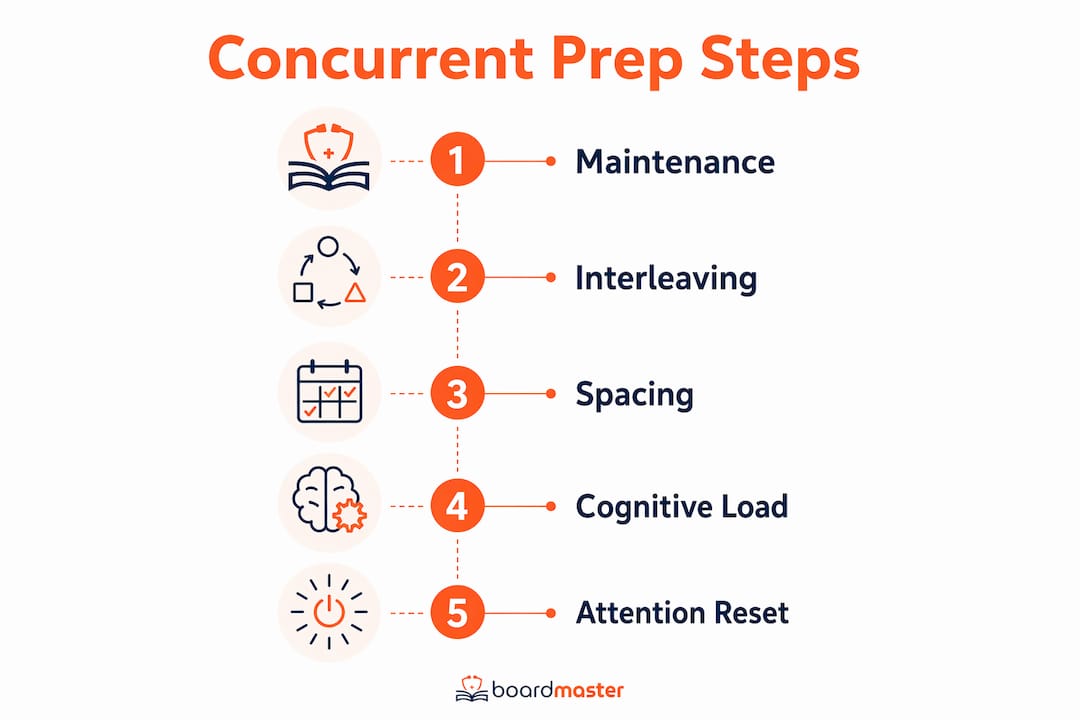
Spacing compounds the benefit. Touching a topic on Monday, Wednesday, and Friday builds stronger retention than three hours on Saturday. The 2013 high-utility learning review confirmed this: distributed practice consistently outperforms massed study for long-term retention, which matters enormously when you need biochemistry in Week 3 and again on Step 1.
Cognitive-load alignment is the mechanism that actually lowers total hours. When you track which topics are already solid, you stop spending time on familiar material and redirect that time to hard content. The PMC PREP study found that after iterative redesign, the correlation between prep time and difficulty rating improved from r = 0.32 to r = 0.59. Students weren't studying more — they were studying the right things.

Finally, attention reset: productive focus degrades after 45–90 minutes of single-subject work. Switching subjects engages a fresh cognitive network instead of grinding through diminishing returns.
Pro Tip: Set a 45-minute timer per subject block. When it fires, switch — even mid-topic. You'll return to it sharper.
What does the research actually say?
The evidence for concurrent prep comes from two distinct lines of work, and they converge on the same conclusion.
The 2013 distributed-practice review placed spacing and interleaving in the top tier of learning strategies, above highlighting, re-reading, and summarizing — the methods most students default to. These aren't marginal gains; they represent a structural advantage in how memory consolidates over time.
The PMC PREP study tested whether iterative instructional design could reallocate student effort without increasing total workload. It could. After redesign, prep time decreased from 2.2 to 2.0 hours on average (p < .001), while alignment between difficulty and time improved substantially.
| Metric | Before redesign | After redesign |
|---|---|---|
| Average prep time | 2.2 hours | 2.0 hours |
| Difficulty–time correlation | r = 0.32 | r = 0.59 |
| Effect size for alignment | — | Large |
That observation reframes the problem. Most students treat a heavy exam schedule as a willpower challenge. It's actually a system design problem.
How to set up a concurrent prep routine this week
The goal is a schedule where no subject goes more than two days without a touch, and one hard topic per week gets a dedicated growth block.
- List every active course and its next exam date. Rank them by urgency and your current weakest performance.
- Assign daily maintenance slots. Fifteen to twenty minutes per course, every day. Use retrieval — questions or flashcards, not re-reading notes.
- Designate one growth block per week per weak course. Sixty to ninety minutes, focused on the specific concepts your self-tests flag as shaky.
- Run a quick diagnostic every Friday. Three to five questions per subject. Anything below 70% accuracy moves from maintenance to growth next week.
- Use AI tools to eliminate planning friction. Upload that week's lecture notes and let BoardMaster generate targeted questions automatically. Your AI flashcards are ready in seconds, already sorted by spaced-repetition priority.
A sample weekly structure:
Monday through Friday, 20 minutes of maintenance per course first thing in the morning. Tuesday and Thursday, one 75-minute growth block on your hardest subject. Saturday, a 30-minute cross-subject interleaving session mixing questions from all active courses. Sunday, a brief weekly schedule review to reassign growth targets for the coming week.
Pro Tip: The night before each study day, open your notes app and write down exactly which topic and which question set you'll start with. Eliminating that 10-minute "what do I study?" decision at the start of a session compounds into real time savings across a semester.
Common pitfalls that make concurrent prep feel harder than it is
- Confusing familiarity with mastery. If you can recognize an answer when you see it, that's not the same as retrieving it cold. Force active recall — cover the answer, write it out, then check. This is the fluency illusion trap, and it's the most common reason students feel prepared but underperform.
- Stacking similar subjects back-to-back. Organic chemistry followed immediately by biochemistry creates interference because the frameworks overlap. Separate them with a dissimilar subject — anatomy, behavioral science, anything that uses a different cognitive schema.
- Skipping pre-organization. Walking into a session without knowing exactly what you're reviewing adds decision fatigue before you've done any real work. Prep materials the night before; see the pro tip above.
- Passive review during maintenance. Re-reading notes feels productive but doesn't build retrieval strength. Every maintenance session should include at least one retrieval practice element: a question set, a flashcard run, or a self-explanation.
- Overloading growth sessions. A 3-hour growth block past the point of focus produces diminishing returns and makes the system feel punishing. Cap growth sessions at 90 minutes and stop when accuracy stops improving.
Monitor whether the system is working by tracking two simple signals: how quickly you answer maintenance questions (speed should stabilize or improve week over week) and whether your Friday diagnostic scores hold steady without extra cramming.
How BoardMaster operationalizes concurrent prep
BoardMaster maps directly onto the maintenance + growth structure. Upload a lecture, and the platform generates USMLE-style questions targeting the concepts your professor emphasized — not generic board content. That's your maintenance loop, automated. The AI question generator removes the planning step entirely.
For growth sessions, BoardMaster's spaced-repetition flashcards surface the cards you're most likely to forget, so your 75-minute block goes to genuinely weak material rather than content you already know. The AI study assistant provides instant explanations when a concept doesn't click, cutting the time you'd otherwise spend hunting through notes. Study podcasts convert lectures into 8-minute audio episodes — useful for low-effort maintenance during commutes.
The real-world result: Sarah entered her preclinical year at the 73rd percentile. After building a concurrent prep routine with BoardMaster's targeted questions and flashcards, she reached the 92nd percentile while cutting her study hours in half.
Week 1 checklist:
- Upload notes from your three most active courses.
- Generate a 10-question set per course for daily maintenance.
- Create a flashcard deck for your weakest subject's growth block.
- Run the Friday diagnostic and note which topics need growth attention next week.
Key Takeaways
Concurrent prep works because it replaces re-learning cycles with spaced retrieval and interleaving, cutting total study time while improving retention across every active course.
| Point | Details |
|---|---|
| Daily maintenance is non-negotiable | Touch every active subject for 15–20 minutes daily to prevent re-learning costs. |
| Growth blocks target weak spots only | Reserve 60–90 minute weekly sessions for topics where Friday diagnostics show below 70% accuracy. |
| Interleaving beats blocked study | Switching subjects improves test performance and prevents the fluency illusion. |
| Iterative reallocation saves time | PMC data showed average prep time dropped from 2.2 to 2.0 hours when effort aligned with difficulty. |
| BoardMaster automates the loop | Upload lectures, generate questions, and run spaced-repetition flashcards to replace manual planning. |
The system is the strategy
Most medical students treat a brutal exam schedule as a test of endurance. It isn't. It's a scheduling problem with a known solution: stop re-learning, start maintaining. The students who burn out aren't less intelligent — they're running a fragmented system that forces them to rebuild knowledge from zero before every exam. A maintenance + growth structure doesn't ask you to study more. It asks you to study in a sequence that makes forgetting less likely.
One practical tip worth internalizing: schedule your hardest growth topic first in the day, before clinical duties or lecture fatigue set in. Then alternate to a maintenance subject. That sequencing alone prevents the cognitive exhaustion that makes long sessions feel mandatory. For more on avoiding burnout through system design, the BoardMaster blog covers the evidence in depth.
BoardMaster puts concurrent prep on autopilot
Upload one lecture tonight and BoardMaster generates a full question set from your professor's actual content — the material most likely to appear on your next class exam and your boards. In Week 1, most students have their maintenance loop running across three courses, 300+ flashcards created, and a prioritized growth schedule in place. No manual planning required.

Sarah's jump from the 73rd to the 92nd percentile while halving her study hours wasn't luck. It was the direct result of replacing ad hoc cramming with a structured concurrent prep routine, powered by questions built from her own lecture notes. That same routine is available to you today. Start your free trial and upload your first lecture to see exactly which concepts your professor emphasizes most.
FAQ
What is concurrent prep in medical school?
Concurrent prep is a study structure that divides work into short daily maintenance sessions (15–20 minutes per subject) and longer weekly growth blocks (60–90 minutes) for weak topics, so no subject is ever fully forgotten before an exam.
Why does concurrent prep reduce study stress compared to cramming?
It eliminates re-learning costs. Because you touch each subject daily, material stays retrievable, and you never face the panic of rebuilding weeks of forgotten content the night before an exam.
How long should daily maintenance sessions be?
Fifteen to twenty minutes per active course, using active retrieval (questions or flashcards) rather than passive re-reading. Attention quality matters more than duration.
Does interleaving really work, or does it just feel harder?
It works precisely because it feels harder. Interleaved practice improved test performance by 20–40% compared to blocked practice in educational research — the difficulty signals active retrieval, which builds durable memory.
How does BoardMaster support a concurrent prep routine?
BoardMaster generates USMLE-style questions from your uploaded lecture notes, creates spaced-repetition flashcards automatically, and provides an AI study assistant for instant explanations — replacing the manual planning that makes concurrent prep hard to sustain.