
TL;DR:
- Generic question banks mainly test recall, not the clinical reasoning skills required for medical exams. They often contain flawed questions and outdated content that do not reflect current exam blueprints or cognitive demands. Using expert-reviewed, curriculum-specific questions improves exam preparedness by promoting reasoning and accurate assessment of knowledge gaps.
Generic question banks are defined by a critical flaw: they test what students can recall, not what they can reason through clinically. For medical students preparing for USMLE Step 1, Step 2, or block exams, that distinction determines whether a practice score reflects real readiness or false confidence. More than 70% of traditional test bank items operate only at the two lowest levels of Bloom's Taxonomy, focusing on recall and basic comprehension. That means the majority of questions you practice with may not prepare you for the clinical reasoning boards actually demand. Understanding the limitations of generic question banks is the first step toward building a study plan that actually works.
Why generic question banks fall short on cognitive depth
Bloom's Taxonomy is the standard framework for classifying the cognitive demand of educational assessments. It runs from Level 1 (recall) through Level 6 (creation), with clinical reasoning sitting at Levels 4 and 5 (analysis and evaluation). Board exams like USMLE Step 1 and Step 2 CK are built around Levels 4 and 5. Generic question banks are not.
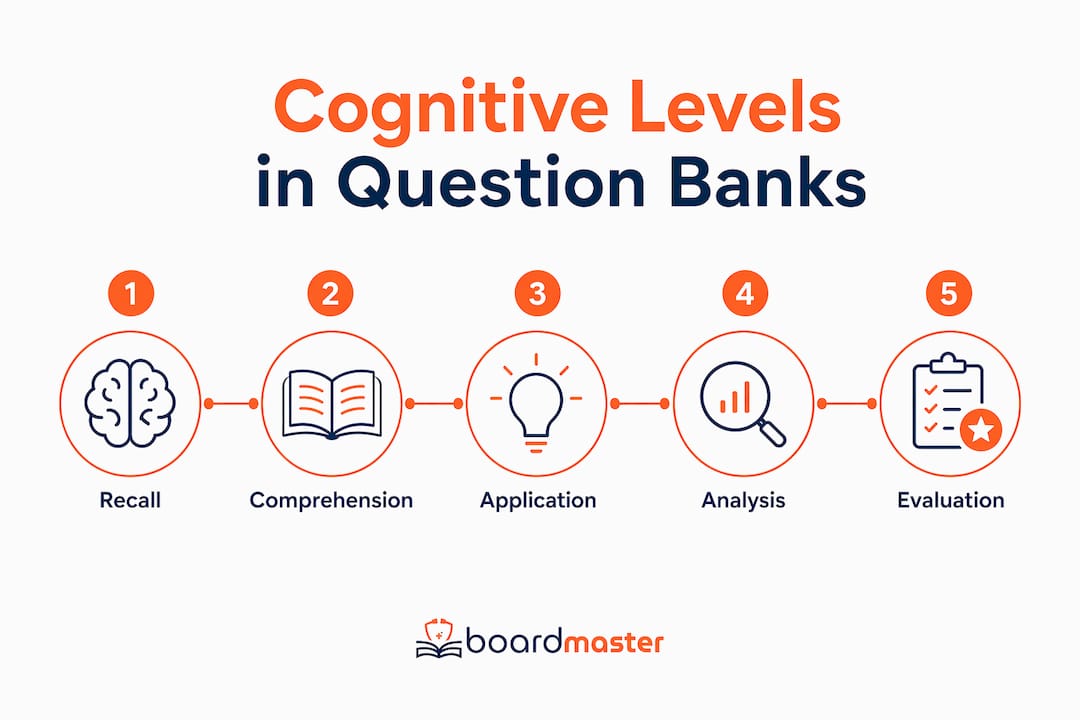
Over 70% of items in standard test banks test only recall and comprehension. That means a student can score well in practice by memorizing definitions, then walk into boards and struggle with a clinical vignette that requires applying pathophysiology to a real patient scenario. The gap between practice performance and actual exam performance is not a mystery. It is a predictable outcome of low-level question design.
The practical consequence is significant. Students who train almost exclusively on recall questions develop a false sense of readiness. They recognize terms and definitions quickly, but freeze when a question asks them to evaluate two plausible diagnoses or prioritize a management step under uncertainty.
- Recall questions (Bloom's Levels 1–2): "What is the mechanism of metformin?" These test memory, not judgment.
- Application questions (Bloom's Level 3): "A patient with Type 2 diabetes and CKD Stage 3 is started on metformin. What is the risk?" These require connecting facts to a clinical context.
- Analysis and evaluation questions (Bloom's Levels 4–5): "A 58-year-old presents with worsening fatigue and an eGFR of 42. Which medication adjustment is most appropriate and why?" These mirror actual board question structure.
Pro Tip: When evaluating any question bank, pull 10 random questions and classify each by Bloom's level. If fewer than half require you to analyze or evaluate a clinical scenario, the bank is training recall, not reasoning.
What common item-writing flaws reduce question bank effectiveness?
Item-writing quality is the second major failure point in generic question banks. A well-written multiple-choice question requires a clear stem, one defensible correct answer, and three to four plausible distractors that a student with partial knowledge might reasonably choose. Generic banks frequently miss on all three.

Weak distractors and convergence errors are common in generic and AI-generated question banks, making the correct answer identifiable without actual content knowledge. Convergence errors occur when multiple distractors share overlapping language with the correct answer, allowing test-wise students to identify the right choice through pattern recognition rather than clinical understanding. That is not assessment. That is a logic puzzle.
The consequences extend beyond wasted study time. Flawed questions create measurement errors that distort a student's understanding of their own knowledge gaps. A student who scores 80% on a set of poorly written questions may believe they have mastered a topic they have barely engaged with.
"Without expert review, generic question banks routinely produce items where the correct answer can be identified by eliminating obviously implausible options, not by applying medical knowledge. This trains test-taking strategy, not clinical mastery."
Expert review is indispensable for ensuring validity, reliability, and cognitive depth in medical question banks. The most common item-writing flaws students encounter include:
- Implausible distractors: Options so clearly wrong that any student eliminates them immediately, reducing a four-option question to a coin flip.
- Convergence errors: Two or more distractors that partially overlap with the correct answer, signaling the right choice through structure rather than content.
- Factual inaccuracies: Incorrect information embedded in stems or answer choices, which actively teaches wrong content.
- Item exposure: Static pools lose diagnostic value over time as students memorize specific questions rather than learning the underlying concepts.
Item exposure is particularly damaging in study groups. When the same 2,000-question pool circulates among hundreds of students, the questions become pattern-recognition exercises. The bank stops measuring knowledge and starts measuring familiarity with the question set itself.
Why do generic question banks lag behind current exam objectives?
Content currency is the third structural weakness in generic question banks. Medical knowledge evolves rapidly. USMLE exam blueprints update annually. Drug approvals, guideline revisions, and shifts in clinical best practice all affect what appears on boards. Generic question banks often struggle to update content rapidly, leaving students practicing on material that no longer reflects current exam priorities.
The problem compounds when students rely on practice scores as a proxy for readiness. High practice scores in generic banks do not guarantee exam success because outdated questions and flawed item structures create misleading performance signals. A student who scores in the 85th percentile on a bank built around a three-year-old blueprint may be studying the wrong content entirely.
Curriculum alignment is an equally serious gap. Generic banks are built for a broad, national audience. They do not know that your physiology professor emphasizes renal tubular physiology over cardiac electrophysiology, or that your pharmacology course tests drug interactions at a depth the average bank never reaches. The result is a one-size-fits-all approach that ignores learner variability and prevents targeted, diagnostic study improvements.
| Gap | What it means for you |
|---|---|
| Outdated content | You practice on material that no longer appears on current exam blueprints |
| No curriculum alignment | Questions ignore what your professors actually emphasize |
| Static item pools | Repeated use trains memorization, not clinical reasoning |
| Low cognitive demand | Practice scores overestimate real exam readiness |
- Check the bank's last content review date. If it is not publicly listed or exceeds 12 months, treat the content as potentially outdated.
- Cross-reference with the current USMLE content outline. The USMLE publishes its blueprint annually. Compare the bank's topic distribution against it.
- Map questions to your syllabus. If a bank cannot tell you which questions align with your current block, it is not built for your exam.
- Track your diagnostic data. A bank that does not show you which clinical domains you are weakest in cannot guide your study.
How can medical students improve exam preparedness beyond generic banks?
The solution to the drawbacks of standardized questions is not simply "study more." It is studying with materials that match the cognitive level, content currency, and curriculum specificity that your actual exams require. Several strategies make a measurable difference.
Seek physician-authored, expert-reviewed questions. Expert involvement remains critical even when AI tools assist in question generation. Physician-written questions reflect real clinical reasoning patterns and are far less likely to contain the distractor flaws that plague generic banks. BoardMaster's physician-written question bank contains 5,000+ board-style questions written and reviewed by practicing physicians, which addresses the expert oversight gap directly.
Use lecture-derived, professor-specific questions. The most efficient study approach aligns practice questions with what your professor actually teaches. BoardMaster allows students to upload lecture notes and generates USMLE-style questions from lectures that reflect the specific concepts and emphases of individual courses. This is the practical application of curriculum alignment. Sarah, a medical student using BoardMaster, moved from the 73rd to the 92nd percentile while cutting her study hours in half by focusing on professor-specific, high-yield content rather than a generic bank.
Prioritize adaptive, diagnostic feedback. Adaptive prompting refined by expert feedback is required to minimize question inaccuracies and improve distractor quality. The same principle applies to how you study. A bank that tracks your performance by clinical domain and adjusts question difficulty accordingly gives you diagnostic data. A static bank gives you a score.
| Study approach | Cognitive level targeted | Curriculum alignment |
|---|---|---|
| Generic question bank | Primarily recall (Bloom's 1–2) | None |
| Expert-reviewed question bank | Mixed, often Bloom's 3–4 | Partial |
| Professor-specific, lecture-derived questions | Bloom's 3–5 | Direct |
Pro Tip: After every practice session, categorize your wrong answers by whether you failed due to recall gaps or reasoning errors. Recall gaps need more content review. Reasoning errors need more high-level question practice. Treating both the same way wastes time.
The role of custom practice questions in exam readiness is not a minor upgrade. For students whose block exams and board exams overlap in content, curriculum-aligned questions let you prepare for both simultaneously instead of splitting your study time between two separate tracks.
Key Takeaways
Generic question banks fail medical students primarily because they test recall over reasoning, lack expert oversight, and ignore individual curriculum requirements.
| Point | Details |
|---|---|
| Low cognitive demand | Over 70% of generic bank items test only recall and comprehension, not clinical reasoning. |
| Flawed item quality | Weak distractors and convergence errors allow correct answers to be identified without content knowledge. |
| Outdated content | Generic banks struggle to update rapidly, leaving students practicing on material misaligned with current exam blueprints. |
| Item exposure risk | Static question pools lose diagnostic value as students memorize questions rather than mastering concepts. |
| Curriculum alignment gap | Professor-specific, lecture-derived questions prepare students for both block exams and boards simultaneously. |
What I've learned watching students succeed and fail with question banks
I have seen medical students spend hundreds of hours in generic question banks and walk into boards underprepared. The pattern is consistent. They score well in practice, feel confident going in, and then encounter a clinical vignette that requires them to reason through two competing diagnoses under time pressure. The generic bank never trained them for that moment.
The most common misconception I encounter is that volume equals preparation. Students believe that completing 3,000 questions from a large generic bank is inherently better than completing 800 carefully selected, curriculum-aligned questions. The research does not support that belief. Practice scores from generic banks often do not predict real exam success due to outdated content and structural disparities in question design. Volume without quality is just repetition.
What I have seen actually work is a combination of expert-validated content and tight curriculum alignment. Students who practice with questions written at the level of clinical analysis, questions that mirror what their professors emphasize, and questions that give them diagnostic feedback on specific weak areas consistently outperform students who grind through generic banks. The importance of tailored question banks is not theoretical. It shows up in percentile scores and in how confidently students reason through hard clinical scenarios on exam day.
The uncomfortable truth is that most students choose a question bank based on brand recognition or peer recommendation, not on evidence of cognitive rigor or curriculum fit. That is a decision worth reconsidering before your next block exam.
— Dr. Ahmed Abuzoor
BoardMaster addresses what generic question banks cannot
Medical students who recognize the limitations of generic question banks need a study tool built around the specific demands of their coursework and their boards.
BoardMaster combines 5,000+ physician-written board questions with an AI question generator that converts your lecture notes into USMLE-style practice questions targeting the concepts your professors actually test. Every question is built for clinical reasoning at Bloom's Levels 4 and 5, not recall. The platform tracks your performance by clinical domain and adjusts your study focus accordingly. For students preparing for USMLE Step 1 and Step 2, BoardMaster merges block exam prep and board prep into a single, efficient study track. You stop splitting your time and start building the clinical reasoning skills that boards actually measure.
FAQ
Why do generic question banks fail to predict board exam scores?
High practice scores in generic banks do not predict real exam success because outdated content and flawed item structures create misleading performance signals. Students may master a question set without mastering the underlying clinical concepts.
What is item exposure and why does it matter?
Item exposure occurs when students repeatedly encounter the same questions from a static pool, shifting study from concept mastery to question memorization. Static pools lose diagnostic value over time and stop accurately measuring what a student actually knows.
How does Bloom's Taxonomy apply to medical exam preparation?
Bloom's Taxonomy classifies questions by cognitive demand, from recall at Level 1 to evaluation at Level 5. USMLE board exams target Levels 4 and 5, while over 70% of generic bank items test only Levels 1 and 2, creating a direct mismatch between practice and exam demands.
What makes a question bank curriculum-aligned?
A curriculum-aligned question bank generates or selects questions based on the specific topics, depth, and emphasis of a student's individual coursework. BoardMaster achieves this by converting uploaded lecture notes into targeted USMLE-style questions that reflect what individual professors teach.
Is expert review necessary even when AI generates questions?
Yes. Expert review remains indispensable for ensuring validity and cognitive depth in medical question banks. AI tools without physician oversight frequently produce distractor flaws and factual inaccuracies that undermine question quality.